앞서 우리는 §인자, ⁋정의 1에서 variety \(X\)의 (Weil) divisor를 정의하였다. Zariski topology의 정의에 의하여, 이는 기본적으로 \(X\) 위에 정의된 어떤
한편, divisor는 음수 계수 또한 허용하므로 이 zero set은 zero set이 아니라, 음수 order의 zero, 즉 pole이 될 수도 있다. 이런 경우 우리는 주어진 divisor와 linearly equivalent한 effective divisor를 찾은 후, 이 성질을 탐구할 수 있다. (§인자, ⁋정의 7)
위에서 우리는 서술의 편의상 Weil divisor에 대한 논의만 하였지만, Cartier divisor에 대해서도 비슷한 논증을 할 수 있으며, 그 결과로 나오는 정의는 다음과 같다.
정의 1 Variety \(X\) 위에 정의된 Weil divisor \(D=\sum n_i D_i\)가 effective라는 것은 모든 \(i\)에 대해 \(n_i\geq 0\)인 것이다. Cartier divisor \(\{(U_i, f_i)\}\)가 effective라는 것은 모든 \(i\)에 대해 \(f_i\)가 \(U_i\) 위에서 regular인 것이다.
그렇다면 우리의 목적은 divisor \(D\)의 divisor class 안에서 어떠한 effective divisor가 존재하는지 살펴보는 것이다. 이를 위해 divisor \(D\)가 정의하는 line bundle \(\mathcal{L}=\mathcal{O}_X(D)\)를 생각하자. (§선다발과 벡터다발, ⁋정의 17) 우리는 \(\mathcal{L}\)의 각각의 nonzero global section \(s\in \Gamma(X, \mathcal{L})\)는 pole이 없으므로 effective divisor \(\divisor(s)\)를 정의하며, 이는 원래의 \(D\)와 trivialization만큼만 차이나는 것을 확인할 수 있으므로 \(D\)와 linearly equivalent하다. 즉 \(D\)와 linearly equivalent한 effective divisor를 찾기 위해선 \(\mathcal{O}_X(D)\)의 nonzero global section을 보면 된다. 다만 주의할 사항은 \(\divisor(s)\)는 \(s\) 자체가 아니라 \(s\)의 nonzero multiple에 의존한다는 것으로, 이때문에 우리가 관심을 가져야할 대상은 \(\Gamma(X, \mathcal{L})\) 자체가 아니라 그 projectivization이다.
정의 2 Variety \(X\) 위의 line bundle \(\mathcal{L}\)에 대하여, \(\mathcal{L}\)의 complete linear system은 \(\mathcal{L}\)의 global section space \(\Gamma(X, \mathcal{L})\)의 projectivization
\[\lvert \mathcal{L} \rvert = \mathbb{P}(\Gamma(X, \mathcal{L}))\]이다. \(\mathcal{L}\)에 대한 linear system은 \(\lvert \mathcal{L} \rvert\)의 nonempty projective subspace이다. 즉, 부분벡터공간 \(V \subseteq \Gamma(X, \mathcal{L})\)에 대해 \(\mathbb{P}(V) \subseteq \lvert \mathcal{L} \rvert\)의 꼴이다.
Projective space의 linear system
앞서 §선다발과 벡터다발, ⁋예시 12 이후의 계산에 의해 \(\Gamma(\mathbb{P}^n, \mathcal{O}_{\mathbb{P}^n}(d))\)가 차수 \(d\)의 동차다항식들의 공간 \(\mathbb{K}[\x_0, \ldots, \x_n]_d\)와 동형임을 보았다. 이 공간의 각 원소들은 \(\mathbb{P}^n\)의 degree \(d\) hypersurface를 정의하므로, 우리는 \(\mathcal{O}_{\mathbb{P}^n}(d)\)의 complete linear system
\[\lvert \mathcal{O}_{\mathbb{P}^n}(d)\rvert=\mathbb{P}(\Gamma(\mathbb{P}^n, \mathcal{O}_{\mathbb{P}^n}(d)))\cong \mathbb{P}(\mathbb{K}[\x_0,\ldots, \x_n]_d)\cong \mathbb{P}^{\binom{n+d}{d} - 1}\]을 기하적으로 degree \(d\) hypersurface in \(\mathbb{P}^n\)들의 family로 이해할 수 있다.
예시 3 편의상 \(n=2\)로 고정하자. 그럼 degree \(1\) hypersurface들, 즉 \(\mathbb{P}^2\)의 직선들의 family는 \(\mathbb{P}^2\) 자기자신과 isomorphic하다. 더 자세히 살펴보면,
\[\lvert \mathcal{O}_{\mathbb{P}^2}(1)\rvert\cong \mathbb{P}(\mathbb{K}[\x_0,\x_1,\x_2]_1)\cong \mathbb{P}^{\binom{3}{1}-1}=\mathbb{P}^2\]에서 우변 \(\mathbb{P}^2\)의 한 점 \([a_0:a_1:a_2]\)는 \(\mathbb{P}^2\)의 한 직선 \(Z(a_0\x_0+a_1\x_1+a_2\x_2)\)을 정의한다.
조금 더 복잡하고 기하적인 예시를 위해, 우리는 \(\mathbb{P}^2\) 위의 line bundle \(\mathcal{O}_{\mathbb{P}^2}(2)\)가 정의하는 complete linear system
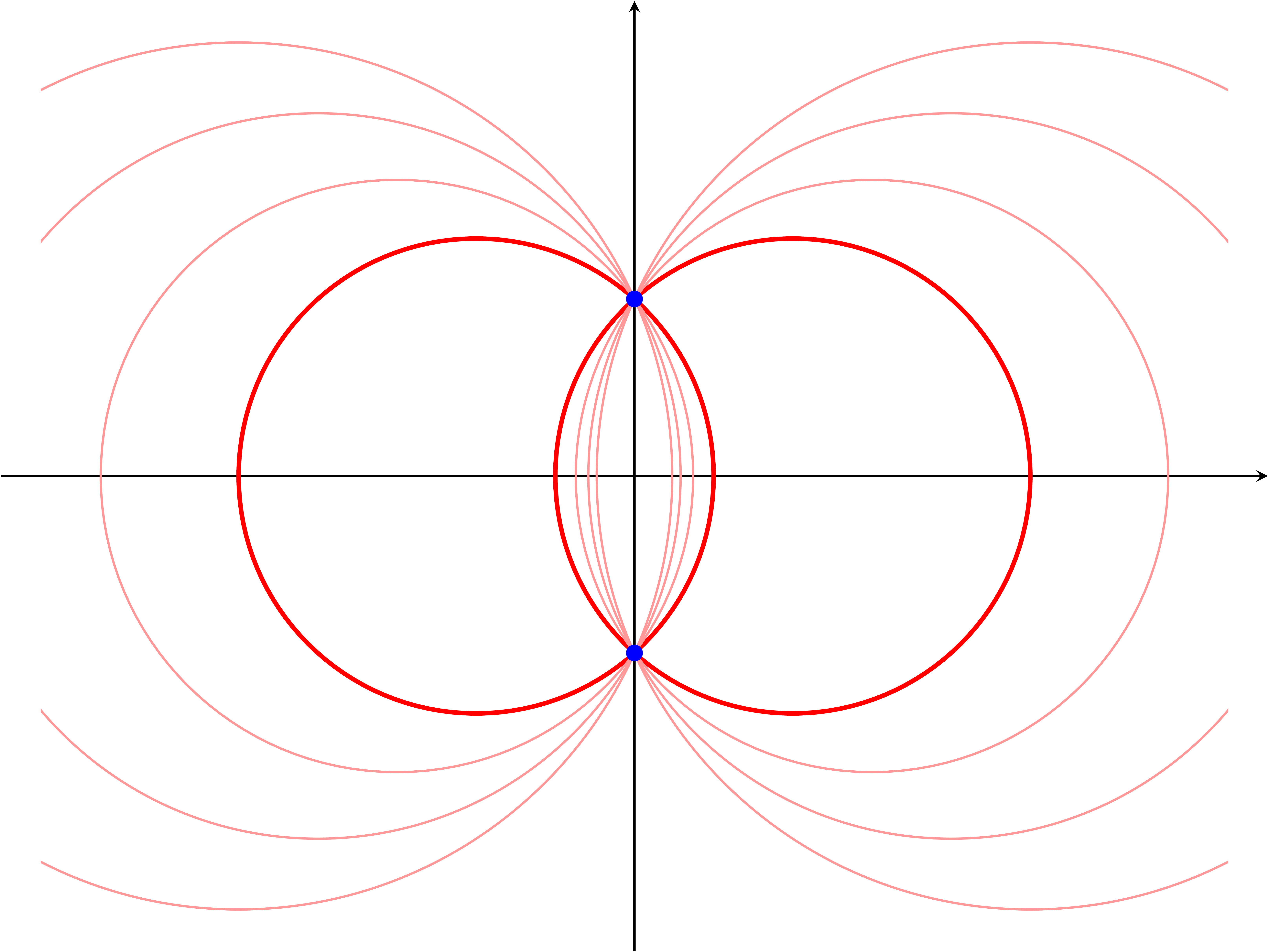
\[\lvert \mathcal{O}_{\mathbb{P}^2}(2)\rvert\cong \mathbb{P}(\mathbb{K}[\x_0,\x_1,\x_2]_2)\cong \mathbb{P}^{\binom{3}{2}-1}=\mathbb{P}^5\]의 1차원 부분공간 (즉 \(1\)차원 linear system)을 생각하자. 대표적인 예시는 두 conic의 pencil이다. \(\mathbb{P}^2\)에서 정의된 두 conic \(C_1=Z(F_1)\), \(C_2=Z(F_2)\)을 생각하자. 그럼 \(C_1\)과 \(C_2\)가 동일한 conic이 아닌 한, 이들의 linear combination
\[Z(\lambda F_1+\mu F_2)\]은 \(\mathbb{P}^2\)의 또 다른 degree \(2\) curve이며, 정의에 의해 이들 conic은 모두 \(C_1\cap C_2\)를 지나게 된다. 이 때, 점 \([\lambda:\mu]\in \mathbb{P}^1\)이 이들 conic을 parametrize한다.
더 구체적인 예시를 위해, \(\mathbb{P}^2\)에서의 두 conic
\[C_1: Z((\x_0-2\x_2)^2+\x_1^2-9\x_2^2),\qquad C_2: Z((\x_0+2\x_2)^2+\x_1^2-9\x_2^2)\]을 생각하자. 이 식은 그 자체로는 복잡해보이지만 \(U_2\)로 제한하면 두 원
\[(\x-2)^2+\y^2=9,\qquad (\x+2)^2+\y^2=9\]의 방정식이다. 이들은 \(U_2\) 위에서는 위의 두 식으로부터 계산되는 \((x,y)=(0,\pm\sqrt{5})\)에서 만나며, \(U_2\) 바깥 — 즉 \(U_2\)의
한편 일반적인 degree 2 homogeneous polynomial은
\[F(\x_0,\x_1,\x_2) = a_{00}\x_0^2 + a_{11}\x_1^2 + a_{22}\x_2^2 + a_{01}\x_0\x_1 + a_{02}\x_0\x_2 + a_{12}\x_1\x_2\]의 꼴이며, 이것이 정확히 \(\Gamma(X, \mathcal{O}(2))\)가 \(6\)차원 공간인 이유이다. 한편, 위에서 계산한 네 점짜리 집합 \(C_1\cap C_2\)를 지나야 한다는 조건을 추가한다면, 이들 네 점이 각각 하나씩의 제약조건을 걸이 필요한 parameter를 하나씩 지워주므로 이를 나타내기 위한 parameter는 2개임을 안다. 더 구체적으로, 다음 네 개의 조건
\[0=F(0,\sqrt{5},1)=5a_{11}+a_{22}+\sqrt{5}a_{12}\] \[0=F(0,-\sqrt{5},1)=5a_{11}+a_{22}-\sqrt{5}a_{12}\] \[0=F(1,i,0)=a_{00}-a_{11}+ia_{01}\] \[0=F(1,-i,0)=a_{00}-a_{11}-ia_{01}\]이 \(a_{12}=0\), \(a_{01}=0\), \(5a_{11}=-a_{22}\), \(a_{00}=a_{11}\)을 강제하므로 실질적인 변수는 \(a_{00}\), \(a_{02}\)의 두 개이다. 즉, 이들 conic의 모임은 \(\Gamma(X,\mathcal{O}(2))\)의 2차원 부분공간 \(V\)를 이룰 것이며, 이를 projectivize한 것이 \([\lambda:\mu]\)로 나타나는 \(\mathbb{P}^1\)이 된다.
물론 정의 2는 \(X\)가 projective space이든 quasi-projective variety이든 임의의 variety에 동일하게 적용된다. 그러나 우리가 위의 예시 3을 이렇게 공들여 계산한 이유는, 임의의 quasi-projective variety \(X\subseteq \mathbb{P}^n\)에 대해서도 \(D\)가 어떠한 \(\mathcal{O}_{\mathbb{P}^n}(d)\)에서 온다면 homogeneous polynomial의 언어를 그대로 사용할 수 있기 때문이다. 즉 이 경우 restriction map
\[\Gamma(\mathbb{P}^n, \mathcal{O}_{\mathbb{P}^n}(d)) \to \Gamma(X, \mathcal{O}_{\mathbb{P}^n}(d)\vert_X)\]은 homogeneous polynomial \(F \in \mathbb{K}[\x_0, \ldots, \x_n]_d\)를 \(X\) 위의 section으로 보내며, 그 kernel은 \(I(X)\)의 차수 \(d\)인 homogeneous part \(I(X)_d\)이다. 따라서
\[\Gamma(X, \mathcal{O}_{\mathbb{P}^n}(d)\vert_X) \cong \mathbb{K}[\x_0, \ldots, \x_n]_d / I(X)_d\]로서 \(\mathbb{P}^n\)에서와 본질적으로 동일한 계산이 가능하다. 특히 \(F - G \in I(X)\)일 때 같은 교차를 정의하므로, parameter space는 \(\mathbb{P}(V/(V \cap I(X)))\)가 된다.
Base Locus
우리는 남은 글에서 \(X\)의 linear system \(L=\mathbb{P}(V)\)와 \(V\)의 basis \(F_0,\ldots, F_r\)이 주어졌을 때, 이를 사용하여 embedding
\[\varphi_L:X\rightarrow \mathbb{P}^r;\qquad x\mapsto [F_0(x):\cdots:F_r(x)]\]을 정의한다.
물론 이것이 항상 가능한 것은 아니다. 가령 예시 3에서, \((a_{00},a_{02})=(1,0), (0,1)\)에 해당하는 다음의 두 basis
\[F_1(\x_0,\x_1,\x_2)=\x_0^2+\x_1^2-5\x_2^2, \qquad F_2(\x_0,\x_1,\x_2)=\x_0\x_2\]를 택하면 이 “embedding”은
\[\mathbb{P}^2\rightarrow \mathbb{P}^1;\qquad [\x_0,\x_1,\x_2]\mapsto [\x_0^2+\x_1^2-5\x_2^2:\x_0\x_2]\]이 된다. 이는 우선 \(\mathbb{P}^2\)에서 더 작은 공간 \(\mathbb{P}^1\)로 가는 함수이므로 어딘가 잘못되었다는 것을 알고 있고, 이는 두 함수 \(F_1,F_2\)가 동시에 \(0\)이 되는 부분이 존재하기 때문이다.
위에서의 embedding \(\varphi_L\)은 실은 \(V\)의 basis의 선택에 의존하지만, \(\varphi_L\)이 갖는 여러 성질들은 그렇지 않다. 가령, 방금 전과 같이 basis들 모두가 vanish하는 \(X\)의 점들은 basis의 선택에 의존하지 않는다.
이를 엄밀하게 기술하기 위해, Weil divisor \(D = \sum n_i D_i\)의 support를 \(\operatorname{Supp}(D) = \bigcup_{n_i \neq 0} D_i\)로 정의한다. 즉, support는 divisor에서 계수가 \(0\)이 아닌 prime divisor들의 합집합이다. 이를 이용하면 다음이 잘 정의된다.
정의 4 Linear system \(L \subseteq \lvert \mathcal{L} \rvert\)의 base locus \(\operatorname{Bs}(L)\)는 \(L\)의 모든 원소가 공유하는 closed subset이다. 구체적으로, \(L = \mathbb{P}(V)\)에서 \(V \subseteq \Gamma(X, \mathcal{L})\)일 때,
\[\operatorname{Bs}(L) = \bigcap_{s \in V \setminus \{0\}} \operatorname{Supp}(\operatorname{div}(s))\]여기서 \(\operatorname{div}(s)\)는 section \(s\)의 zero divisor이다.
특히 \(\mathbb{P}^n\)의 hypersurface 계산에서는 \(V \subseteq \mathbb{K}[\x_0, \ldots, \x_n]_d\)에 대해 \(\operatorname{Bs}(L) = \bigcap_{[F] \in L} Z(F)\)와 동일하다. 그럼 우리가 하고 싶었던 정의는 다음의 정의이다.
정의 5 \(L\)이 basepoint-free라는 것은 \(\operatorname{Bs}(L) = \emptyset\)인 것이다. 즉, 임의의 점 \(p \in X\)에서 \(p\)를 지나지 않는 \(L\)의 원소가 항상 존재한다.
예시 6 예시 3에서 살펴본 \(\mathbb{P}^n\)의 두 예시를 살펴보자. 우선 처음의 complete linear system
\[\lvert \mathcal{O}_{\mathbb{P}^2}(1)\rvert=\mathbb{P}(\mathbb{K}[\x_0,\x_1,\x_2]_1)\]을 생각하자. 벡터공간 \(\mathbb{K}[\x_0,\x_1,\x_2]_1\)의 basis를 \(\x_0,\x_1,\x_2\)로 택하면, \(\x_0,\x_1,\x_2\)가 동시에 \(0\)이 되는 \(\mathbb{P}^2\)의 점은 없으므로 이는 basepoint-free이다. 이 basis의 선택이 정의하는 \(\varphi_L\)은 그냥 identity이다.
두 conic의 base locus의 경우, 위에서 살펴보았듯 base locus가 공집합이 아니다. 실제로, base locus는 예시 3에서 이미 살펴본 \(C_1\cap C_2\)의 네 개의 교점이며, 기하적으로 pencil의 각 원소들은 정확히 \(C_1\cap C_2\)의 네 교점을 공유하므로 이것이 base locus의 정의와 맞아떨어지는 것을 안다.
위에서 살펴봤듯, basepoint-free linear system의 핵심 성질은 \(\varphi_L\)이 잘 정의된다는 것이다. 즉 다음이 성립한다.
명제 7 Quasiprojective variety \(X \subseteq \mathbb{P}^n\) 위의 basepoint-free linear system \(L = \mathbb{P}(V)\)에서, \(V\)의 기저 \(F_0, \ldots, F_r \in \mathbb{K}[\x_0, \ldots, \x_n]_d\)가 다음 조건을 만족한다고 하자.
\[\bigcap_{i=0}^r Z(F_i) \cap X = \emptyset\]그러면 \(V\)는 \(X\)에서 projective space로의 regular map
\[\varphi_L: X \to \mathbb{P}^r, \quad p \mapsto [F_0(p) : \cdots : F_r(p)]\]을 정의한다. 여기서 \(F_i(p)\)는 \(F_i\)의 \(p\)에서의 값을 나타낸다.
위에서와 다른 예시를 하나만 더 살펴보자.
예시 8 \(\mathbb{P}^1\)에서 \(d \ge 1\)일 때, \(\lvert \mathcal{O}_{\mathbb{P}^1}(d) \rvert\)의 complete linear system이 정의하는 map은
\[\nu_d: \mathbb{P}^1 \to \mathbb{P}^d, \quad [s : t] \mapsto [s^d : s^{d-1}t : \cdots : t^d]\]이다. 이는 §사영다양체, ⁋예시 16에서 살펴본 Veronese embedding을 complete linear system의 언어로 복원할 수 있다는 것을 보여준다.
Ample line bundle
비록 우리는 모든 variety가 quasi-projective임을 가정하고 있지만, 일반적으로 variety는 더 추상적으로 정의할 수 있다. 이러한 접근에는 장단점이 있는데, 좋은 점은 우리의 논의가 더 유연해진다는 것이고, 그로 인해 포기하게 되는 것은 variety를 embed하는 것이 더 이상 자명하지 않다는 것이다.
가령 우리의 언어에서 \(\mathbb{P}^1\times \mathbb{P}^1\)이 (quasi-projective) variety라고 하려면 반드시 이를 어떤 projective space로 넣어주어야 한다. (§사영다양체, ⁋예시 16) 대신, variety의 정의에서 ambient projective space의 존재를 가정하지 않는다면 이를 굳이 보이지 않아도 \(\mathbb{P}^1\times \mathbb{P}^1\)은 자동으로 variety이지만, 일반적인 variety가 projective space로 embed되는지는 불분명하다는 것이다.
그러나 추상적인 variety에서도 line bundle과 linear system 등등을 모두 정의할 수 있다. 그럼 특히 명제 7을 사용하면 projective space로의 적절한 함수를 정의할 수 있게 된다. 다음 정의의 중요성은 이러한 맥락에서 이해해야 한다.
정의 9 Line bundle \(\mathcal{L}\) (또는 대응하는 linear system \(\lvert \mathcal{L} \rvert\))이 very ample이라는 것은, complete linear system \(\lvert \mathcal{L} \rvert = \mathbb{P}(\Gamma(X, \mathcal{L}))\)이 정의하는 regular map \(\varphi_{\mathcal{L}}: X \to \mathbb{P}(\Gamma(X, \mathcal{L}))\)이 closed embedding인 것이다.
이것이 잘 정의되려면 \(\varphi_L\)이 basis의 선택에 의존하지 않아야 하며, 실제로 그러하다는 것을 쉽게 확인할 수 있다.
Very ample의 정의에서 핵심은 사상이 단순한 morphism이 아니라 closed embedding이라는 점이다. 즉, 위에서 설명한 것과 같이 추상적인 variety의 세계에서도 이를 사용하여 projective variety를 정의하고, 심지어 very ample line bundle \(\mathcal{L}\)을 사용하면 \(X\)를 이 ambient projective space에서 명시적인 좌표로 표현할 수도 있게 된다.
우리는 \(\mathcal{O}_{\mathbb{P}^n}(1)\)은 very ample이지만, \(\mathcal{O}_{\mathbb{P}^n}(-1)\)은 그렇지 않다는 것을 안다. §선다발과 벡터다발, ⁋예시 12에서 살펴보았듯, 이는 \(\mathcal{O}_{\mathbb{P}^n}(-1)\)은 fiber가 base를 따라 이동할 때 꼬이는 방향이 section들이 zero section을 넘어가는 것을 허용하지 않아 global section이 존재하지 않기 때문이다. 반면 \(\mathcal{O}_{\mathbb{P}^n}(1)\)이 가지고 있는 꼬임은 이를 허용해주어 global section을 존재하게 해 준다.
이 예시는 너무 간단한 예시이기는 하지만, 만일 \(\mathbb{P}^n\)보다 복잡한 어떤 공간이 있고, 이 공간의 복잡성이 특정한 line bundle의 꼬임만으로는 (올바른 방향임에도) 해소가 안 된다면, 우리는 이것이 해소될 때까지 더욱 더 꼬임을 추가해줄 수 있을 것이다. 이러한 상상으로부터 다음을 정의한다.
정의 10 \(\mathcal{L}\)이 ample이라는 것은 어떤 \(m > 0\)에 대해 \(\mathcal{L}^{\otimes m}\)이 very ample인 것이다.
이 정의의 유용성을 보려면 ample이지만 very ample은 아닌 line bundle을 갖는 공간을 생각해야겠지만, 아직은 그러한 공간을 소개하기에는 다소 이르다. 하지만 머지 않아 그러한 공간을 다루게 되면 ampleness가 본격적으로 그 쓸모를 증명하게 된다.
참고문헌
[Har] R. Hartshorne, Algebraic Geometry, Graduate Texts in Mathematics, Springer, 1977.
[Sha] I. R. Shafarevich, Basic Algebraic Geometry I: Varieties in Projective Space, Springer, 2013.
-
\(\mathbb{P}^2\)의
무한대 직선 과 그 기하적인 직관에 대해서는 §사영다양체, ⁋예시 11에서 이미 분석하였다. ↩
댓글남기기