
This post was translated from Korean by LLM (Kimi). The translation may contain errors or awkward sentences. The Korean original is the source of truth.
Covering
Definition 1 A family \((A_i)_{i\in I}\) is a covering of a set \(A\) if \(A=\bigcup_{i\in I} A_i\). Given two coverings \((A_i)_{i\in I}\) and \((A'_j)_{j\in J}\) of \(A\), the covering \((A'_j)_{j\in J}\) is finer than \((A_i)_{i\in I}\) if for every \(j\in J\), there exists \(i\in I\) such that \(A'_j\subseteq A_i\).
Let \((A_i)_{i\in I}\) be a covering of a set \(A\). For any function \(f:B \rightarrow A\), the family \((f^{-1}(A_i))_{i\in I}\) of subsets of \(B\) is a covering of \(B\). This is called the preimage of \((A_i)\) under \(f\). For any function \(g:A\rightarrow C\), the family \((g(A_i))_{i\in I}\) of subsets of \(C\) need not be a covering of \(C\), but if \(g\) is surjective, then these sets cover \(C\). This is called the image of \((A_i)\) under the surjection \(g\).
Proposition 2 Let \(A\) be a set with covering \((A_i)_{i\in I}\), and let \(B\) be any set.
- Suppose functions \(f,g:A\rightarrow B\) satisfy \(f\vert_{A_i}=g\vert_{A_i}\) for every \(i\in I\). Then \(f=g\).
-
Let \((f_i:A_i\rightarrow B)_{i\in I}\) be a family of functions satisfying the condition
\[f_i|_{A_i\cap A_j}=f_j|_{A_i\cap A_j}\]Then there exists a function \(f:A\rightarrow B\) extending all \(f_i\).
Proof
For the first claim, let \(x\in A\) be given. Since \((A_i)_{i\in I}\) covers \(A\), there exists \(i\in I\) with \(x\in A_i\). Then
\[f(x)=(f|_{A_i})(x)=(g|_{A_i})(x)=g(x)\]which establishes the first claim.
For the second claim, using the given functions \(f_i=(F_i,A_i,B)\), form \(F=\bigcup F_i\) and consider the triple \(f=(F,A,B)\). Clearly \(\pr_1F=A\), so to show that \(f\) is a function, it suffices to prove that for any \(x\in A\), there is a unique \(y\) such that \((x,y)\in F\).
Let \(y,y'\in B\) satisfy \((x,y)\in F\) and \((x,y')\in F\). Then there exist \(i\) and \(j\) such that \((x,y)\in F_i\) and \((x,y')\in F_j\). Now
\[y=(f_i)(x)=(f_i|_{A_i\cap A_j})(x)=(f_j|_{A_i\cap A_j})(x)=(f_j)(x)=y'\]so the second claim is also established.
By the first claim, the function \(f\) satisfying the condition in part 2 is necessarily unique. Moreover, if \(A_i\cap A_j=\emptyset\) for all \(i,j\), then the hypothesis of part 2 is automatically satisfied. We make the following definition.
Definition 3 Sets \(A\) and \(B\) are disjoint if \(A\cap B=\emptyset\). More generally, a family \((A_i)_{i\in I}\) is pairwise disjoint if for any \(i, j\in I\) with \(i\neq j\), we have \(A_i\cap A_j=\emptyset\).
Definition 4 A partition of a set \(A\) is a pairwise disjoint covering of \(A\).
In general, the empty set plays no role among the members of such a family, so when we speak of a partition, we assume that no member is empty.
Sum of Sets
Proposition 5 Let \((A_i)_{i\in I}\) be a family of sets. Then there exists a set \(S\) such that:
- \(S\) is the union of a pairwise disjoint family \((S_i)_{i\in I}\), and
- for every \(i\in I\), there exists a bijection from \(A_i\) to \(S_i\).
Proof
Let \(S_i\) be
Definition 6 A set \(S\) satisfying the conditions above is called the sum of the family \((A_i)_{i\in I}\) and is denoted by \(\sum_{i\in I} A_i\).
This set is often called the disjoint union and denoted by \(\bigsqcup_{i\in I} A_i\). The following proposition shows that this terminology is apt.
Proposition 7 Let \((A_i)_{i\in I}\) be a pairwise disjoint family. If \(A\) denotes their union and \(S\) their sum, then there exists a bijection between \(A\) and \(S\).
Proof
If \(f_i:A_i\rightarrow S_i\) are the bijections satisfying the condition of Proposition 5, then by Proposition 2, the family \((f_i)_{i\in I}\) extends to a bijection from \(\bigcup_{i\in I} A_i=A\).
The intuition for calling this the sum of sets will emerge later. (§Operations of Cardinals, ⁋Definition 1)
Universal Property
There is a point we have not yet mentioned regarding Definition 6. The sum \(X\) of a family of sets \((A_i)\) is not unique: infinitely many sets satisfy the conditions of Proposition 5. For instance, in the proof of that proposition, we took \(S\) to be the set of pairs \((x,i)\), but we could equally well have taken the set of pairs \((i,x)\). Strictly speaking, then, the notation \(\sum A_i\) for the sum of the \(A_i\) is not well-defined.
Let us first examine the universal property of the sum.
Theorem 8 (Universal property of sum) Let \((A_i)\) be a family of sets, let \(S\) be the set defined in Proposition 5, and let \(\iota_i:A_i\rightarrow S\) be the injections. Given another set \(B\) and functions \(f_i:A_i\rightarrow B\), there exists a unique function \(f:S\rightarrow B\) such that \(f_i=f\circ\iota_i\).
Proof
We first show that such a function \(f\), if it exists, is unique. It suffices to show that for any \(x\in S\), the value \(f(x)\) is uniquely determined. Since \(S\) is the union of a pairwise disjoint family \((S_i)\), there exists a unique \(i\in I\) with \(x\in S_i\). As \(\iota_i:A_i\rightarrow S_i\) is a bijection, there exists a unique \(x_i\in A_i\) with \(\iota_i(x_i)=x\). Now
\[f(x)=f(\iota_i(x_i))=(f\circ\iota_i)(x_i)=f_i(x_i)\]so the value \(f(x)\) at \(x\) must equal \(f_i(x_i)\), and hence \(f\) is uniquely determined.
For existence, taking a cue from the uniqueness proof, we define \(f(x)\) to be \(f_i(x_i)\) as above, and verify that \(f\) is indeed a function. With this definition, \(f\) is defined on all elements of \(S\), and each \(x\) is assigned exactly one value, as argued above.
In many contexts, the set \(S\) from the proof of Proposition 5 is taken as the definition of the sum of the \(A_i\), but this is actually putting the cart before the horse. The reason we regard \(S\) as the sum of the \(A_i\) in many fields is notational convenience, not because the set \(S\) itself has special significance. The properties of the sum do not derive from the set \(S\), but from the universal property above.
Thus we might instead adopt the following definition from the start.
Definition 6\('\) The sum of a given family of sets \((A_i)\) is a set \(\sum A_i\) together with injections \(\iota_i:A_i\rightarrow \sum A_i\) satisfying the following condition:
For any set \(B\) and functions \(f_i:A_i\rightarrow B\), there exists a unique function \(f:\sum A_i\rightarrow B\) such that \(f_i=f\circ\iota_i\).
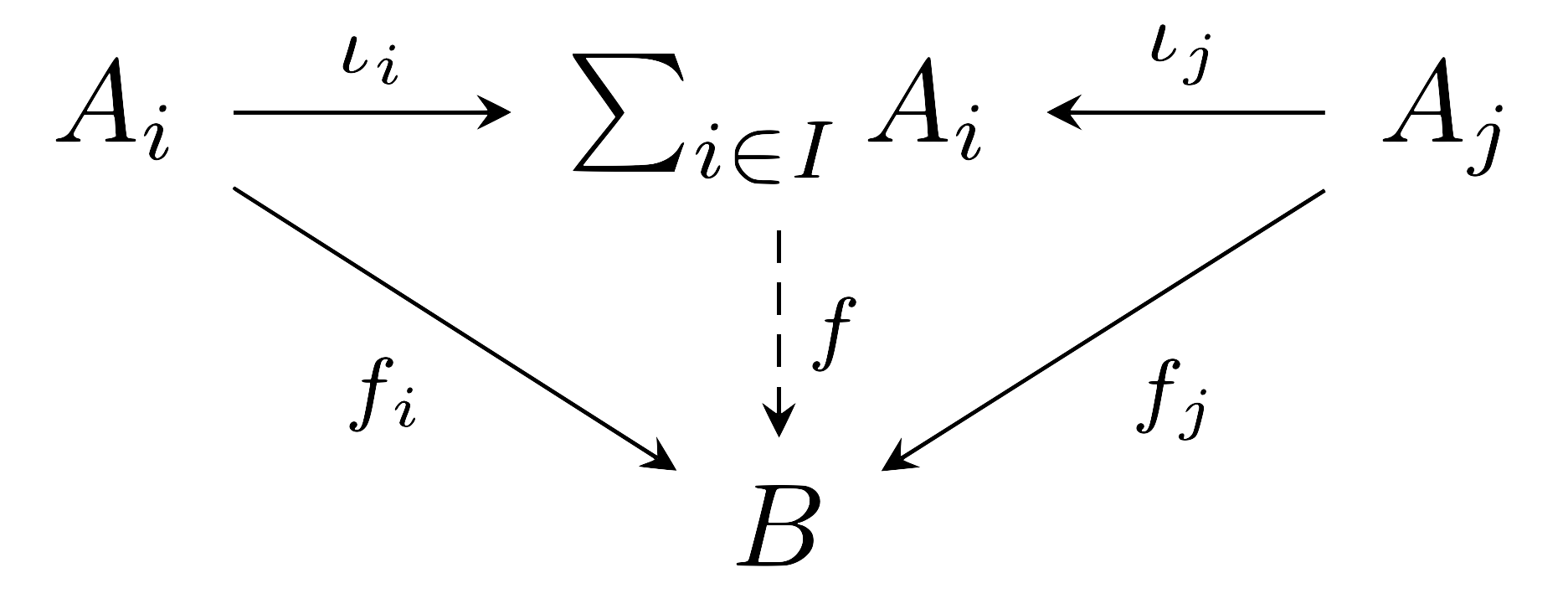
To use this as a definition, we must of course show that at least one object satisfying the universal property exists. Theorem 8 provides precisely this.
We mentioned earlier that the set \(\sum A_i\) is not strictly well-defined. However, even though such a set is not uniquely defined, any two such sets are in bijection. We say that such an object is unique up to bijection. From Definition 6\('\), we can show that the sum of sets is unique up to bijection.
Corollary 9 For a family of sets \((A_i)\), the sum \(\sum A_i\) is unique up to bijection.
Proof
Suppose two sums \(S\) and \(S'\) are given, with injections \(\iota_i\) and \(\iota_i'\) from \(A_i\) to \(S\) and \(S'\) respectively. Applying the universal property of \(S\) to the functions \(\iota_i':A_i\rightarrow Y\), we obtain a unique \(\phi':S\rightarrow S'\) such that \(\iota_i'=\phi'\circ\iota_i\). Similarly, applying the universal property of \(S'\) to the functions \(\iota_i\), we obtain a unique \(\phi:S'\rightarrow S\) such that \(\iota_i=\phi\circ\iota_i'\). Then
\[\iota_i'=\phi'\circ\iota_i=\phi'\circ(\phi\circ\iota_i')=(\phi'\circ\phi)\circ\iota_i'\]Now apply the universal property of \(S'\) to the functions \(\iota_i':A_i\rightarrow S'\). There exists a unique function \(\psi:S'\rightarrow S'\) such that \(\iota_i'=\psi\circ\iota_i'\). This is of course satisfied by \(\psi=\id_{S'}\), so by uniqueness, any such \(\psi\) equals \(\id_{S'}\). Hence \(\phi'\circ\phi=\id_{S'}\), and since \(\id_{S'}\) is a bijection, \(\phi'\) is surjective and \(\phi\) is injective. (§Retraction and Section, ⁋Proposition 3)
Similarly, we can show that \(\phi\circ\phi'=\id_S\), from which it follows that \(\phi\) is surjective and \(\phi'\) is injective. Thus each is a bijection, and there exists a bijection between \(S\) and \(S'\).
References
[Bou] N. Bourbaki, Theory of Sets. Elements of mathematics. Springer Berlin-Heidelberg, 2013.
댓글남기기