
This post was translated from Korean by LLM (Kimi). The translation may contain errors or awkward sentences. The Korean original is the source of truth.
The end of the previous post enables us to give new characterizations of injective and surjective functions. (§Operations on Functions, ⁋Remark)
Proposition 1 Consider a function \(f:A\rightarrow B\). If there exists \(r:B\rightarrow A\) such that \(r\circ f=\id_A\), then \(f\) is injective. If there exists \(s:B\rightarrow A\) such that \(f\circ s=\id_B\), then \(f\) is surjective.
Conversely, if \(f\) is surjective, then there exists \(s:B\rightarrow A\) such that \(f\circ s=\id_B\), and if \(f\) is injective, then there exists \(r:B\rightarrow A\) such that \(r\circ f=\id_A\).
Proof
The second part was already proved in the previous post, so we need only establish the first part. Suppose \(r\circ f=\id_A\). If \(f(x)=f(y)\), then
\[x=\id_{A}(x)=(r\circ f)(x)=r\circ(f(x))=r\circ(f(y))=(r\circ f)(y)=\id_{A}(y)=y\]so \(f\) is injective. Similarly, if \(f\circ s=\id_{B}\), then for any \(y\in B\),
\[y=\id_{B}(y)=(f\circ s)(y)=f(s(y))\]so \(y\in f(A)\), and hence \(f\) is surjective.
Thus a function \(f:A\rightarrow B\) is injective if and only if there exists \(r:B\rightarrow A\) making the diagram
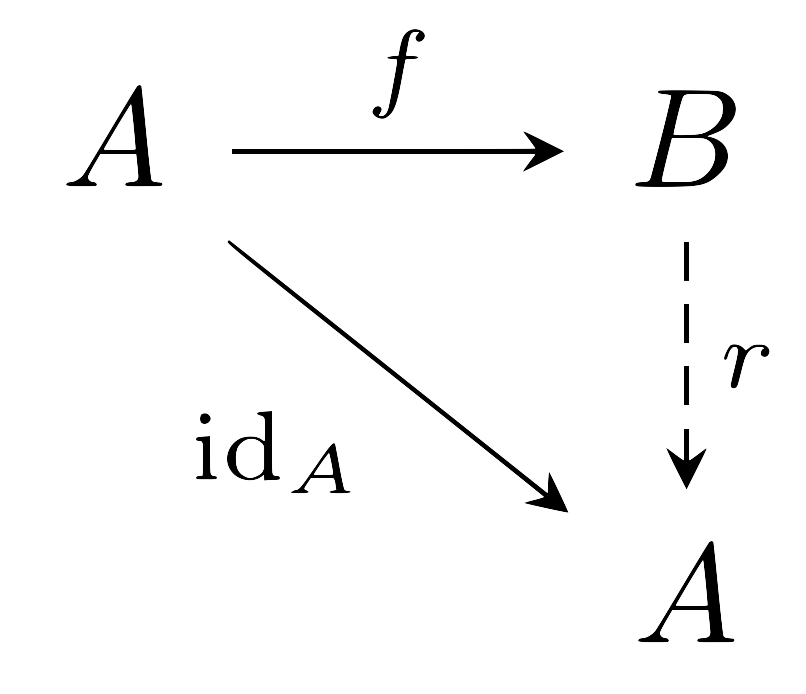
commute. A function \(f:A\rightarrow B\) is surjective if and only if there exists \(s:B\rightarrow A\) making the diagram
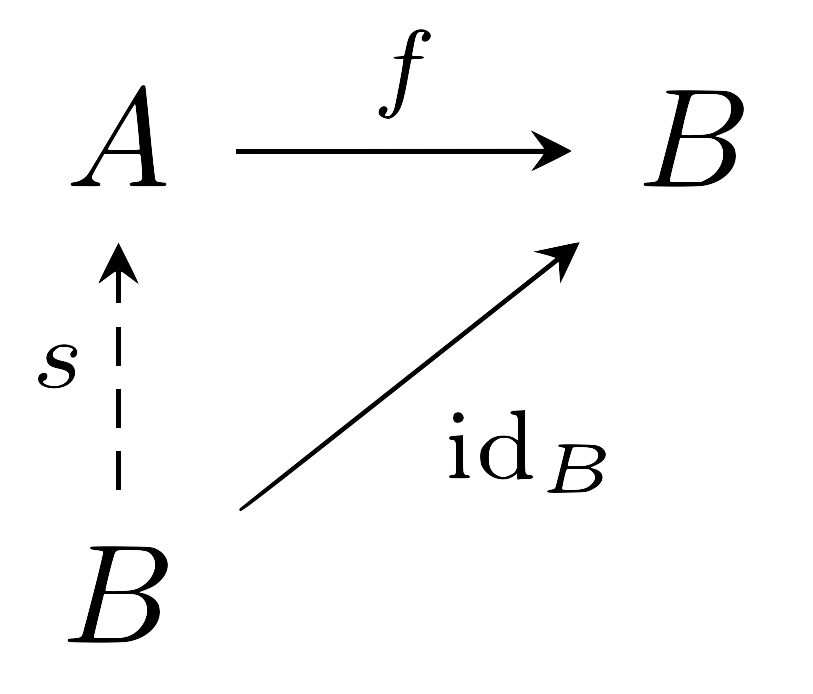
commute. Such \(r\) and \(s\) have names.
Definition 2 Let \(f\) be an injective function from \(A\) to \(B\). A function \(r:B\rightarrow A\) satisfying \(r\circ f=\id_A\) is called a retraction of \(f\).
If \(f\) is a surjective function from \(A\) to \(B\), a function \(s:B\rightarrow A\) satisfying \(f\circ s=\id_B\) is called a section of \(f\).
If \(f\) is injective with retraction \(r\), then \(f\) may be viewed as a section of \(r\); conversely, if \(f\) is surjective with section \(s\), then \(f\) may be viewed as a retraction of \(s\). Hence a retraction is surjective and a section is injective.
For a function \(f:A \rightarrow B\) and subsets \(X\subseteq A\), \(Y\subseteq B\), the two inclusions
\[X\subseteq f^{-1}(f(X)),\qquad f(f^{-1}(Y))\subseteq Y\]always hold, and the proofs are immediate. If \(f\) is injective, then for \(r\) defined as in §Operations on Functions, ⁋Remark,
\[f^{-1}(f(X))=r(f(X))=\id_A(X)=X\]If \(f\) is surjective, then for \(s\) defined as in §Operations on Functions, ⁋Remark,
\[Y=\id_B(Y)=f(s(Y))\subseteq f(f^{-1}(Y))\]so the above inclusions become equalities. The following proposition is straightforward to prove, but the results are worth remembering.
Proposition 3 Let \(f:A\rightarrow B\) and \(f':B\rightarrow C\) be functions, and set \(f''=f'\circ f\).
- If \(f\) and \(f'\) are both injective, then so is \(f''\). Moreover, if \(r\) and \(r'\) are retractions of \(f\) and \(f'\) respectively, then \(r\circ r'\) is a retraction of \(f''\).
- If \(f\) and \(f'\) are both surjective, then so is \(f''\). Moreover, if \(s\) and \(s'\) are sections of \(f\) and \(f'\) respectively, then \(s\circ s'\) is a section of \(f''\).
- If \(f''\) is injective, then \(f\) is also injective. In particular, if \(r''\) is a retraction of \(f''\), then \(r''\circ f'\) is a retraction of \(f\).
- If \(f''\) is surjective, then \(f'\) is also surjective. In particular, if \(s''\) is a section of \(f''\), then \(f\circ s''\) is a section of \(f'\).
Proof
-
Suppose \(f''(a_1)=f''(a_2)\). Then \(f'(f(a_1))=f'(f(a_2))\), and since \(f'\) and \(f\) are injective in succession, we obtain \(a_1=a_2\). Hence \(f''\) is injective. Now let \(r\) and \(r'\) be retractions of \(f\) and \(f'\) respectively, i.e., \(r\circ f=\id_A\) and \(r'\circ f'=\id_B\). Then for any \(a\in A\),
\[((r\circ r')\circ(f'\circ f))(a)=(r\circ\id_{B}\circ f)(a)=(r\circ f)(a)=\id_{A}(a)=a\]so \(r\circ r'\) is a retraction of \(f''\).
-
Let \(c\in C\). Since \(f'\) is surjective, there exists \(b\in B\) with \(f'(b)=c\). Since \(f\) is surjective, there exists \(a\in A\) with \(f(a)=b\). Thus \(f''(a)=c\), and \(f''\) is surjective. Now let \(s\) and \(s'\) be sections of \(f\) and \(f'\) respectively. For any \(c\in C\),
\[((f'\circ f)\circ(s\circ s'))(c)=(f'\circ\id_{B}\circ s')(c)=(f'\circ s')(c)=\id_{C}(c)=c\]so \(s\circ s'\) is a section of \(f''\).
-
Let \(a_1\), \(a_2\in A\) and suppose \(f(a_1)=f(a_2)\). Then \(f''(a_1)=f'(f(a_1))=f'(f(a_2))=f''(a_2)\), and since \(f''\) is injective, \(a_1=a_2\). Hence \(f\) is injective. For any \(a\in A\),
\[((r''\circ f')\circ f)(a)=(r''\circ f'')(a)=\id_A(a)=a\]so \(r''\circ f'\) is a retraction of \(f\).
-
Since \(f''\) is surjective, for any \(c\in C\) there exists \(a\in A\) with \(f''(a)=c\). Thus \(f'(f(a))=c\), so \(f(a)=b\in B\) satisfies \(f'(b)=c\). Moreover, for any \(c\in C\),
\[(f'\circ(f\circ s''))(c)=(f''\circ s'')(c)=\id_C(c)=c.\]
Proposition 4
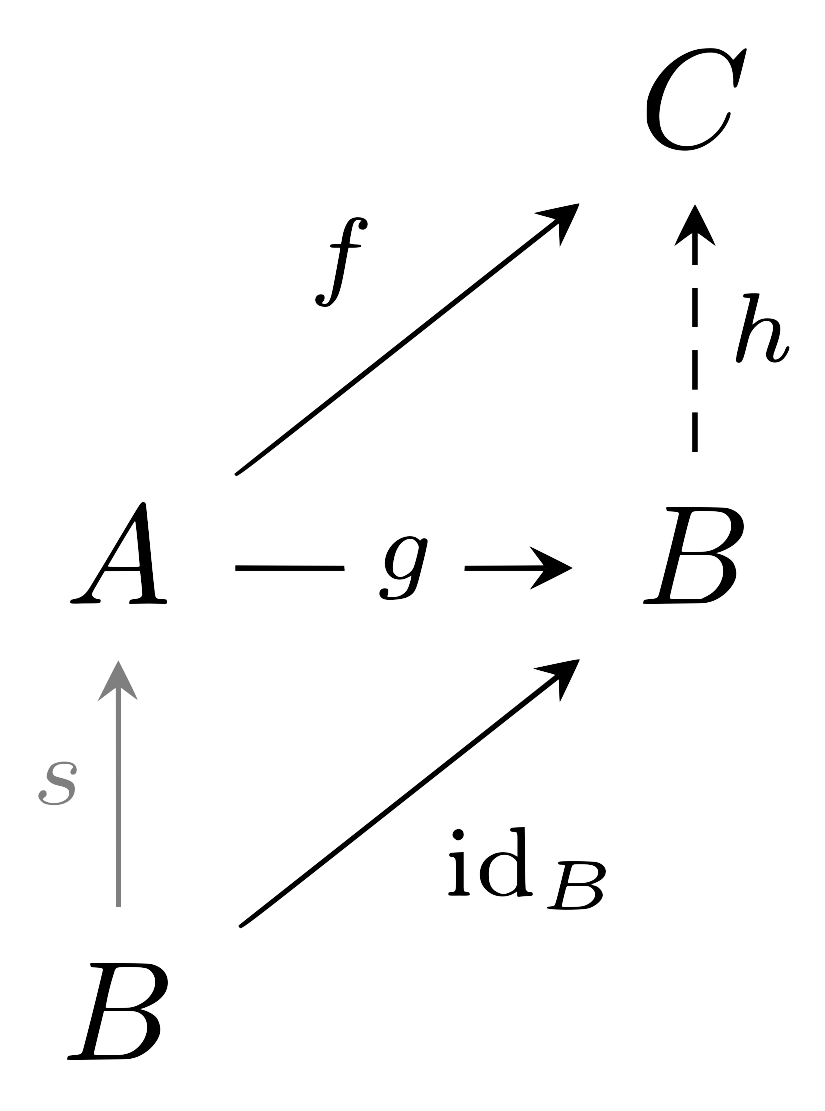
- Let \(A,B,C\) be sets, and let \(g:A\rightarrow B\) be a surjection and \(f:A\rightarrow C\) a function. Then
there exists $h:B\rightarrow C$ with $f=h\circ g$ if and only if$(g(x)=g(y))\implies(f(x)=f(y))$ . If these equivalent conditions hold, then \(h\) satisfying \(f=h\circ g\) is uniquely determined by \(f\); moreover, if \(s\) is a section of \(g\), then \(h=f\circ s\). - Let \(A,B,C\) be sets, and let \(g:A\rightarrow B\) be an injection and \(f:C\rightarrow B\) a function. Then
there exists a function $h:C\rightarrow A$ such that $f=g\circ h$ if and only if$f(C)\subseteq g(A)$ . If these equivalent conditions hold, then \(h\) is uniquely determined by \(f\); moreover, if \(r\) is a retraction of \(g\), then \(h=r\circ f\).
The result in part 1 states that there exists \(h\) making the diagram
commute. Part 2 states that there exists \(h\) making the diagram
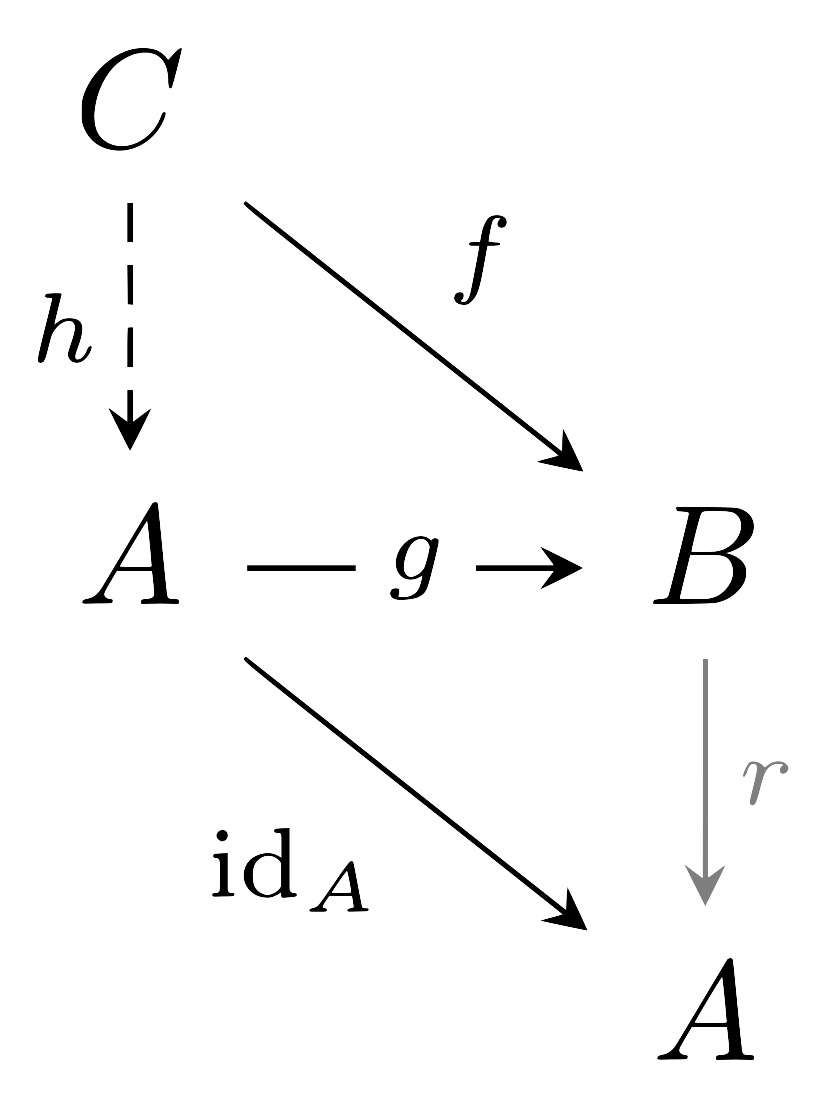
commute.
Proof of Proposition 4
-
Suppose \(f=h\circ g\). If \(g(x)=g(y)\), then
\[f(x)=(h\circ g)(x)=h(g(x))=h(g(y))=(h\circ g)(y)=f(y)\]so \((g(x)=g(y))\implies(f(x)=f(y))\) holds. We must prove the converse to establish the equivalence, and also show that when these conditions hold, \(h\) is uniquely determined as \(h=f\circ s\). First observe that if these conditions hold, \(h\) must be unique. The value of \(h\) is determined by its values on each \(y\in B\). Since \(g\) is surjective, for any section \(s\) of \(g\), we have \(s(y)=x\) for some \(x\). Then
\[h(y)=(f\circ s)(y)=f(x)\]Even if another section \(s'\) exists with \(s'(y)=x'\), we have
\[g(x)=g(s(y))=y=g(s'(y))=g(x')\]so by the second of the equivalent conditions, \(f(x)=f(x')\). Hence \(h(y)\) is independent of the choice of \(s\). Thus \(h\), if it exists, is unique.
Now we prove the converse direction. Suppose \((g(x)=g(y))\implies(f(x)=f(y))\). Let \(s\) be a section of \(g\), and define \(h=f\circ s\) as suggested by the uniqueness proof. For any \(x\in A\),
\[(h\circ g)(x)=((f\circ s)\circ g)(x)=f(s(g(x)))\]On the other hand,
\[g(s(g(x)))=\id_B(g(x))=g(x)\]so by hypothesis \(f(s(g(x)))=f(x)\). Hence \(h(g(x))=f(x)\), and such an \(h\) exists.
-
Suppose \(f=g\circ h\). For any \(y\in f(C)\), write \(y=f(x)\); then \(y=f(x)=g(h(x))\in g(A)\), so \(f(C)\subseteq g(A)\) is immediate. As in part 1, we first establish uniqueness of \(h\). Since \(h\) is defined by the condition \(f=g\circ h\), to show that \(h\) has a uniquely determined value at each \(y\in G\), it suffices to show that the right-hand side of
\[h(y)=(\id_A\circ h)(y)=((r\circ g)\circ h)(y)=(r \circ f)(y)\]has the same value regardless of the choice of retraction \(r\). Since \(r\circ g=r'\circ g=\id_A\), for any \(g(x)\in g(A)\) we have \(r(g(x))=x=r'(g(x))\). That is, \(r\vert_{g(A)}=r'\vert_{g(A)}\). By the second of the equivalent conditions, \(r\) and \(r'\) must agree on \(f(y)\in f(C)\subseteq g(A)\). Hence \(h\), if it exists, is unique.
Now we prove the converse. Define \(h=r\circ f\) as suggested by the uniqueness proof. If \(f(C)\subseteq g(A)\), then for any \(x\in C\),
\[(g\circ h)(x)=(g\circ(r\circ f))(x)=(g\circ r)(f(x))\]Since \(f(x)\in f(C)\subseteq g(A)\), write \(f(x)=g(y)\). Then
\[(g\circ r)(f(x))=(g\circ r)(g(y))=(g\circ(r\circ g))(y)=(g\circ\id_A)(y)=g(y)=f(x)\]so \((g\circ h)(x)=f(x)\) holds for all \(x\in C\). Thus such an \(h\) exists.
References
[Bou] N. Bourbaki, Theory of Sets. Elements of mathematics. Springer Berlin-Heidelberg, 2013.
댓글남기기