
This post was translated from Korean by LLM (Kimi). The translation may contain errors or awkward sentences. The Korean original is the source of truth.
Consider the following diagram
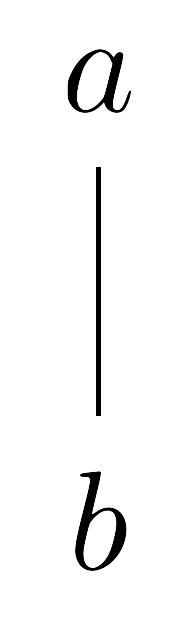
and let this represent \(b\leq a\). For example, the following diagram
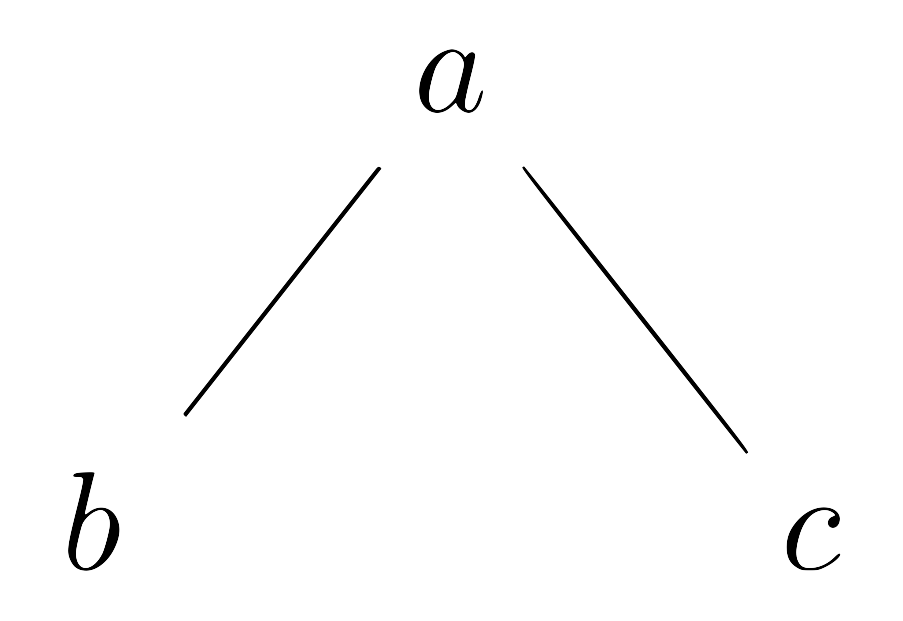
represents the situation where \(b\leq a\) and \(c\leq a\), but there is no particular relation between \(b\) and \(c\). We call such a diagram a Hasse diagram.
Maximal and Minimal Elements
Definition 1 An element \(a\) of an ordered set \(A\) is called a minimal element (resp. maximal element) of \(A\) if for all \(x\in A\), whenever \(a\leq x\) (resp. \(a\geq x\)), we have \(x=a\).
A minimal element need not be unique. For instance,
in this diagram, both \(b\) and \(c\) are minimal elements of the set \(\{a,b,c\}\). Mathematicians usually prefer elements with this property to be unique, so this situation is not entirely desirable.
Greatest and Least Elements
Definition 2 An element \(a\) of an ordered set \(A\) is called a least element (resp. greatest element) of \(A\) if for all \(x\in A\), we have \(a\leq x\) (resp. \(x\leq a\)).
In the previous example, neither \(b\) nor \(c\) can be a least element, because neither \(b\leq c\) nor \(c\leq b\) holds. By definition, a least element is unique. Moreover, the following holds.
Proposition 3 If \(A\) has a least element \(a\), then \(a\) is the unique minimal element of \(A\).
Proof
For any element \(x\) of \(A\), we have \(a\leq x\). Thus, if there exists \(x\in A\) such that \(x\leq a\), then antisymmetry of \(\leq\) implies \(x=a\). Hence we see that \(a\) is a minimal element of \(A\).
If \(a'\) is another minimal element of \(A\) and \(a'\neq a\), then the contrapositive of Definition 1 implies \(a'\not\leq a\), which contradicts the fact that \(a\) is a least element. Therefore \(a'=a\).
Occasionally we must consider a new element larger than every element of an ordered set, or smaller than every element. It is common to denote such hypothetical elements by \(\pm\infty\).
Proposition 4 Let \(A\) be an ordered set and let \(A'=A\sqcup\{+\infty\}\). Then there exists an order relation on \(A'\) extending the order relation defined on \(A\) and having \(a\) as its greatest element.
Proof
It suffices to add the elements of \(\bigcup_{x\in A}\left\{(x, +\infty)\right\}\) to the original order relation.
Suprema and Infima
Definition 5 Let \(A\) be a preordered set and let \(X\) be its subset. If \(a\in A\) satisfies \(a\leq x\) (resp. \(a\geq x\)) for all \(x\in X\), we call it a lower bound (resp. upper bound) of \(X\) in \(A\).
A set possessing a lower bound (resp. upper bound) is called bounded below (resp. bounded above), and a set that is both bounded below and bounded above is simply called bounded.
Consider the following ordered set \(A=\{a,b,c,d,e\}\).
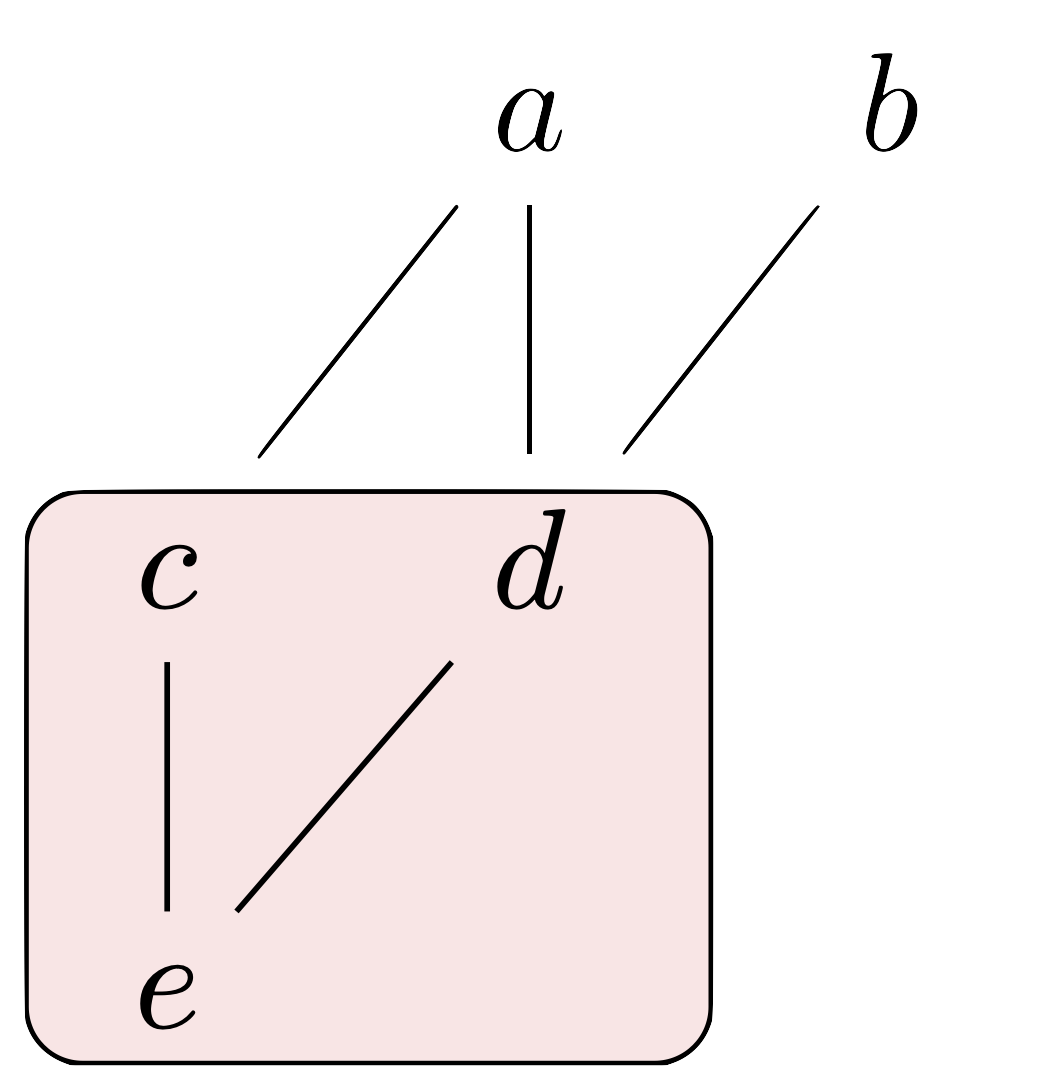
Then \(a\) is an upper bound of the set \(X=\left\{c,d,e\right\}\), but \(b\) is not. If we consider the set \(X'=\left\{d,e\right\}\), both \(a\) and \(b\) are upper bounds of this set. From the above example we see that a lower bound of a set \(X\) need not belong to \(X\); however, if it does, then that element becomes a least element of \(X\).
Definition 6 Let \(A\) be an ordered set and let \(X\subseteq A\). An element \(a\) of \(A\) is called the greatest lower bound (or infimum) of \(X\) if it is the greatest element among the lower bounds of \(X\). Similarly we define the least upper bound (or supremum).
If the supremum of \(X\subseteq A\) exists, we denote it by \(\sup_AX\), and the infimum by \(\inf_AX\). By definition, one easily checks that if \(X\subseteq A\) has a greatest element \(a\), then \(a=\sup_AX\).
Proposition 7 Let \(A\) be an ordered set and suppose \(X\subset A\) has both a supremum and an infimum.
- If \(X\neq\emptyset\), then \(\inf_A X\leq\sup_A X\).
- If \(X=\emptyset\), then \(\sup_AX\) and \(\inf_AX\) become the least and greatest elements of \(A\), respectively.
Proof
- If \(X\neq\emptyset\), then there exists at least one element. Let this be \(a\). Then by definition \(\inf X\leq a\) and \(a\leq\sup X\), and by transitivity \(\inf_AX \leq\sup_AX\).
- If \(X=\emptyset\), then any element \(a\) of \(A\) satisfies \(a\leq x\) and \(x\leq a\) for all \(x\in X\). Therefore any element of \(A\) is both a lower bound and an upper bound of \(X\), and \(\sup_AX\) and \(\inf_AX\) become the least and greatest elements of \(A\).
Suprema, Infima, and Set Operations
We now examine the relationship between the set operations we have seen and suprema and infima.
Proposition 8 For two subsets \(X,X'\) of an ordered set \(A\), if \(\sup_AX\) and \(\sup_AX'\) are defined and \(X'\subseteq X\), then \(\sup X'\leq\sup X\).
Proof
Choose an arbitrary \(x\in X'\). Since \(X'\subseteq X\), we have \(x\in X\). Moreover, for any \(x\in X\) we have \(x\leq \sup X\), and therefore \(\sup X\) is an upper bound of \(X'\). Now by definition \(\sup X'\leq \sup X\).
Proposition 9 For an ordered set \(A\), consider families \((x_i)_{i\in I}\) and \((y_i)_{i\in I}\) satisfying \(x_i\leq y_i\) for all \(i\in I\). If both have suprema in \(A\), then \(\sup_{i\in I} x_i\leq \sup_{i\in I} y_i\).
Proof
For any \(i\in I\), we have \(x_i\leq y_i\) and \(y_i\leq \sup y_i\), so \(x_i\leq \sup y_i\) for all \(i\). Therefore, by the minimality of \(\sup x_i\), we have \(\sup x_i\leq\sup y_i\).
Proposition 10 Let \(A\) be an ordered set, \(I\) an index set, and \((J_k)_{i\in I}\) a covering of \(I\), and suppose that \((x_i)_{i\in J_k}\) has a supremum in \(A\) for each \(k\). Then \(\sup_{i\in I} x_i\) exists if and only if \(\sup_{k\in K}(\sup_{j\in J_k}x_j)\) exists, and the two values are equal.
Proof
Write \(b_k=\sup_{i\in J_k} x_i\). First suppose that \((x_i)_{i\in I}\) has a supremum, and denote it by \(a\). Then \(a\leq b_k\) holds for all \(k\). Also, if \(c\geq b_k\) holds for all \(k\), then for any \(x_i\) there is a \(k'\) with \(i\in J_{k'}\), which satisfies \(b_{k'}\geq x_i\); hence \(c\geq x_i\) for any \(i\). Now by the minimality of \(a\) we must have \(c\geq a\), and therefore \(a\) is the supremum and \(\sup_{i\in I}x_i=\sup_{k\in K}(\sup_{i\in J_k} x_j)\).
Conversely, if \((b_k)_{k\in K}\) has a supremum \(a'\), the proof can be completed in the same way.
Proposition 11 For the product \(A=\prod A_i\) of ordered sets \((A_i)_{i\in I}\) and a subset \(X\) thereof, let \(X_i=\pr_i X\). Then \(\sup_AX\) exists if and only if each \(\sup_{A_i}X_i\) exists, and \(\sup_AX=(\sup_{A_i}X_i)\).
Proof
First suppose that \(\sup_{A_i} X_i\) exists for each \(i\). Then it is obvious that \((\sup_{A_i} X_i)_{i\in I}\) is an upper bound of \(X\). If \((c_i)\) were another upper bound of \(X\), then each \(c_i\) would be an upper bound of \(X_i\), so by the minimality of \(\sup_{A_i}X_i\) we have \(c_i\geq\sup X_i\), and therefore \((c_i)\geq(\sup X_i)_{i\in I}\).
Conversely, suppose \(\sup X=(a_i)\) exists. For all \(i\), \(a_i\) is an upper bound of \(X_i\). This is because if \(x_i\in X_i\), then there exists \(x\in X\) whose \(i\)-th component is \(x_i\) and which satisfies \(x\leq (a_i)\). Now for any other upper bound \(a_i'\), define a new element \((c_i)\) by replacing the \(i\)-th component of \((a_i)\) with \(a_i'\); then \(c\geq a\), so \(a_i'\geq a_i\).
Remark For an ordered set \(A\) and \(X'\subseteq X\subseteq A\), it may happen that only one of \(\sup_AX'\) and \(\sup_XX'\) exists, or that both exist but have different values. For instance, let us compare \(X'=\{x\in\mathbb{Q}\mid x < \sqrt{2}\}\) in various sets.
- As a subset of \(X_1=\mathbb{Q}\), this set has no supremum, but it does in \(A=\mathbb{R}\). That is, even if \(\sup_AX'\) exists, \(\sup_{X_1}X'\) may not exist.
- On the other hand, consider the set \(X_2=X'\cup \left\{2\right\}\). Then \(X'\subseteq X_2\subseteq X_1\) and \(\sup_{X_2}X'=2\), but \(\sup_{X_1}A\) does not exist.
- Finally, in \(X'\subseteq X_2\subseteq A\), both \(\sup_{X_2}X'\) and \(\sup_AX'\) exist but the two values differ.
Nevertheless, we can still prove the following.
Proposition 12 Let \(A\) be an ordered set and let \(X'\subseteq X\subseteq A\). If both \(\sup_AX'\) and \(\sup_XX'\) exist, then \(\sup_AX'\leq\sup_XX'\). If \(\sup_AX'\) exists and belongs to \(X\), then \(\sup_XX'\) also exists and equals \(\sup_AX'\).
Proof
The set of upper bounds of \(X'\) in \(X\) is contained in the set of upper bounds of \(X'\) in \(A\); hence the supremum is larger. If \(\sup_AX'\) exists and belongs to \(X\), then it is obviously the supremum of \(X'\) in \(X\).
References
[Bou] N. Bourbaki, Theory of Sets. Elements of mathematics. Springer Berlin-Heidelberg, 2013.
댓글남기기