
In previous posts, we defined binary relations. Under this definition, the binary relation \(<\) defined on the set of natural numbers \(\mathbb{N}\) is the set
\[{<}=\{(0,1),(0,2),\ldots, (1,2),(1,3),\ldots, \}\]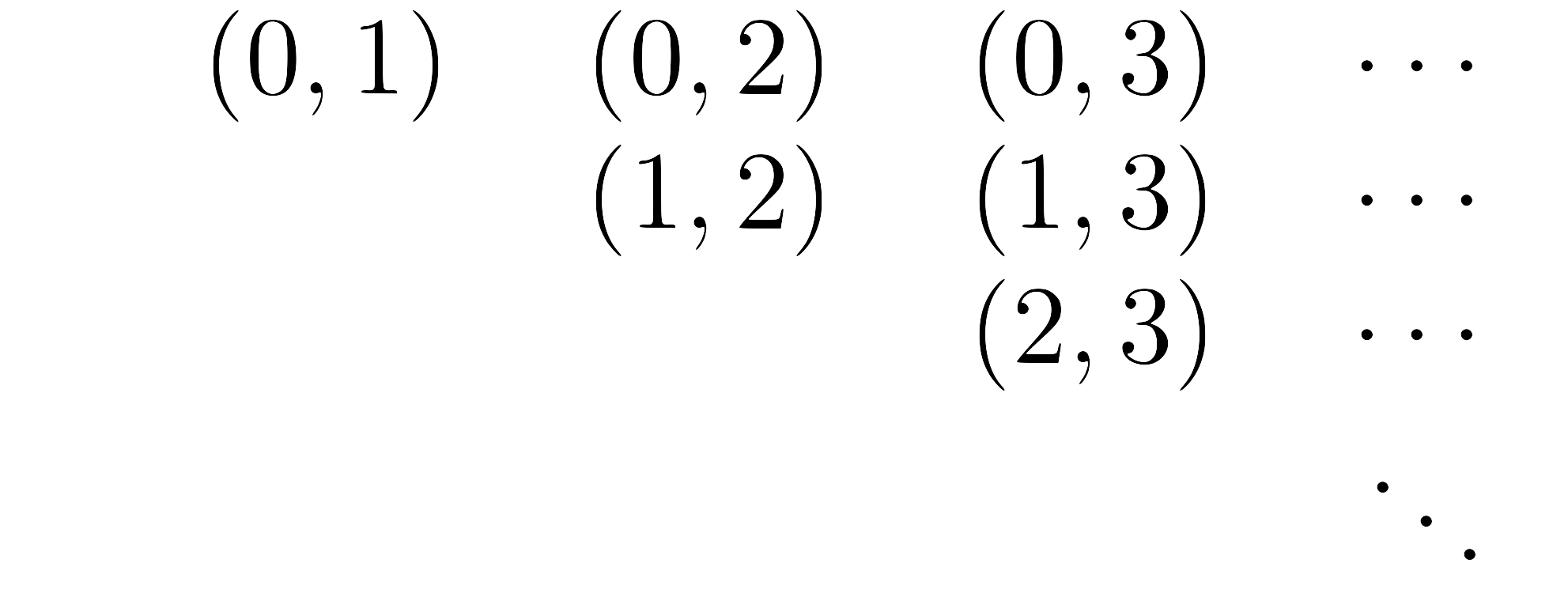
Following the notation of §Binary Relation, ⁋Definition 7, \({<}(1)\) is the collection of all \(n\in\mathbb{N}\) such that \((1,n)\in\mathbb{N}\), hence
\[{<}(1)=\{2,3,\ldots\}\]Conversely, given the information about the set \({<}(k)\) for every natural number \(k\), the set \(<\) can be recovered.
The discussion above applies equally to general binary relations \((R,A,B)\). Thus a binary relation \(R\) may be viewed precisely as a rule assigning the set \(R(a)\) to each \(a\in A\). In this light, a function is a binary relation for which \(R(a)\) is a singleton set for every \(a\in A\).
Definition of a Function
Definition 1 For a non-empty set \(A\), a binary relation \(f=(F,A,B)\) is called a function if \(A=\pr_1F\) and for each \(x\in A\), the set \(F(\{x\})\) is a singleton set.1
The condition \(A=\pr_1F\) means that every element \(x\) of \(A\) corresponds to at least one \(y\in B\); the second condition means that every \(x\in A\) corresponds to at most one \(y\in B\). Hence \(f=(F,A,B)\) is a function precisely when:
For every \(x\in A\), there exists a unique \(y\in B\) such that \((x,y)\in F\).
This \(y\) is called the value of \(f\) at \(x\), and the unique element of \(F(\{x\})\) is denoted by \(f(x)\). The set \(A=\pr_1F\) is called the domain of \(f\).
In keeping with this notation, the image of a set \(X\subseteq A\) under the binary relation \(F\) is written \(f(X)\) rather than \(F(X)\), and the preimage of a set \(Y\subseteq B\) is written \(f^{-1}(Y)\) rather than \(F^{-1}(Y)\). (§Binary Relation, ⁋Definition 5 and §Operations on Binary Relations, ⁋Definition 1) The triple \(f=(F,A,B)\) is written more concisely as \(f:A\rightarrow B\).
The set
\[F=\{(x,y)\mid (y=f(x))\wedge(x\in A)\}\]representing a function \(f=(F,A,B)\) may also be regarded as the graph of the function drawn on the “coordinate plane” \(A\times B\). More generally, a binary relation \(R\) may likewise be regarded as the graph of the binary relation. A function \(f\) is a constant function if \(f(x)=f(x')\) for all \(x,x'\in \pr_1 F\).
In certain contexts, expressions such as \(f_x\) are used to denote function values. Under this notation, the domain of \(f\) is called the index set, and \(F\) is called a family. When \(f=(F,I,A)\) is regarded as a family, \(F\) is denoted by \((f_i)_{i\in I}\).
If \(f\) is a function from a set \(A\) to itself, then \(x\in A\) is fixed by \(f\) if \(f(x)=x\).
Definition 2 For any set \(A\), the identity function \(\id_A\) is defined as the triple \((\Delta_A,A,A)\). That is, \(\id_A\) is the function given by \(f(x)=x\) for every \(x\in A\).
By definition, \(\id_A\) is the function that fixes every element of \(A\).
Commutative Diagrams
When working with multiple functions, the following diagrams prove convenient.
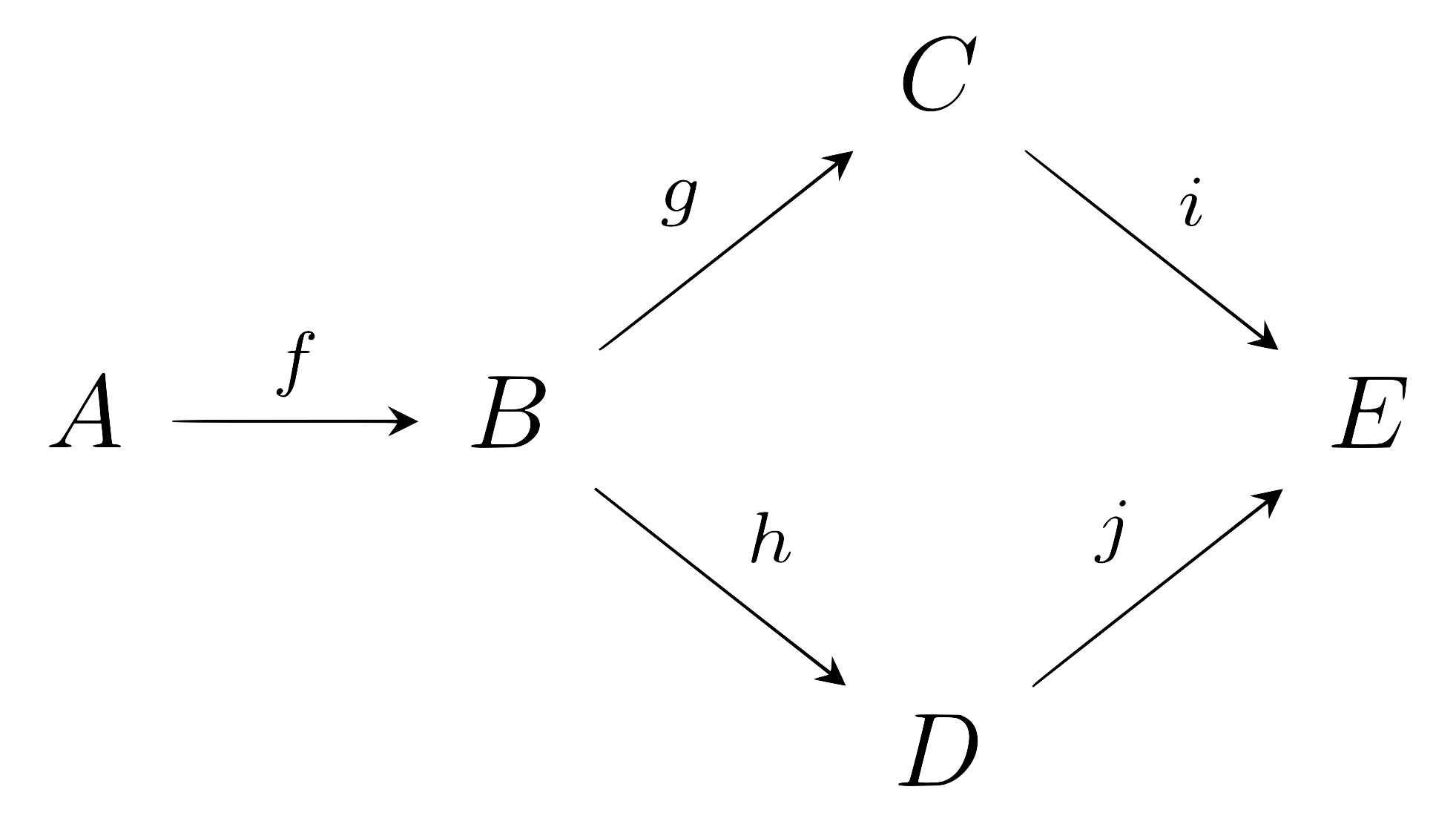
Here \(A\overset{f}{\longrightarrow}B\) is a convenient notation for \(f:A\rightarrow B\).
In the situation above, if \((i\circ g)(x)=(j\circ h)(x)\) for every \(x\in B\), then the square
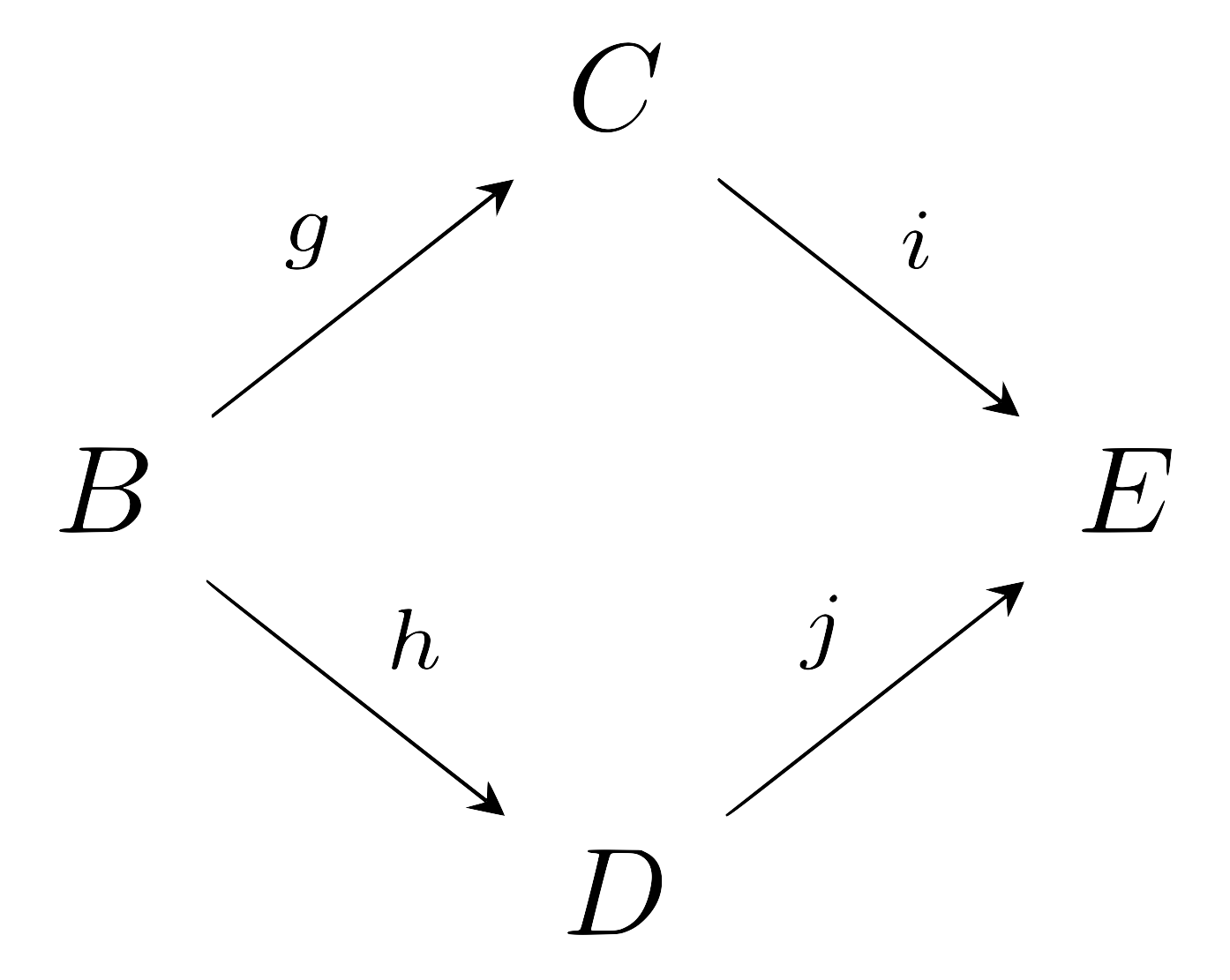
is said to commute. Similarly, the diagram
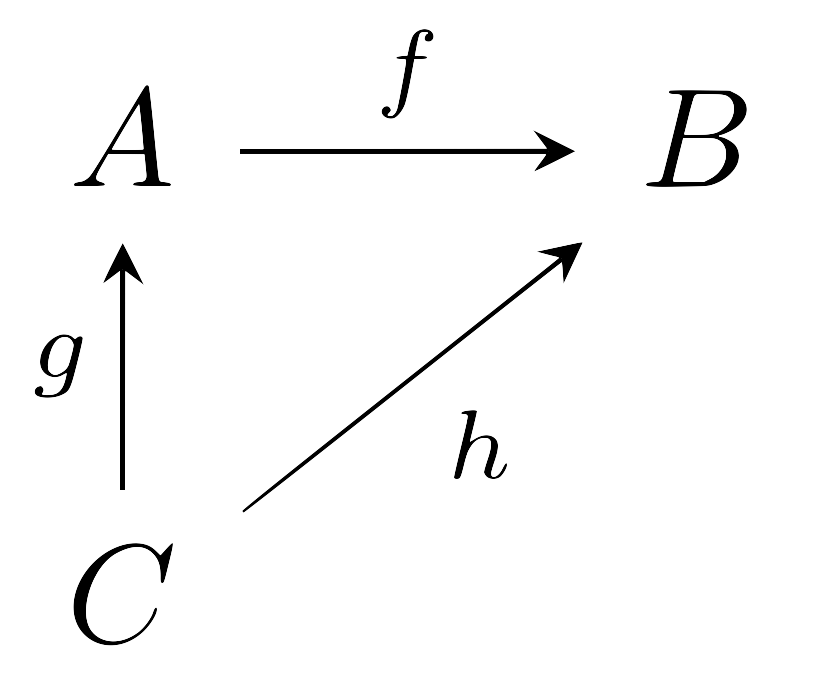
is a commutative diagram if \(h(x)=(f\circ g)(x)\) for all \(x\). This situation is sometimes expressed concisely as \(h=f\circ g\), a notation which implies not only that \(H=F\circ G\) holds but also that the sources and targets on both sides coincide.
When working with diagrams, it is understood that for each object \(A\), the function \(\id_A\) from \(A\) to itself is present, even when not explicitly indicated by arrows. Thus strictly speaking, the commutativity of the triangle above means not only \(h=f\circ g\) but also
\[{\id_B}\circ h=f\circ g,\qquad h\circ{\id_C}=f\circ{\id_A}\circ g,\quad\cdots\]However, by the properties of the identity function discussed in §Operations on Binary Relations, ⁋Definition 9, the above equations are all equivalent to \(h=f\circ g\). On the other hand,
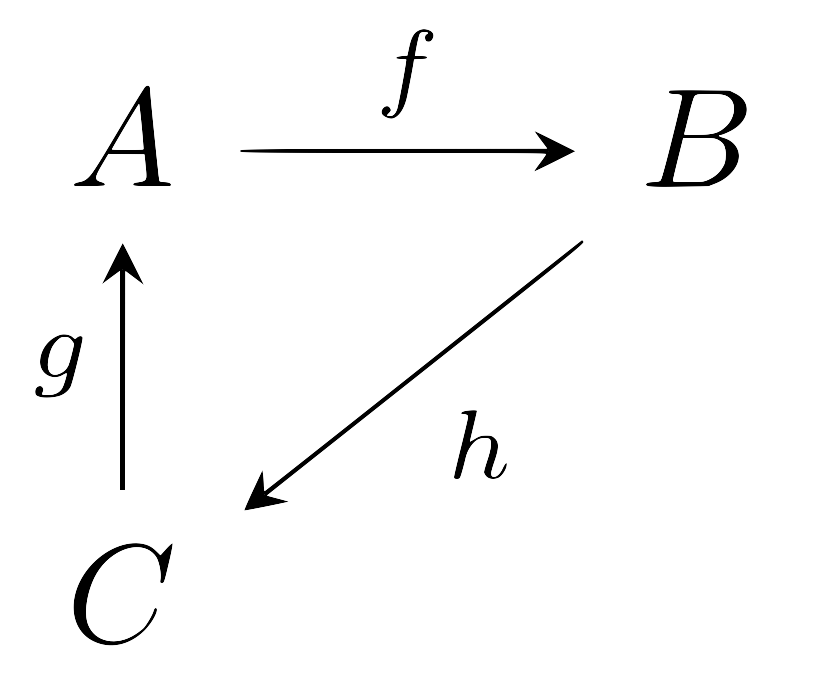
commuting means that all three conditions
\[{\id_A}=g\circ h\circ f,\quad {\id_B}=f\circ g\circ h,\quad {\id_C}=h\circ f\circ g\]hold. In particular, the diagram
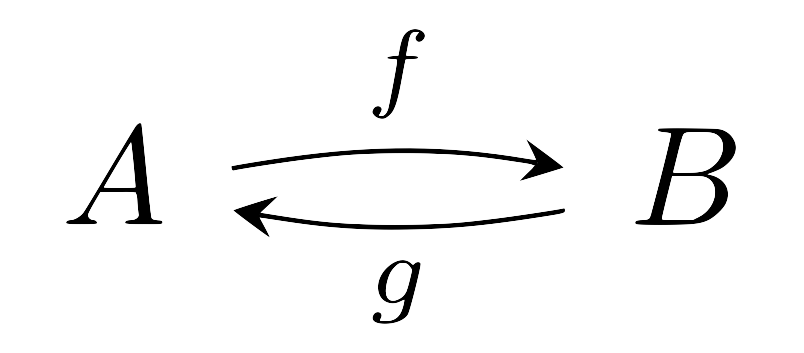
commuting means that \(g\circ f=\id_A\) and \(f\circ g=\id_B\).
Extension and Restriction of Functions
Definition 3 Two functions \(f=(F,A,B),f'=(F',A',B')\) are compatible on a set \(S\) if \(S\) is contained in the domains of both \(f\) and \(f'\), and \(f(x)=f'(x)\) for all \(x\in S\).
Let \(f\) and \(f'\) be two functions, and suppose \(S=\pr_1 F\cap\pr_1 F'\) is non-empty. If the two functions are compatible on \(S\), then a new function \(g\) with domain \(\pr_1F\cup\pr_1F'\) can be defined by
\[g(x)=\begin{cases}f(x)&x\in \pr_1F\setminus\pr_1F'\\ f(x)=f'(x)&x\in \pr_1F\cap\pr_1F'\\ f'(x)&x\in\pr_1F'\setminus\pr_1F\end{cases}\]This situation is captured in the following definition.
Definition 4 Let \(f=(F,A,B)\) and \(f'=(F',A',B')\) be functions. If \(F\subseteq F'\) and \(B\subseteq B'\), then \(f'\) is called an extension of \(f\), and we say that \(f'\) extends \(f\).
Conversely, a function may be restricted to a smaller domain. Let \(f=(F,A,B)\) be a function and let \(X\subseteq A\). If we define the relation \(R\) by
\((x\mathrel{R} y)\) if and only if \(((x\in X)\wedge(y=f(x)))\)
then \(R\), the collection of all \((x,y)\) satisfying this condition, is a function whose domain is \(X\). This leads to the following definition.
Definition 5 The function \(g\) defined above is called the restriction of \(f\) to \(X\), and is denoted by \(f\vert_{X}\).
References
[Bou] N. Bourbaki, Theory of Sets. Elements of mathematics. Springer Berlin-Heidelberg, 2013.
-
Strictly speaking, we have not yet defined the cardinality of a set, but this condition can be expressed as \(x,y\in R(a)\implies x=y\), for instance. ↩
댓글남기기