
In this article, we explore examples of equivalence relations that arise in various contexts.
Equivalence Relations Defined by Functions
In the previous article, we saw that from an equivalence relation \((R,A,A)\), a canonical function \(p:A\rightarrow A/R\) is well-defined. The converse also holds: given any function, we can use it to construct an equivalence relation.
Proposition 1 Let a set \(A\) and a function \(f\) with domain \(A\) be given. Then the relation on \(x\) and \(y\) given by “\(x,y\in A\) and \(f(x)=f(y)\)” is an equivalence relation on \(A\).
Proof
It is obvious that the given relation is reflexive on \(A\). Moreover, if \(f(x)=f(y)\), then \(f(y)=f(x)\), and if \(f(x)=f(y)\) and \(f(y)=f(z)\), then \(f(x)=f(z)\), so this relation is also symmetric and transitive.
Definition 2 The equivalence relation defined in the previous proposition is called the equivalence relation defined by \(f\).
For an equivalence relation \((R,A,A)\) and the induced \(p:A\rightarrow A/R\), we can verify that the equivalence relation \(R\) is exactly the same as the equivalence relation obtained by applying Definition 2 to \(p\).
Unary Relations and Compatible Equivalence Relations
Definition 3 Let \((R,A,A)\) be an equivalence relation. A unary relation \(P\) is compatible with \(R\) if \(P(x)\wedge (x\sim_{\tiny R}y)\implies P(y)\).
For example, the unary relation
\(x\) is even
is compatible with the equivalence relation
\(x-y\) is a multiple of 4
Rewriting the definition above from the perspective of equivalence classes, we have the following.
Proposition 4 Let \(R\) be an equivalence relation on a set \(A\), and let \(P\) be a unary relation compatible with \(R\). Then the statements “\(t\in A/R\) and there exists \(x\in t\) such that \(P(x)\)” and “\(t\in A/R\) and for all \(x\in t\), \(P(x)\)” are equivalent.
Proof
To put it more explicitly:
When \(P\) is compatible with \(R\), if even a single element of an equivalence class satisfies \(P\), then \(P\) holds for all elements in the same class.
And this is exactly the definition of a compatible unary relation.
The reverse direction is obvious. Suppose for some \(t\in A/R\) there exists \(a\in t\) such that \(P(a)\). Then for all \(x\in t\), since \(a\sim_{\tiny R}x\), we have \(P(x)\).
Saturation of Equivalence Relations
Definition 5 Let \(R\) be an equivalence relation on \(A\) and \(X\) be a subset of \(A\). \(X\) is saturated with respect to \(R\) if the unary relation \(x\in A\) is compatible with \(R\).
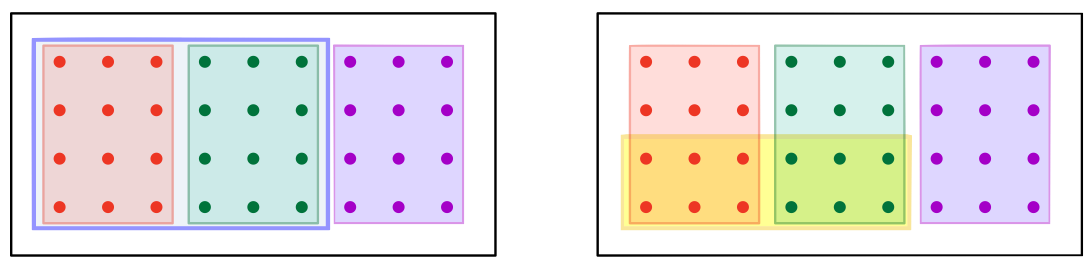
According to the definition above, for a set \(X\) to be \(R\)-saturated, it must satisfy the condition that if \(x\in X\), then \(R(x)\subseteq X\). Therefore, an \(R\)-saturated subset \(X\) is a set that can be expressed as \(\bigcup_{x\in B}R(x)\) for some subset \(B\subseteq A\). From this, we can easily verify the following two results:
- If \((A_i)_{i\in I}\) is a family of \(R\)-saturated subsets, then \(\bigcup_{i\in I} A_i\) and \(\bigcap_{i\in I} A_i\) are also \(R\)-saturated.
- If \(X\subseteq A\) is \(R\)-saturated, then \(A\setminus X\) is also \(R\)-saturated.
Now consider the canonical projection \(p:A\rightarrow A/R\) and \(X\subseteq A\). By §Operations on Binary Relations, ⁋Proposition 7, we obtain
\[p^{-1}(p(X))\supseteq X\]The reverse inclusion does not hold in general, but if \(X\) is \(R\)-saturated, then the reverse inclusion also holds. For each \(x\in X\), since \(p^{-1}(\left\{p(x)\right\})\subseteq X\),
\[p^{-1}(p(X))=\bigcup_{x\in X}p^{-1}(\left\{p(x)\right\})\subseteq X\]holds.
On the other hand, even if \(X\) is not \(R\)-saturated, the set \(p^{-1}(p(X))\) becomes \(R\)-saturated. To see this, choose \(x\in p^{-1}(p(X))\) arbitrarily, and let any \(x'\) satisfying \(x\sim_{\tiny R} x'\) be given. Then
\[x\sim_{\tiny R} x'\iff p(x)=p(x')\]and from the given assumption, \(p(x)\in p(X)\), so we obtain \(x'\in p^{-1}(p(X))\). Meanwhile, if \(X'\) is an \(R\)-saturated subset containing \(X\), then
\[X'=p^{-1}(p(X'))\supseteq p^{-1}(p(X))\]so \(p^{-1}(p(X))\) is the smallest \(R\)-saturated subset containing \(X\). This is called the saturation of \(X\).
Canonical Decomposition
Definition 6 For an equivalence relation \((R,A,A)\) and a function \(f\) with domain \(A\), \(f\) is compatible with \(R\) if the unary relation \(y=f(x)\) with respect to \(x\) is compatible with \(R\).
That is, for \(f\) to be compatible with \(R\), \(f\) must be a constant function when restricted to each equivalence class. Now applying §Retraction and Section, ⁋Proposition 4, we obtain the following.
Proposition 7 Consider an equivalence relation \((R,A,A)\) and the canonical projection \(p:A\rightarrow A/R\). Then \(f:A\rightarrow B\) is compatible with \(R\) if and only if there exists \(h:A/R\rightarrow B\) such that \(f=h\circ p\).
That is, the following diagram commutes:
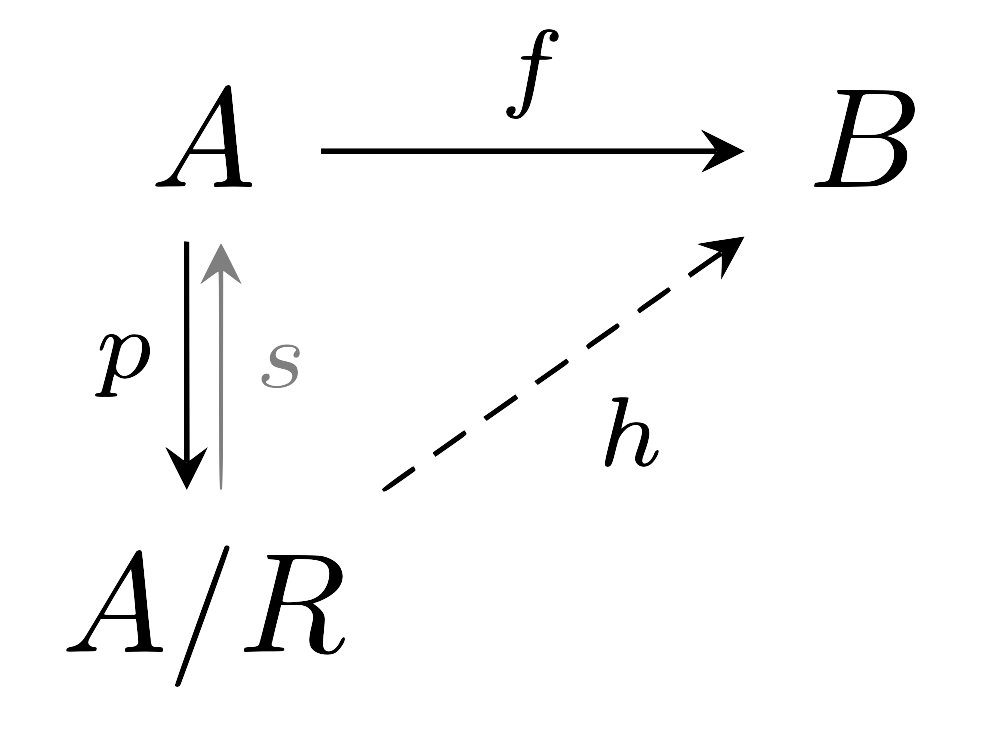
In this case, \(h\) is uniquely determined by a section \(s\) of \(p\) as \(h=f\circ s\).
In particular, let \(R\) be the equivalence relation defined by \(f\). (Definition 2) Then we can consider the following diagram:
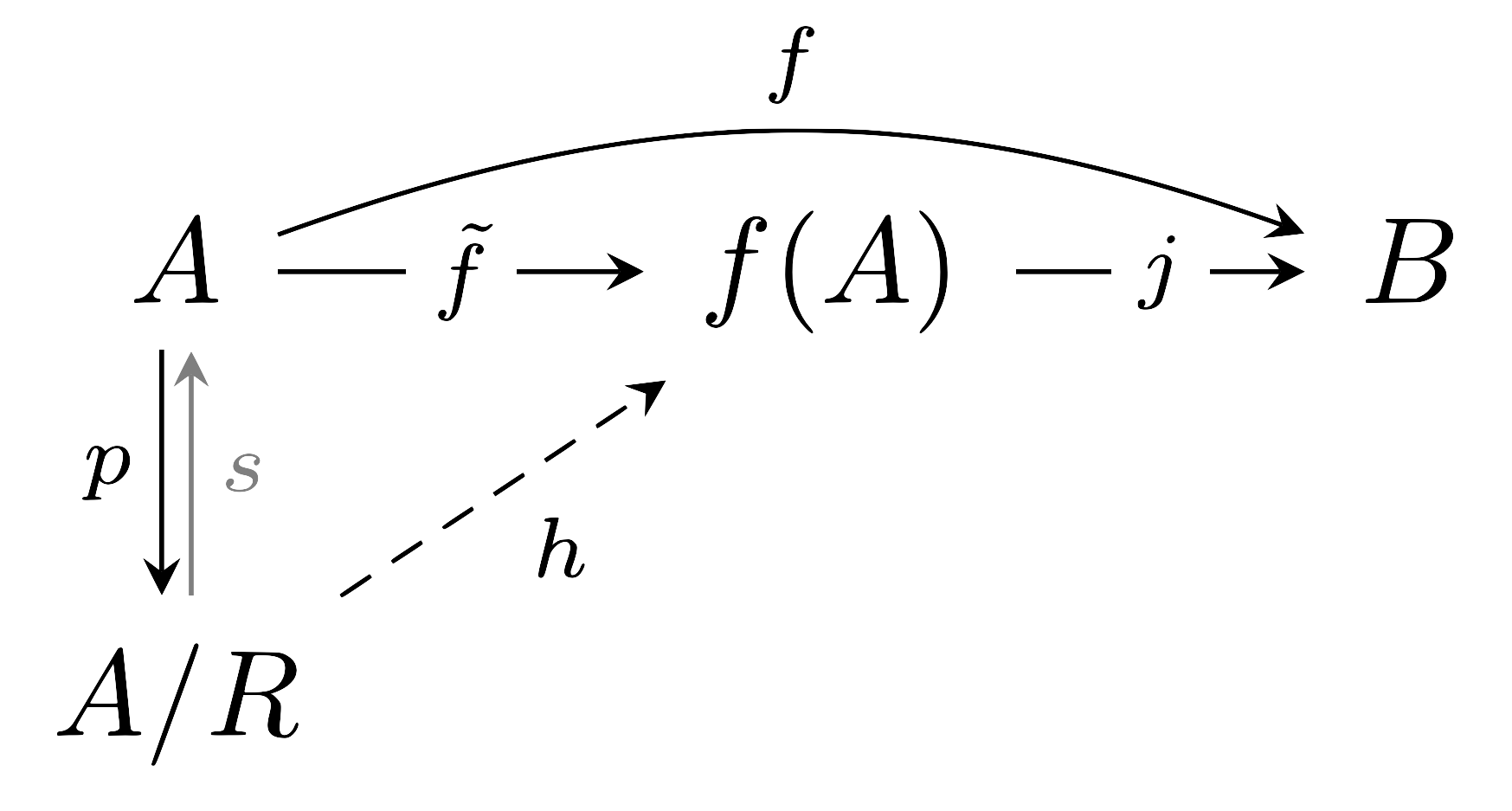
Here \(\tilde{f}\) is the function obtained by restricting the codomain of \(f\) to \(f(A)\), and \(j\) is the canonical injection. From the commutativity of the diagram above, we obtain the equation
\[f=j\circ\tilde{f}=j\circ h\circ p\]If \(h(t)=h(t')\) for some \(t, t'\in A/R\), then for \(x\in t\) and \(x'\in t'\), we have \(f(x)=f(x')\), so \(x\sim_{\tiny R}x'\), and therefore \(t=t'\), making \(h\) an injective function. But since the codomain of \(h\) is restricted to the range of \(f\), \(h\) is also a surjective function. Therefore, \(h\) is a bijection, and the above equation is called the canonical decomposition of \(f\).
Additionally, suppose an equivalence relation \(S\) is given on the codomain \(B\). Then we first obtain the following diagram:
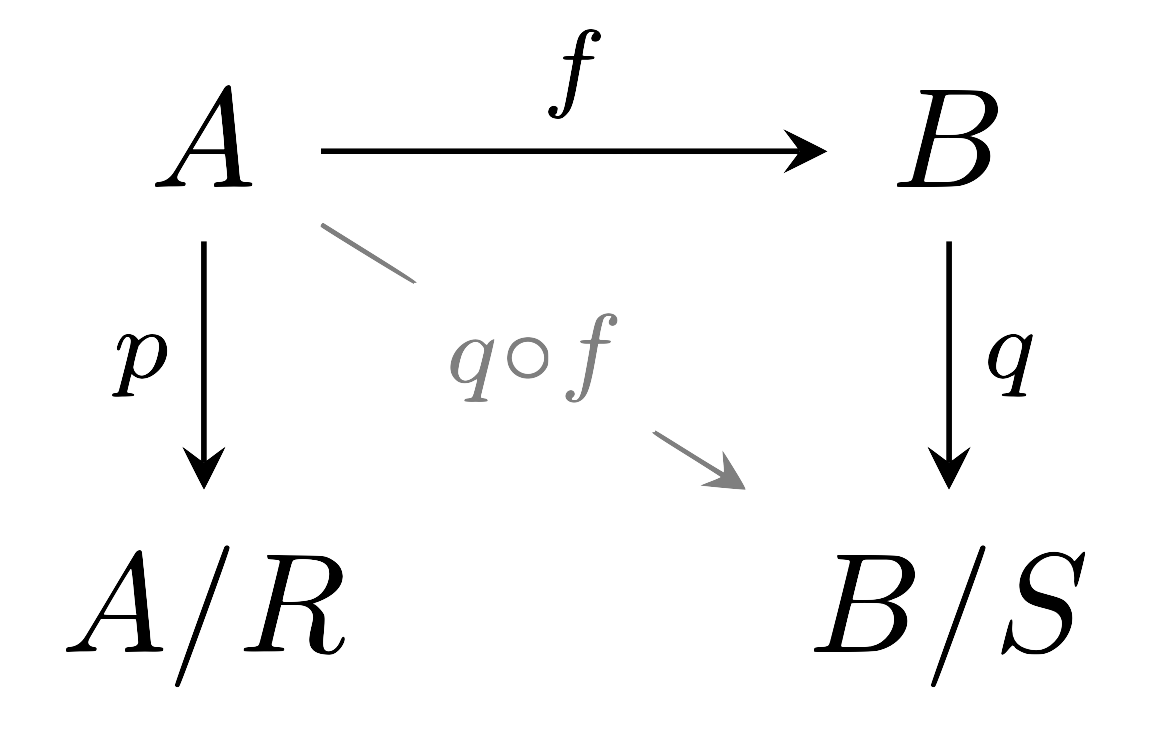
If \(q\circ f\) is compatible with \(R\), then \(f\) is said to be \((R,S)\)-compatible. By Proposition 7, this is equivalent to the existence of \(h:A/R\rightarrow B/S\) such that \(h\circ p=q\circ f\).
Preimage of an Equivalence Relation
Let a function \(f:A\rightarrow B\) be given, and consider an equivalence relation \((S,B,B)\) and the canonical projection \(p:B\rightarrow B/S\).
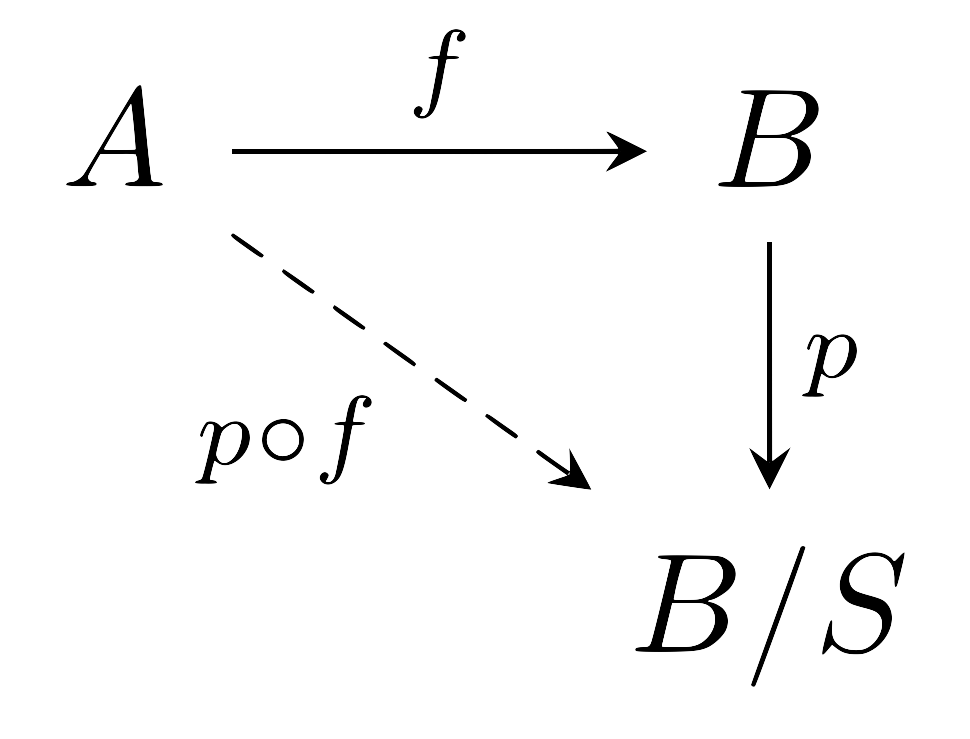
Then the function \(p\circ f:A\rightarrow B/S\) is naturally defined, and the equivalence relation it creates through Definition 2 is called the preimage of \(S\) under \(f\).
Quotient of an Equivalence Relation
The following definition was already mentioned in §Equivalence Relations, ⁋Example 5.
Definition 8 For two equivalence relations \(R\) and \(S\) defined on a set \(A\), \(S\) is finer than \(R\) if \(x\sim_{\tiny S}y\implies x\sim_{\tiny R}y\) always holds.
Let two equivalence relations \(R\) and \(S\) defined on a set \(A\) be given, and suppose \(S\) is finer than \(R\).
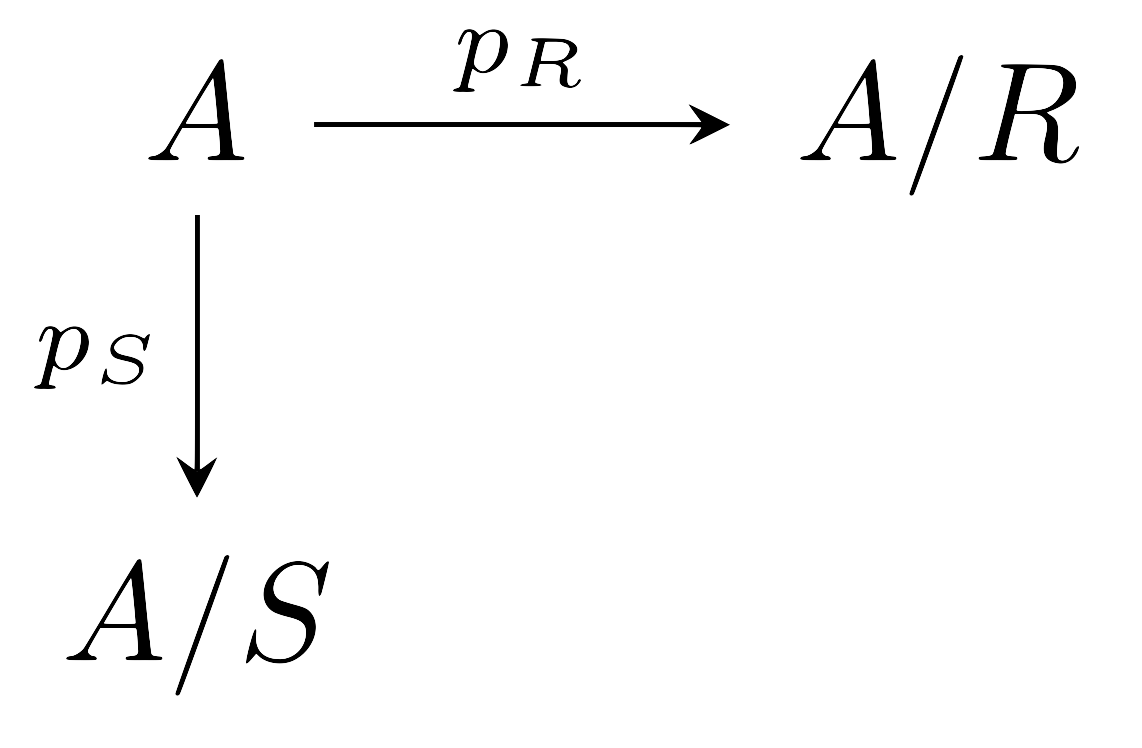
Then the function \(p_S\) is surjective, and \(p_S(x)=p_S(y)\implies p_R(x)=p_R(y)\) always holds. Therefore, there exists a unique \(h:A/S \rightarrow A/R\) such that \(p_R=h\circ p_S\). (§Retraction and Section, ⁋Proposition 4) In this case, \(h\) is called the quotient of \(R\) by \(S\) defined on \(A/S\), and is written as \(R/S\). The canonical decomposition gives:
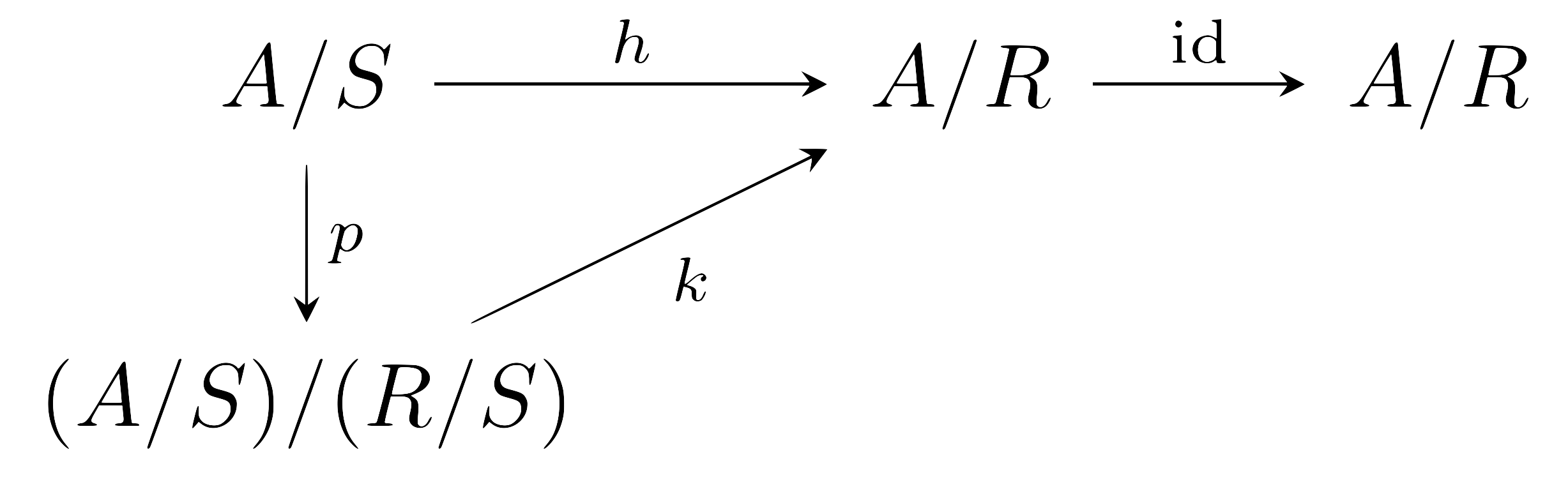
In particular, \(k\) is a bijection.
Product of Equivalence Relations
Finally, let two equivalence relations \((R,A,A)\) and \((R',A',A')\) be given, and define the relation \((S, A\times A', A\times A')\) by
\(u\sim_{\tiny S}v\) if there exist \(x\), \(x'\), \(y\), \(y'\) such that \(u=(x,x')\), \(v=(y,y')\), and \(x\sim_{\tiny R}y\), \(x'\sim_{\tiny R'}y'\)
Let \(u=(x,x'),v=(y,y'),w=(z,z')\) be elements of \(A\times A'\). Then:
- \(u\sim_{\tiny S}u\) always holds. This is because \(x\sim_{\tiny R}x\) and \(x'\sim_{\tiny R'}x'\).
- If \(u\sim_{\tiny S}v\), then \(x\sim_{\tiny R}y\) and \(x'\sim_{\tiny R'}y'\), so \(y\sim_{\tiny R}x\) and \(y'\sim_{\tiny R'}x'\), and therefore \(v\sim_{\tiny S}u\).
- Suppose \(u\sim_{\tiny S}v\) and \(v\sim_{\tiny S}w\). Then \(x\sim_{\tiny R}y, x'\sim_{\tiny R'}y', y\sim_{\tiny R}z, y'\sim_{\tiny R'}z'\) each hold. From \(x\sim_{\tiny R}y\) and \(y\sim_{\tiny R}z\), we have \(x\sim_{\tiny R}z\), and from \(x'\sim_{\tiny R'}y'\) and \(y'\sim_{\tiny R'}z'\), we have \(x'\sim_{\tiny R'}z'\). That is, \(u\sim_{\tiny S}w\) holds.
Therefore, \(S\) is an equivalence relation. This equivalence relation is called the product of \(R\) and \(R'\), and is written as \(R\times R'\).
Let two functions \(f:A\rightarrow B\) and \(f':A'\rightarrow B'\) be given, and let \(R\) and \(R'\) be the equivalence relations induced by \(f\) and \(f'\), respectively. Then \(f\times f':A\times A'\rightarrow B\times B'\) is well-defined, and through this function, we can define an equivalence relation on \(A\times A'\). Calling this equivalence relation \(S\) temporarily, for any \(u=(x,x'),v=(y,y')\in A\times A'\),
\[\begin{aligned}u\sim_{\tiny S}v&\iff (f\times f')(u)=(f\times f')(v)\iff (f(x),f'(x')=(f(y),f'(y'))\\ &\iff (f(x)=f(y))\wedge(f'(x')=f'(y'))\iff (x\sim_{\tiny R}y)\wedge(x'\sim_{\tiny R'}y')\\&\iff u\sim_{\tiny R\times R'}v\end{aligned}\]so \(S=R\times R'\). At this point, since the image of \(A\times A'\) under \(f\times f'\) equals \(f(A)\times f'(A')\), considering the canonical decomposition of \(f\times f'\), there exists a bijection between \((A\times A')/(R\times R')\) and \(f(A)\times f'(A')\).
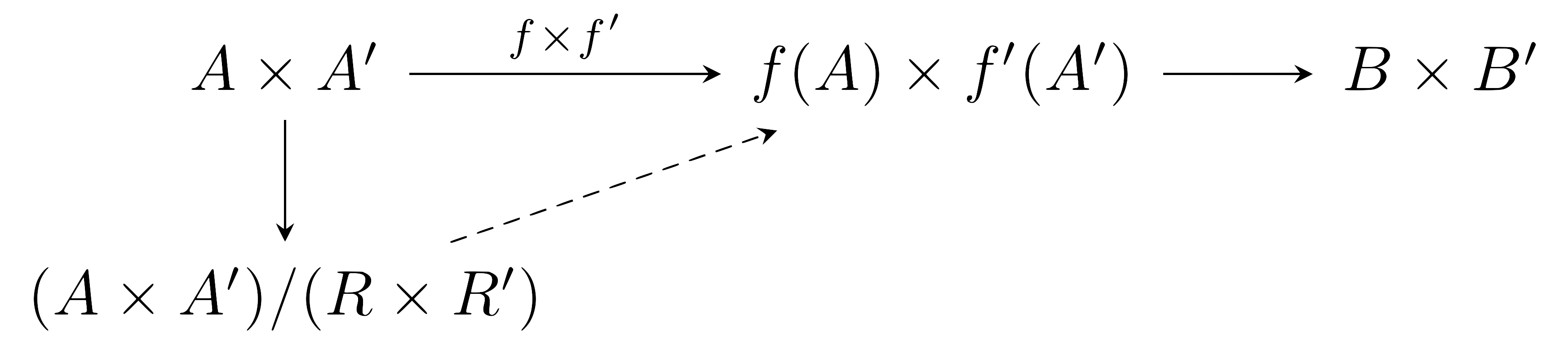
On the other hand, consider the following diagram:
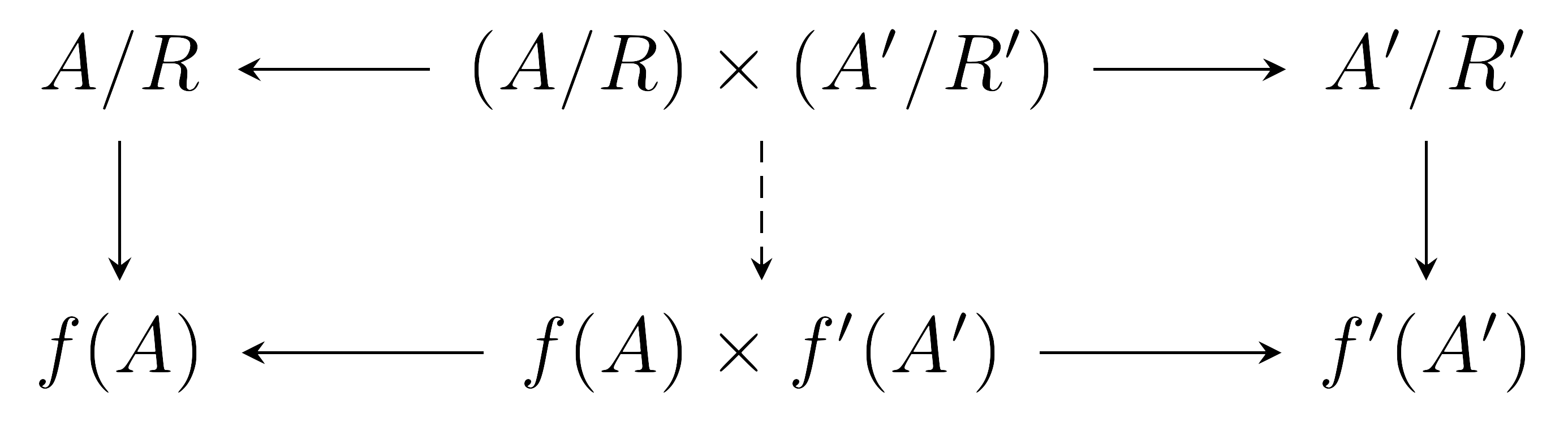
Here \(A/R\rightarrow f(A)\) and \(A'/R'\rightarrow f'(A')\) are the bijections obtained from the canonical decompositions of \(f\) and \(f'\), respectively. Therefore, the function \((A/R)\times (A/R')\rightarrow f(A)\times f'(A')\) induced by these is also a bijection.
By appropriately composing the two bijections obtained above and their inverses, we can obtain a bijection between \((A\times A')/(R\times R')\) and \((A/R)\times(A'/R')\). These bijections are also called canonical.
References
[Bou] N. Bourbaki, Theory of Sets. Elements of mathematics. Springer Berlin-Heidelberg, 2013.
댓글남기기