Partial Products and Associativity
To discuss whether the product of sets is associative, we must first define partial products.
Definition 1 Let a family \((A_i)_{i\in I}\) and its product \(\prod_{i\in I} A_i\) be given. For a subset \(J\subseteq I\) of the index set, \(\prod_{j\in J} A_j\) is called a partial product.
Let a partial product \(\prod_{j\in J}A_j\) of \(\prod_{i\in I}A_i\) be given. Then for any \(F\in\prod_{i\in I}A_i\),
\[f\circ\id_J=\biggl(F\circ\Delta_J, J, \bigcup_{j\in J} A_j\biggr)\]is a new function, and for each \(j\), it satisfies \((f\circ\id_J)(j)=f(j)\in A_j\). That is, \(F\circ\Delta_J\) is an element of \(\prod_{j\in J}A_j\).
By the above paragraph, \(F\mapsto F\circ\Delta_J\) defines a function from \(\prod_{i\in I}A_i\) to \(\prod_{j\in J}A_j\). This is denoted by \(\pr_J\), borrowing the notation for projection functions. Then for \(K\subseteq J\subseteq I\), the composition of the \(J\)-th projection function from \(\prod_{i\in I}A_i\) to the partial product \(\prod_{j\in J}A_j\), and the \(K\)-th projection function from \(\prod_{j\in J}A_j\) to its partial product \(\prod_{k\in K}A_k\)
\[\prod_{i\in I}A_i\longrightarrow \prod_{j\in J}A_j\longrightarrow \prod_{k\in K}A_k\]is simply the \(K\)-th projection function \(\pr_K\) from \(\prod_{i\in I}A_i\) to its partial product \(\prod_{k\in K}A_k\). This is because \(\Delta_K=\Delta_J\circ\Delta_K\).
Proposition 2 Consider a family \((A_i)_{i\in I}\) in which every component is non-empty, and let \(J\subseteq I\). If \(g:J\rightarrow\bigcup_{i\in I} A_i\) satisfies \(g(j)\in A_j\), then there exists an extension \(f:I\rightarrow\bigcup_{i\in I} A_i\) of \(g\) such that \(f(i)\in A_i\) holds.
Proof
Let \(g=(G,J,\bigcup A_i)\). For each \(i\in I\setminus J\), since \(A_i\) is non-empty, we can select one element \(x_i\in A_i\). Now define
\[F=G\cup\biggl(\bigcup_{i\in I\setminus J}\{(i, x_i)\}\biggr)\]and let \(f=(F,I,\bigcup A_i)\). This gives the desired result.
Proposition 3 Let a family \((A_i)_{i\in I}\) with a non-empty index set \(I\) (i.e., \(I\neq\emptyset\)) be given. If \((J_k)_{k\in K}\) is a partition of \(I\), then the function \(f\mapsto (\pr_{J_k}(f))_{k\in K}\) from \(\prod_{i\in I}A_i\) to \(\prod_{k\in K}\left(\prod_{j\in J_k}A_j\right)\) is also a bijection.
Proof 1
Since \((J_k)_{k\in K}\) is a partition, the functions \(f_k:J_k\rightarrow \bigcup_{i\in I} A_i\) form a family of functions with pairwise disjoint domains, and thus by §Sum of Sets, ⁋Proposition 2, we obtain a bijection.
The proof above is concise, but the following proof using the universal property is also elegant.
Proof 2
For notational cleanliness, we uniformly denote:
-
The \(k\)-th projection function of the product \(\prod_{k\in K}\left(\prod_{j\in J_k}A_j\right)\) with respect to index set \(K\)
\[\prod_{k\in K}\left(\prod_{j\in J_k}A_j\right)\rightarrow\prod_{j\in J_k}A_j\]by \(\pr_k\),
-
The \(j\)-th projection function of the product \(\prod_{j\in J_k}A_j\) with respect to index set \(J_k\)
\[\prod_{j\in J_k}A_j\rightarrow A_j\]also by \(\pr_j\),
-
The \(i\)-th projection function of the product \(\prod_{i\in I}A_i\) with respect to index set \(I\)
\[\prod_{i\in I}A_i\rightarrow A_i\]also by \(\pr_i\)
While this may cause some confusion when reading the text, in diagrams the source and target are both specified, so there is no ambiguity.
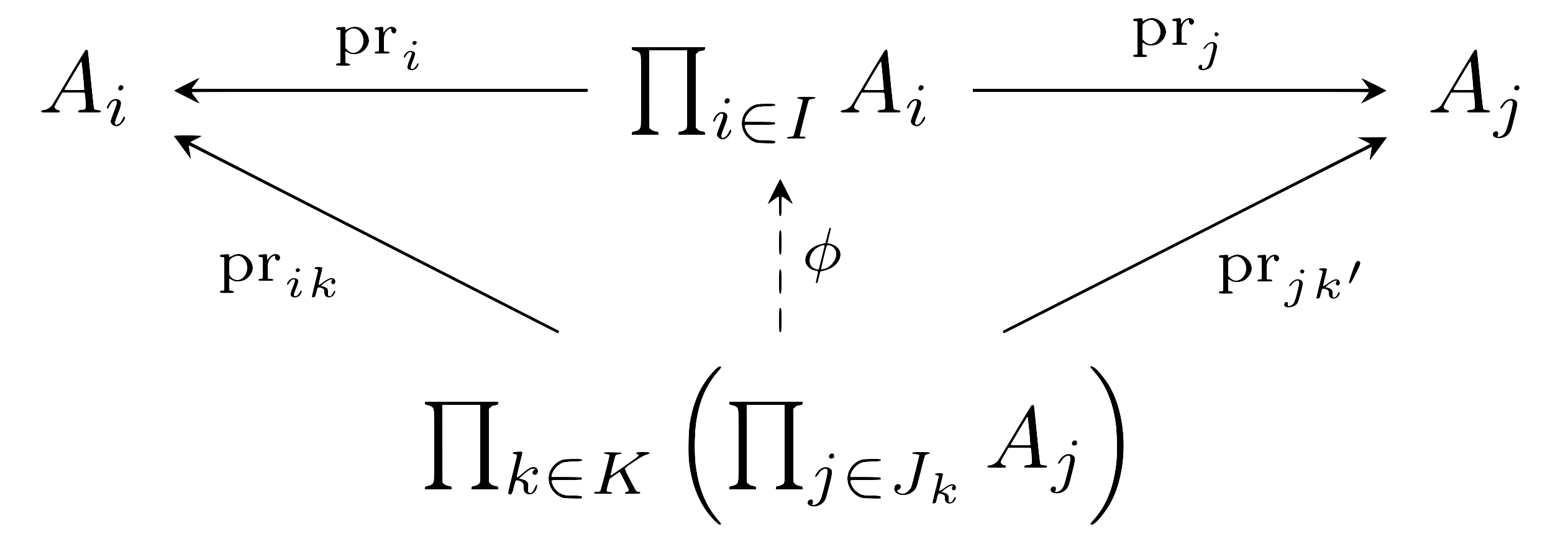
Since \((J_k)_{k\in K}\) is a partition of \(I\), for each \(i\in I\) there exists a unique \(k\in K\) such that \(i\in J_k\). Now define the function \(\pr_{ik}\) as the composition
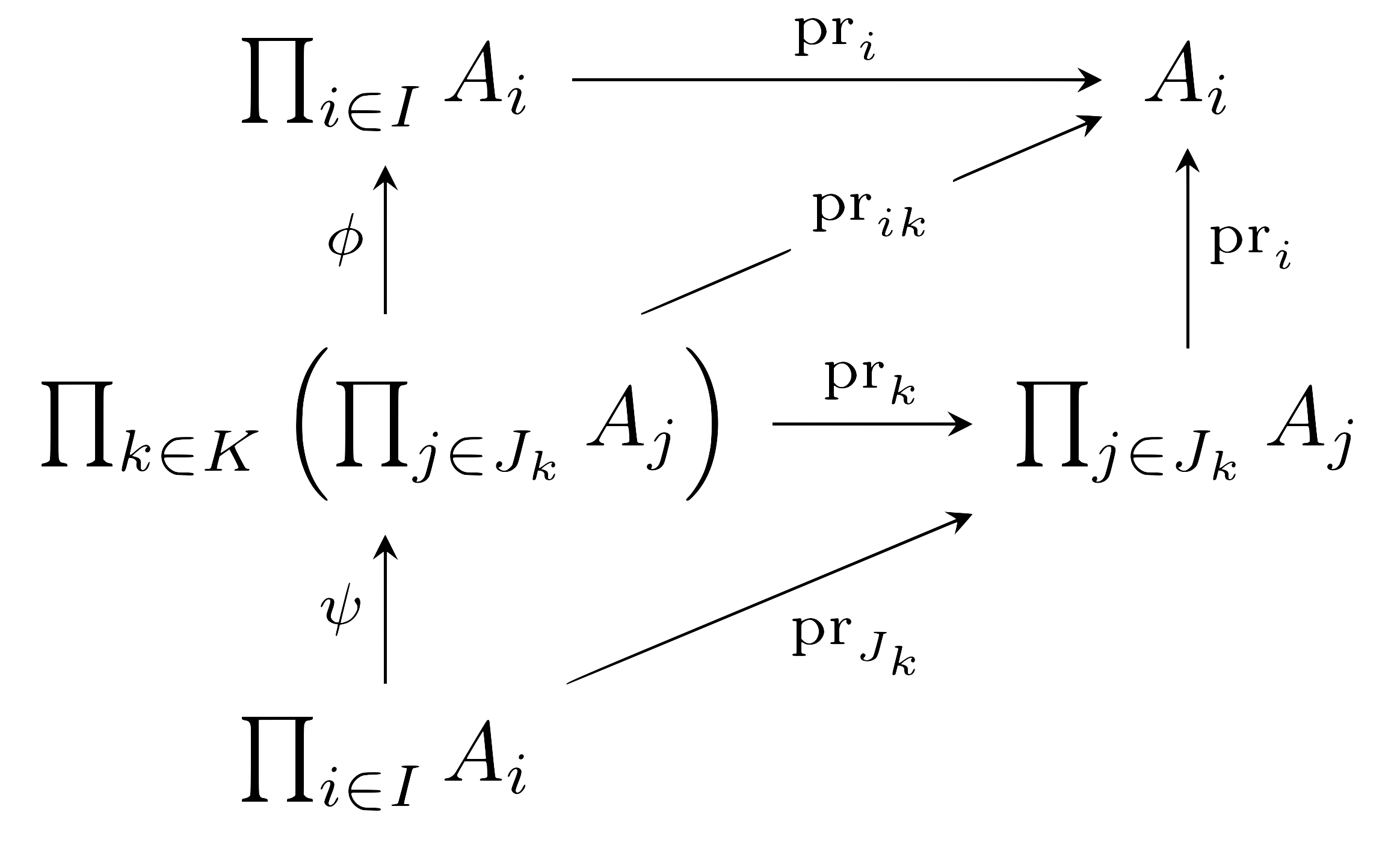
\[\pr_{ik}:\prod_{k\in K}\left(\prod_{j\in J_k}A_j\right)\overset{\pr_k}{\longrightarrow}\prod_{j\in J_k}A_j\overset{\pr_i}{\longrightarrow}A_i\]Then by the universal property of the product \(\prod_{i\in I}A_i\), we know there exists a \(\phi:\prod_{k\in K}\left(\prod_{j\in J_k}A_j\right)\rightarrow\prod_{i\in I}A_i\) making the following diagram commute:
Similarly, by the universal property of the product \(\prod_{k\in K}\left(\prod_{j\in J_k}A_j\right)\) with respect to index set \(K\), we know there exists a \(\psi:\prod_{i\in I}A_i\rightarrow\prod_{k\in K}\left(\prod_{j\in J_k}A_j\right)\) making the following diagram commute:
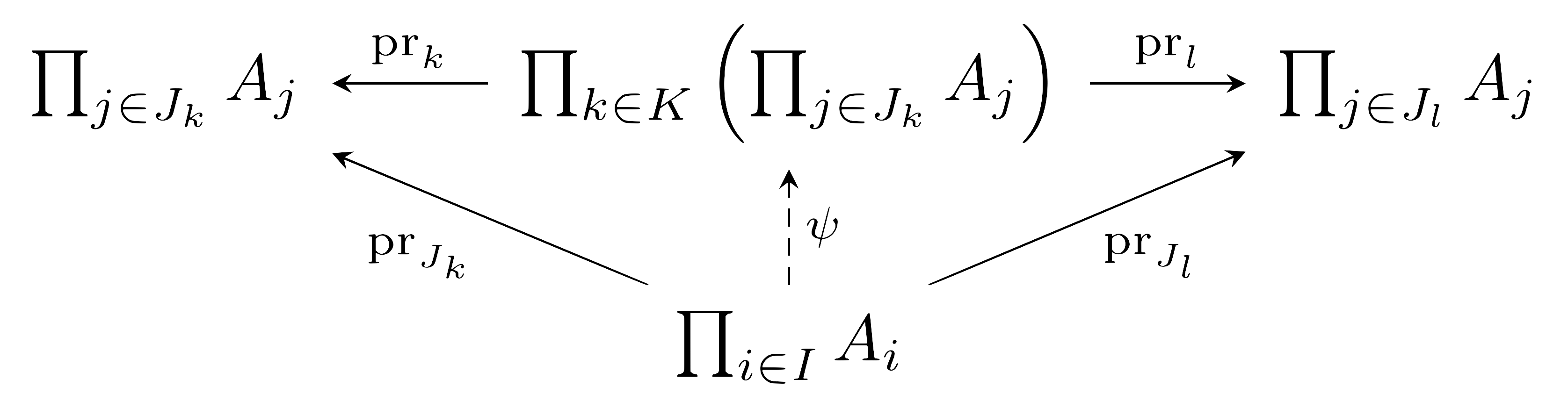
Then \(\phi\circ\psi\) and \(\psi\circ\phi\) are each identity functions, and thus they give the desired bijection.
For example, let us show that \(\phi\circ\psi\) is the identity function from \(\prod_{i\in I}A_i\) to itself. To do this, it suffices to show that for all \(i\in I\), the following diagram commutes:
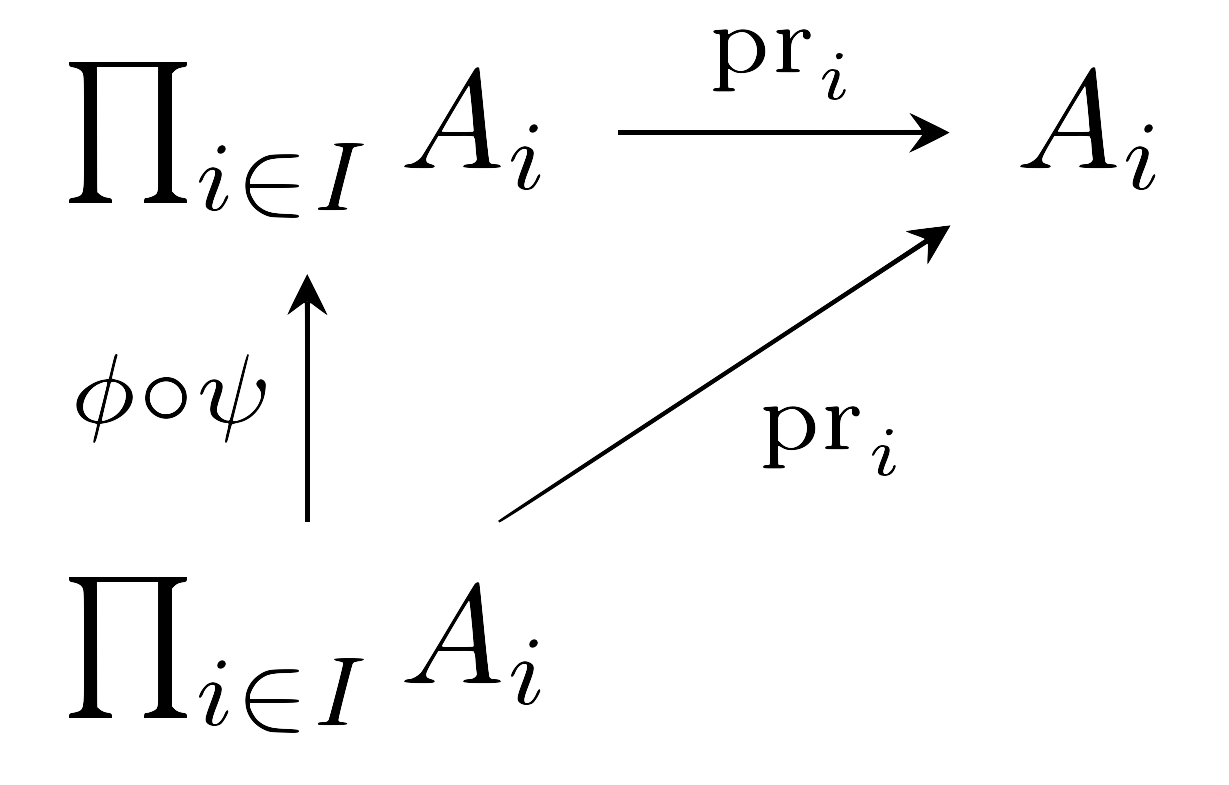
The universal property of the product implies that there exists a unique function \(\prod_{i\in I}A_i\rightarrow \prod_{i\in I}A_i\) making the diagram above commute. Naturally, the identity function from \(\prod_{i\in I}A_i\) to itself also makes the diagram above commute, so by uniqueness this function must equal \(\phi\circ\psi\).
Now from
\[{\pr_i}\circ(\phi\circ\psi)=({\pr_i}\circ\phi)\circ\psi={\pr_{ik}}\circ\psi={\pr_i}\circ({\pr_k}\circ\psi)={\pr_j}\circ{\pr_{J_k}}=\pr_j\]we obtain the desired conclusion. (The last equality views \(\pr_j\) as a projection function to \(\{j\}\subseteq I\).) This equation may look complicated, but it is merely writing out in formula form that the following diagram commutes:
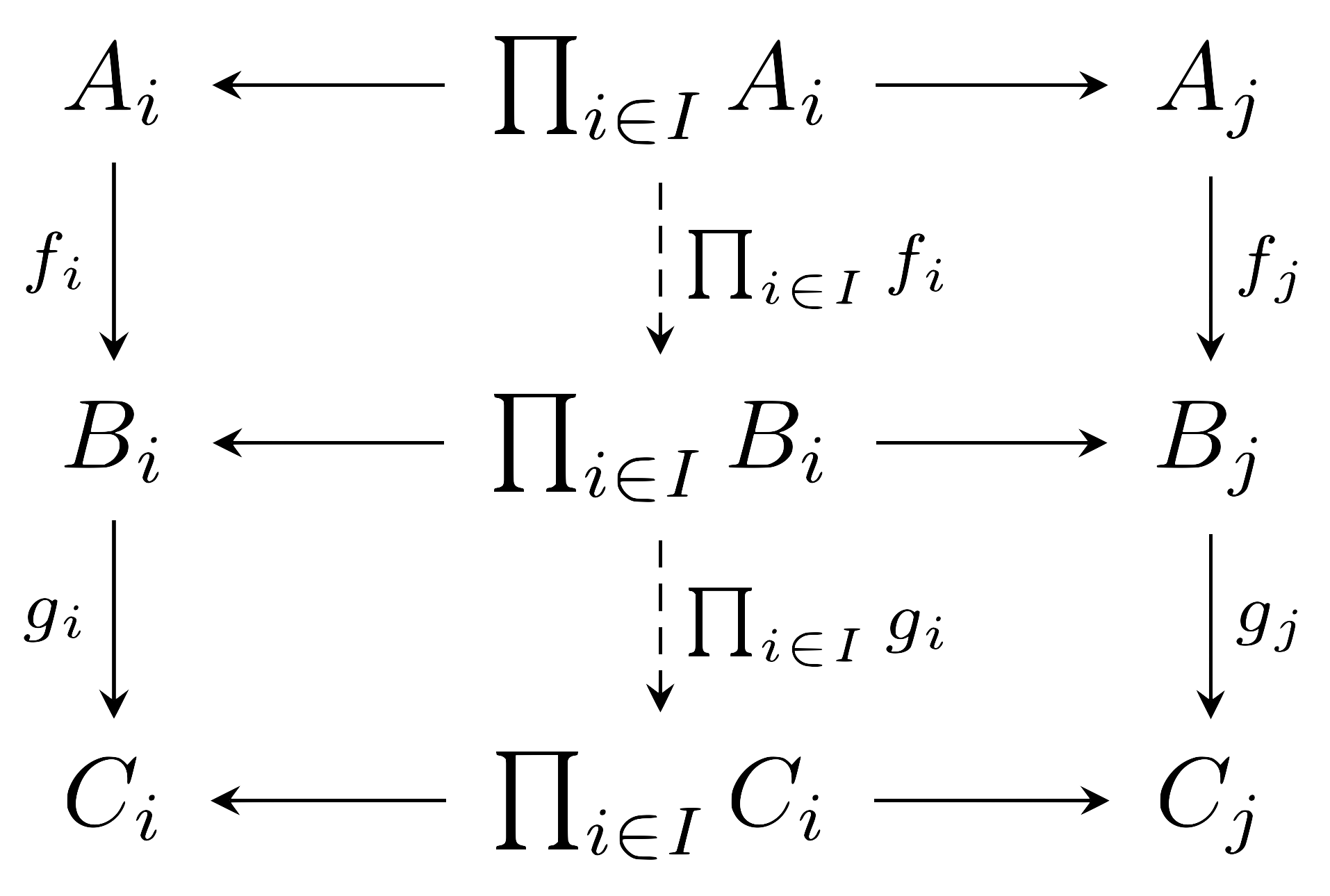
Let \((A_i)_{i\in I}\) and \((B_i)_{i\in I}\) be families with the same index, and let a family of functions \((g_i:A_i\rightarrow B_i)_{i\in I}\) be given. If we define \(u_f:I\rightarrow\bigcup_{i\in I}B_i\) by \(i\mapsto g_i(f(i))\), then \(u_f(i)\in B_i\), so \(u_f\in\prod_{i\in I}B_i\).
Definition 4 The function \(f\mapsto u_f\) defined above is called the product of \((g_i)\) and is denoted by \(\prod_{i\in I}g_i\).
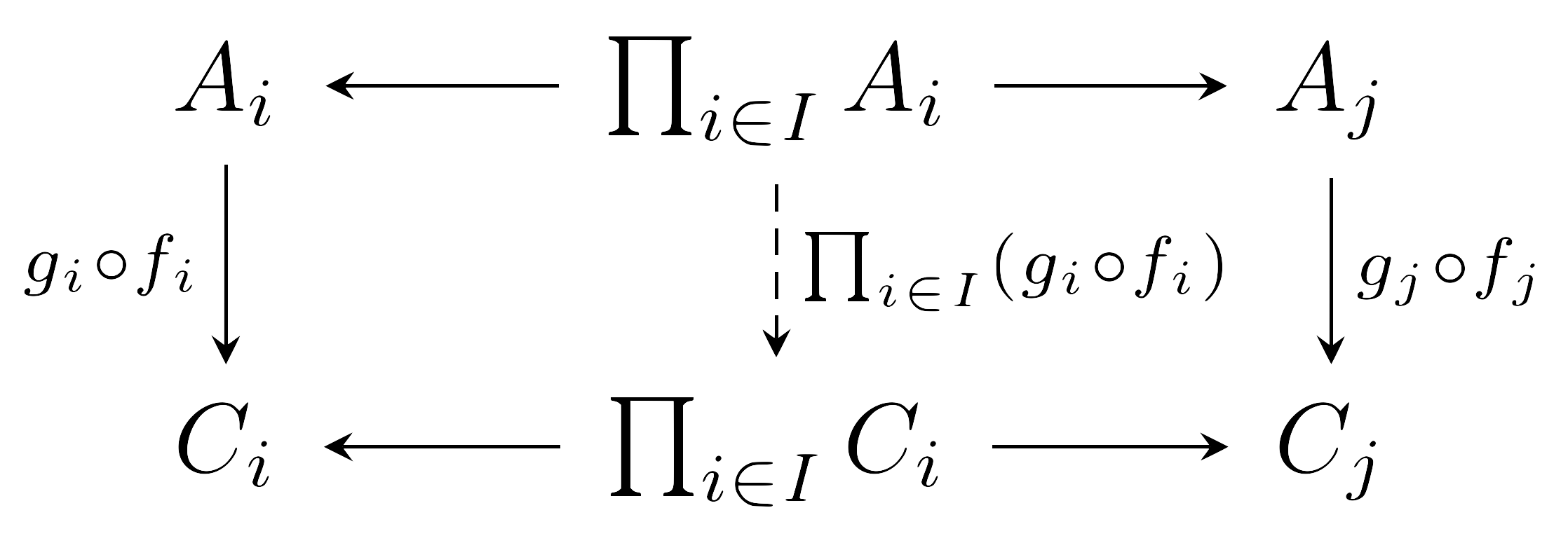
Proposition 5 Let \((A_i)_{i\in I}\), \((B_i)_{i\in I}\), and \((C_i)_{i\in I}\) be three families, and let \((f_i)_{i\in I}\) and \((g_i)_{i\in I}\) be families of functions from \(A_i\) to \(B_i\) and from \(B_i\) to \(C_i\), respectively. Then
\[\prod_{i\in I} (g_i\circ f_i)=\left(\prod_{i\in I} g_i\right)\circ\left(\prod_{i\in I}f_i\right)\]holds.
Proof
There is nothing particularly special to explain beyond the following two commutative diagrams:
and
Since it is obvious that the product of \(\id_{A_i}\) is \(\id_{\prod A_i}\), the above proposition makes it clear that the product of injective functions is an injective function, and the product of surjective functions is a surjective function.
Distributivity Between Operations
When two or more operations are defined, whether distributivity holds between them becomes an important concern.
Proposition 6 Let \(((A_{k,i})_{i\in J_k})_{k\in K}\) be a family of families of sets. Additionally, suppose \(K\neq\emptyset\) and \(J_k\neq\emptyset\) for all \(k\in K\). Then for \(I=\prod_{k\in K} J_k\neq\emptyset\),
\[\bigcup_{k\in K}\left(\bigcap_{i\in J_k}A_{k,i}\right)=\bigcap_{f\in I}\left(\bigcup_{k\in K}A_{k,f(k)}\right),\quad\bigcap_{k\in K}\left(\bigcup_{i\in J}A_{k,i}\right)=\bigcup_{f\in I}\left(\bigcap_{k\in K}A_{k,f(k)}\right)\]hold.
Proof
First, let \(x\in \bigcup_{k\in K}\left(\bigcap_{i\in J_k}A_{k,i}\right)\). We need to show that \(x\in \bigcap_{f\in I}\left(\bigcup_{k\in K}A_{k,f(k)}\right)\), i.e., that for all \(f\in I\), we have \(x\in \bigcup_{k\in K}A_{k,f(k)}\). Since \(x\in \bigcap_{i\in J_k}A_{k,i}\) for some \(k\in K\), we have \(x\in A_{k,f(k)}\). Therefore \(x\in \bigcup_{k\in K}A_{k,f(k)}\) holds for all \(f\), and the inclusion relation is established.
To show the inclusion in the opposite direction, we use the contrapositive. Suppose \(x\not\in \bigcup_{k\in K}\left(\bigcap_{i\in J_k}A_{k,i}\right)\). Then for all \(k\in K\), we have \(x\not\in \bigcap_{i\in J_k}A_{k,i}\). Thus there exists some \(i\) such that for all \(k\), \(x\not\in A_{k,i}\). Now taking \(f\in I\) such that \(f(k)\) is such an \(i\), we have \(x\not\in\bigcup_{k\in K}A_{k,f(k)}\), so \(x\) does not belong to the right-hand side. The second equation can be shown similarly.
Distributivity also holds between product and union, and between product and intersection, as follows, and the proof is almost identical to the above, so it is omitted.
Proposition 7 Let \(((A_{k,i})_{i\in J_k})_{k\in K}\) be a family of families of sets, and define \(I\) as in the previous proposition. Then
\[\prod_{k\in K}\left(\bigcup_{i\in J_k}A_{k,i}\right)=\bigcup_{f\in I}\left(\prod_{k\in K}A_{k,f(k)}\right),\quad\prod_{k\in K}\left(\bigcap_{i\in J}A_{k,i}\right)=\bigcap_{f\in I}\left(\prod_{k\in K}A_{k,f(k)}\right)\]hold.
References
[Bou] N. Bourbaki, Theory of Sets. Elements of mathematics. Springer Berlin-Heidelberg, 2013.
댓글남기기