
This post was translated from Korean by LLM (Kimi). The translation may contain errors or awkward sentences. The Korean original is the source of truth.
Product of Sets
The most natural generalization of an ordered pair is a function. For instance, an \(n\)-tuple may be regarded as a function with domain \(I=\{1,2,\cdots, n\}\) that returns the \(i\)-th component when given \(i\) as input.
Consider sets \(A_1\) and \(A_2\). The product \(A_1\times A_2\) is the collection of ordered pairs \((x_1,x_2)\). Viewing ordered pairs as functions as above, \(A_1\times A_2\) is the collection of functions with domain \(\{1,2\}\), where each function \(f\) satisfies \(f(1)=x_1\in A_1\) and \(f(2)=x_2\in A_2\).
It is then natural to define the product of a general family as follows.
Definition 1 Let \((A_i)_{i\in I}\) be a family of sets. The product of this family is the collection \(P\) of all functions from \(I\) to \(\bigcup A_i\) satisfying \(x_i=f(i)\in A_i\).
As with the notation for families of sets, elements of \(P\) are written as \((x_i)_{i\in I}\); each \(x_i\) is called the \(i\)-th component. The function sending \(F\in P\) to \(F(i)\) is called the \(i\)-th projection and is denoted by \(\pr_i\).
Thus to consider the product of sets is to consider a set of functions.
Let sets \(A\) and \(B\) be given. A function from \(A\) to \(B\) is an element of \(\mathcal{P}(A\times B)\), so the collection of all such functions is a subset of \(\mathcal{P}(A\times B)\). We denote this set by \(B^A\). Let \(\Fun(A,B)\) denote the set of all functions from \(A\) to \(B\). For any \(F\in B^A\), the triple \(f=(F,A,B)\) is a function from \(A\) to \(B\), and the assignment \(F\mapsto f\) is a function from \(B^A\) to \(\Fun(A,B)\).
Conversely, for any function \(f=(F,A,B)\), the correspondence sending \(f\) to the element \(F\in B^A\) is not only a function but also the inverse of the correspondence defined above. Hence there exists a natural bijection between \(B^A\) and \(\Fun(A,B)\), and these two sets may be identified.
Let functions \(u:A'\rightarrow A\) and \(v:B\rightarrow B'\) be given, and consider the following diagram.
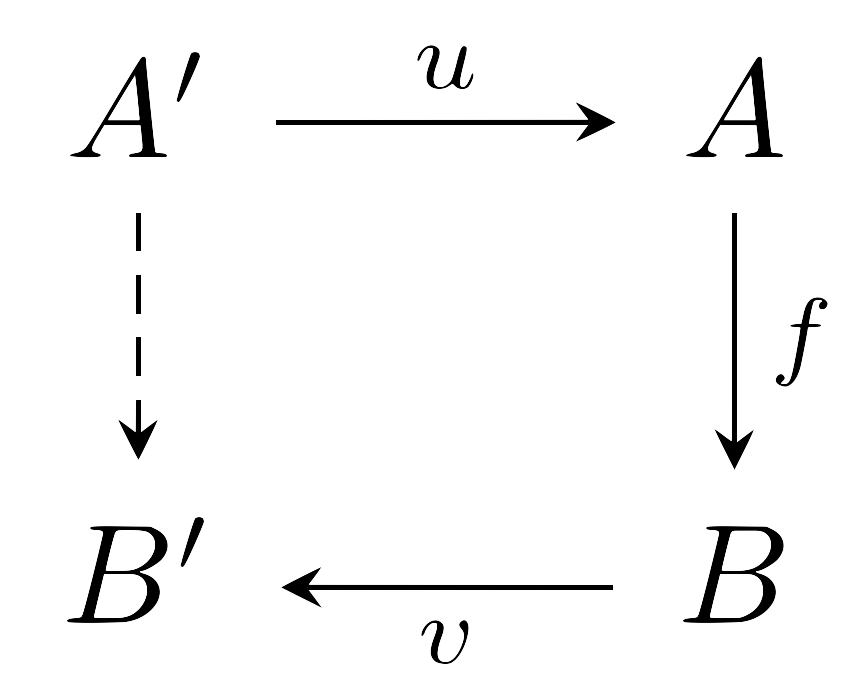
In this diagram, whenever a function \(f:A\rightarrow B\) is given, we can associate to it the function \(\tilde{f}=v\circ f\circ u\) from \(A'\) to \(B'\). The assignment \(f\mapsto \tilde{f}\) is a function from \(\Fun(A, B)\) to \(\Fun(A', B')\).
Proposition 2 In the diagram above, if \(u\) is surjective and \(v\) is injective, then \(f\mapsto \tilde{f}\) is injective. If \(u\) is injective and \(v\) is surjective, then \(f\mapsto \tilde{f}\) is surjective.
Proof
First suppose \(u\) and \(v\) are surjective and injective respectively. To show that \(f\mapsto\tilde{f}\) is injective, we must prove that \(\tilde{f}=\tilde{g}\) implies \(f=g\). Let \(s\) and \(r\) be a section and retraction corresponding to \(u\) and \(v\) respectively. If \(\tilde{f}=\tilde{g}\), then
\[\begin{aligned} f&=\id_B\circ f\circ\id_A=(r\circ v)\circ f\circ(u\circ s)=r\circ(v\circ f\circ u)\circ s\\ &=r\circ\tilde{f}\circ s=r\circ\tilde{g}\circ s\\ &=r\circ(v\circ g\circ u)\circ s=(r\circ v)\circ g\circ (u\circ s)=\id_B\circ g\circ\id_A=g \end{aligned}\]so \(f=g\). Hence the given function is injective.
Similarly, suppose \(u\) and \(v\) are injective and surjective respectively. We must show that for any \(f'\in\Fun(A',B')\), there exists \(f\in\Fun(A,B)\) with \(\tilde{f}=f'\). Let \(r'\) and \(s'\) be a retraction and section for \(u\) and \(v\) respectively. Then
\[f'=\id_{B'}\circ f'\circ\id_{A'}=(v\circ s')\circ f'\circ(r'\circ u)=v\circ(s'\circ f'\circ r')\circ u\]so \(f=s'\circ f'\circ r'\) is an element of \(\Fun(A,B)\) satisfying \(f'=\tilde{f}\). Hence the given function is surjective.
In particular, if both \(u\) and \(v\) are bijections, then \(f\mapsto \tilde{f}\) is also a bijection.
Earlier we saw that the sum of sets satisfies a universal property. Similarly, the product satisfies an analogous universal property.
Theorem 3 Let \(P\) be the product of a family of sets \((A_i)\), with projection functions \(\pr_i:P\rightarrow A_i\). Given another set \(B\) and functions \(f_i:B\rightarrow A_i\), there exists a unique function \(f:B\rightarrow P\) satisfying \(f_i=\pr_i\circ f\).
Proof
Suppose functions \(f\) and \(f'\) are given, both satisfying the condition \(f_i=\pr_i\circ f\). We must show that \(f(y)=f'(y)\) for every \(y\in B\). Since \(f(y)\) and \(f'(y)\) are elements of \(A\) and hence functions (ordered pairs), they are determined by the values they assign to each \(i\) (the \(i\)-th coordinates). Thus it suffices to show that \(\pr_i(f(y))=\pr_i(f'(y))\) for any given \(y\in B\) and \(i\in I\). But
\[\pr_i(f(y))=f_i(y)=\pr_i(f'(y))\]so any such function \(f\) must be unique.
For existence, taking a cue from the uniqueness proof above, we define the value \(f(y)\) to be the function (or ordered pair whose \(i\)-th coordinate is \(f_i(y)\)) satisfying
\[(f(y))(i)=f_i(y)\]
and then verify that the correspondence \(y\mapsto f(y)\) is indeed a function.
Since at least one \((P, \pr_i)\) satisfying the conditions of Theorem 3 exists (Definition 1), we may take this as the definition of the product set. That is, the product of \((A_i)_{i\in I}\) can be characterized as a set \(\prod_{i\in I} A_i\) together with functions \(\pr_i:\prod_{i\in I}A_i\rightarrow A_i\) satisfying the following universal property.
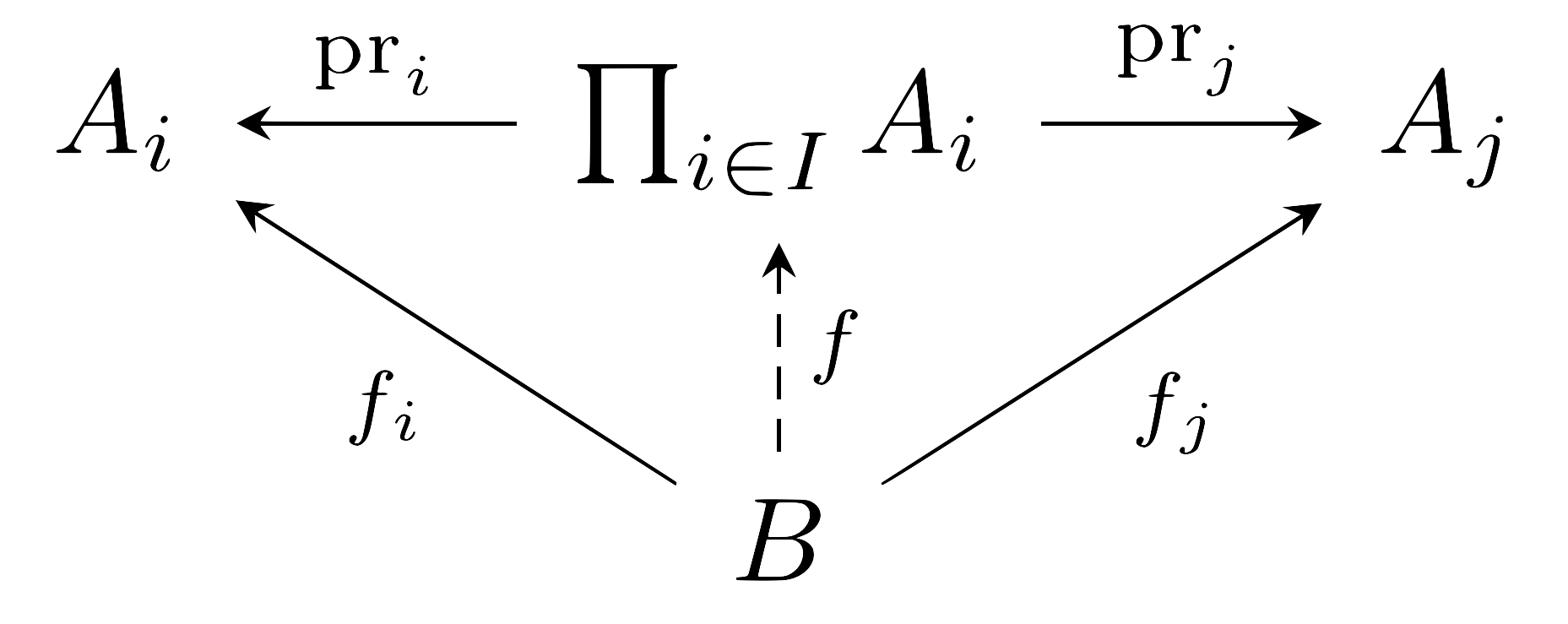
By the same reasoning as in §Sum of Sets, ⁋Corollary 9, one can verify that the object and projections \(\pr_i\) satisfying this universal property are unique up to bijection.
Proposition 4 Let \(A\), \(B\), \(C\) be sets and let \(f:B\times C\rightarrow A\). If \(\tilde{f}\) is the function from \(C\) to \(\Fun(B,A)\) defined by \(y\mapsto f(-,y)\), then \(f\mapsto\tilde{f}\) is a bijection. That is, there exists a bijection between \(\Fun(B\times C,A)\) and \(\Fun(C, \Fun(B, A))\).
Proof
Since \(\tilde{f}\) is a function from \(C\) to \(\Fun(B,A)\), we have \(\tilde{f}\in\Fun(C,\Fun(B,A))\). Thus the given correspondence is a function from \(\Fun(B\times C, A)\) to \(\Fun(C, \Fun(B,A))\). To show that this function is bijective, we construct its inverse.
Let \(g\in\Fun(C, \Fun(B,A))\) be given. For any \(y\in C\), \(g(y)\) is an element of \(\Fun(B, A)\). Define \(\bar{g}:B\times C\rightarrow A\) to be the function sending \((x, y)\) to \(g(y)(x)\). Then for any \(g\in \Fun(C,\Fun(B,A))\), we have a function
\[\begin{aligned} -:\Fun(C, \Fun(B,A))&\rightarrow\Fun(B\times C,A)\\ g\phantom{function}&\mapsto\phantom{function}\bar{g} \end{aligned}\]We must show that this function \(-\) is the inverse of the original function
\[\begin{aligned} \sim\;:\Fun(B\times C,A)&\rightarrow\Fun(C, \Fun(B,A))\\ f\phantom{function}&\mapsto\phantom{function}\tilde{f} \end{aligned}\]For any \(f:B\times C\rightarrow A\), we have \(\tilde{f}\in \Fun(C, \Fun(B, A))\). Applying \(-\) to this function to return to \(\Fun(B\times C,A)\), the result \(\bar{\tilde{f}}\) is the function sending \((x, y)\) to \(\tilde{f}(y)(x)\). Since \(\tilde{f}(y)\) is the function \(f(-, y)\), we have \(\bar{\tilde{f}}=f\).
On the other hand, for any \(g\in\Fun(C, \Fun(B, A))\), applying first \(\bar{g}\) and then \(\tilde{\bar{g}}\), we see that \(\tilde{\bar{g}}\) is the function defined by \(y\mapsto \bar{g}(-,y)\). By the definition of \(\bar{g}\), this is the function sending \(y\) to \(g(y)(-)\). That is, \(\tilde{\bar{g}}=g\). From \(\bar{\tilde{f}}=f\) and \(\tilde{\bar{g}}=g\), we conclude that these are inverse functions of each other. We have thus shown that
\[\begin{aligned} f\overset{\sim}{\longrightarrow}&\tilde{f}\overset{-}{\longrightarrow}\bar{\tilde{f}}=f,\\ g\overset{-}{\longrightarrow}&\bar{g}\overset{\sim}{\longrightarrow}\tilde{\bar{g}}=g \end{aligned}\]Therefore \(\sim\;:f\mapsto\tilde{f}\) is a bijection.
Immediately after defining the union, we observed that replacing the index set via a surjection has no effect. For products of sets, replacing the index set via a bijection likewise has no effect.
Proposition 5 Let \((A_i)_{i\in I}\) be a family of sets and let \(u:K\rightarrow I\) be a bijection. For any \(f:I\rightarrow \prod_{i\in I}A_i\), the function \(f\mapsto f\circ u\) sending \(f\) to \(f\circ u: K\rightarrow \prod_{i\in I} A_i\) is a bijection.
Proof
Consider the diagram
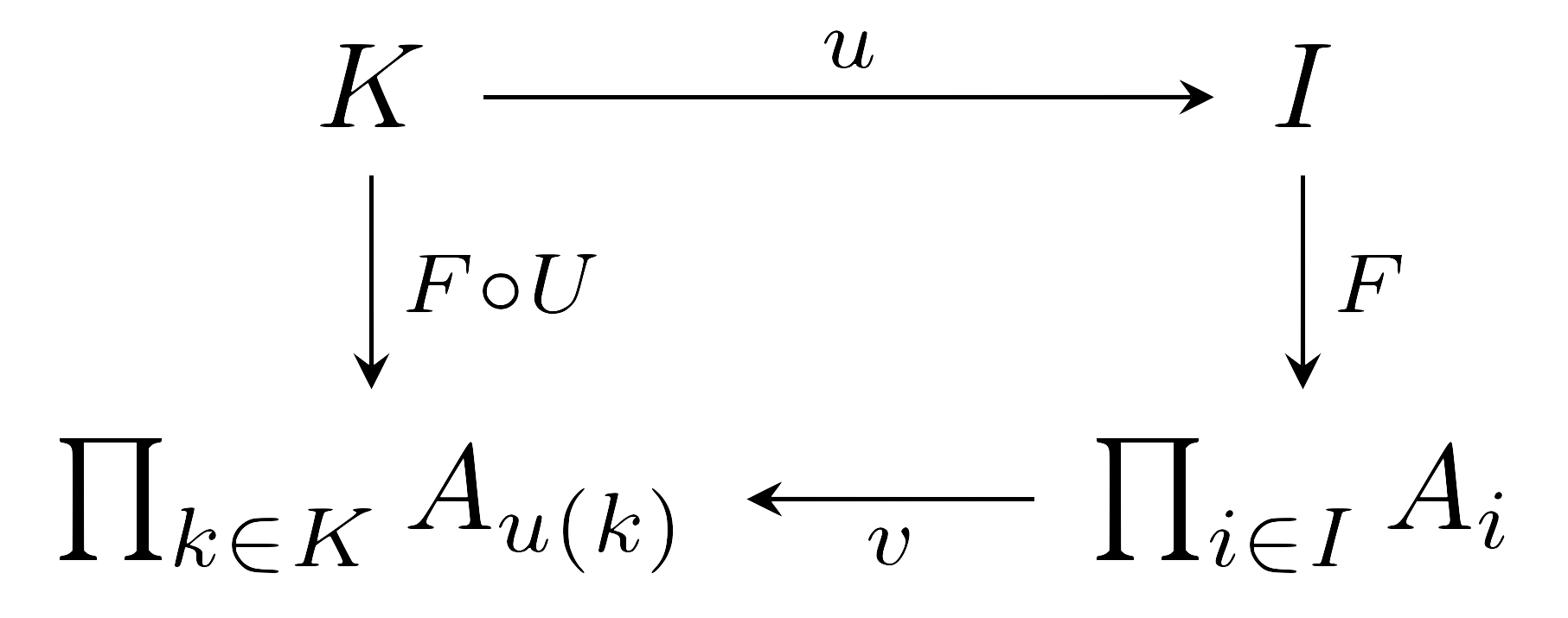
Here \(v\) is the bijection sending \((x_i)_{i\in I}\) to \((x_{u(k)})_{k\in K}\). By Proposition 2 above, \(F\mapsto F\circ U\) is a bijection.
References
[HJJ] K. Hrbacek, T.J. Jeck, and T. Jech. Introduction to Set Theory. Lecture Notes in Pure and Applied Mathematics. M. Dekker, 1978.
[Bou] N. Bourbaki, Theory of Sets. Elements of mathematics. Springer Berlin-Heidelberg, 2013.
댓글남기기