The material we are about to discuss would perhaps feel more natural in the context of category theory or algebraic geometry. However, since [Bou] covers this material in set theory, and since it makes sense to gather the tools we will use going forward, we will now explore inverse limits and direct limits.
Inverse Systems and Inverse Limits
Definition 1 Let \(I\) be a preordered set, and let a family \((A_i)_{i\in I}\) be given. Suppose that for each pair \((i,j)\) satisfying \(i\leq j\), a function \(f_{ij}:A_j\rightarrow A_i\) is defined, satisfying the following two conditions:
- If \(i\leq j\leq k\), then \(f_{ik}=f_{ij}\circ f_{jk}\),
- For each \(i\in I\), \(f_{ii}=\id_{A_i}\)
Then \(\bigl((A_i)_{i\in I}, (f_{ij})_{i\leq j}\bigr)\) is called an inverse system, or a projective system.
In [Bou], no condition beyond \(I\) being a preordered set is imposed in the definition above. However, when we consider directed systems, it is somewhat more natural to think of \(I\) as a right directed set, and indeed, most examples we encounter in practice are cases where \(I\) is a right directed set.
We have already introduced universal properties when defining sums and products of sets, and we have seen how powerful a tool they are. Inverse limits and direct limits are also defined via universal properties.
Definition 2 A set \(\varprojlim A_i\) together with a family \((f_i)_{i\in I}\) of functions \(f_i: \varprojlim A_i\rightarrow A_i\) is called the inverse limit or projective limit of \(\bigl((A_i)_{i\in I}, (f_{ij})_{i\leq j}\bigr)\) if for every \(i\leq j\),
\[f_i=f_{ij}\circ f_j\]holds, and additionally, the following universal property is satisfied:
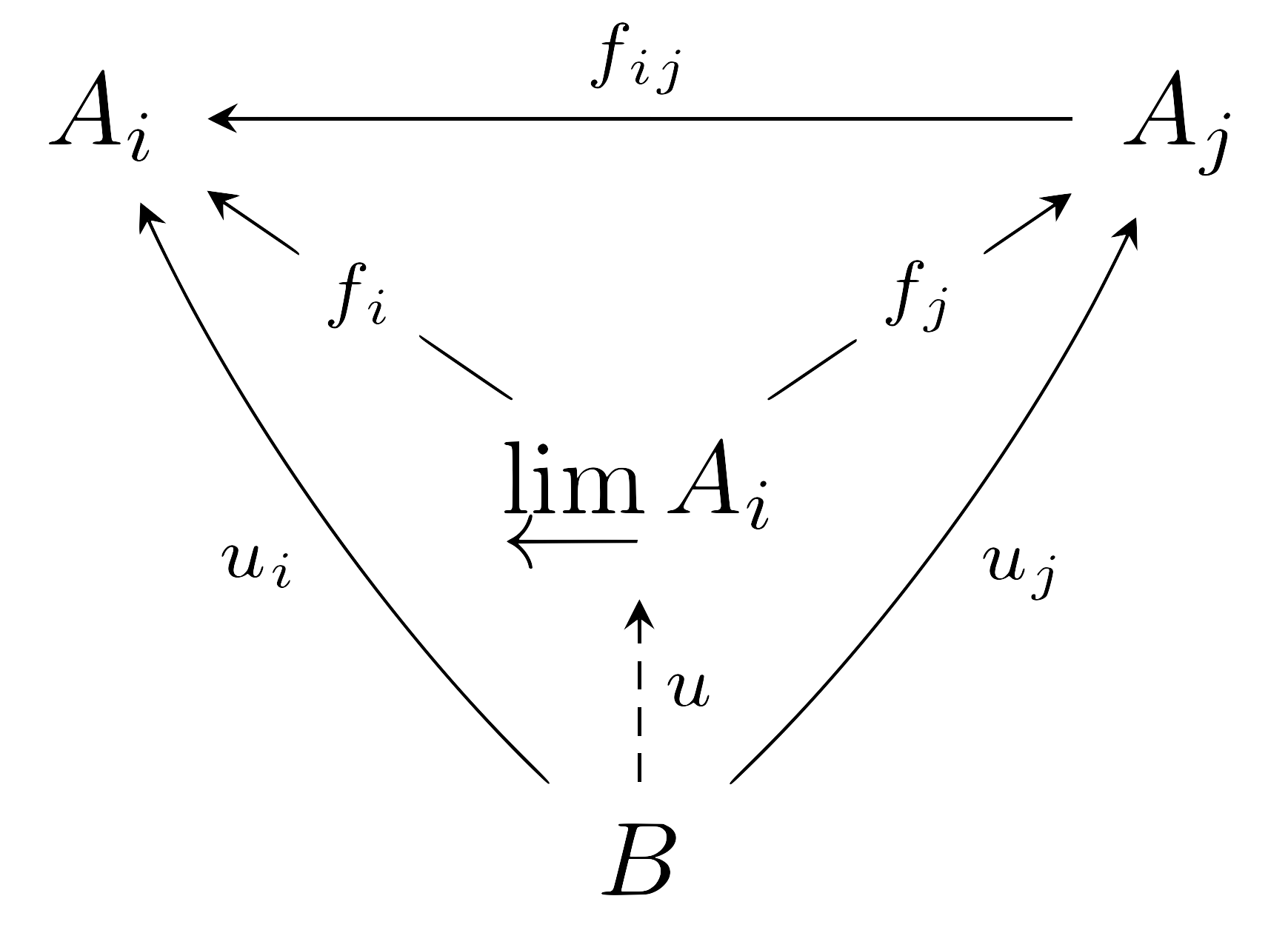
If some set \(B\) and a collection of functions \(u_i:B\rightarrow A_i\) are given such that for each \(i\leq j\), the equation
\[u_i=f_{ij}\circ u_j\]holds, then there exists a unique function \(u:B\rightarrow \varprojlim A_i\) such that for all \(i\in I\),
\[u_i=f_i\circ u\]is satisfied.
As we mentioned when introducing the universal properties of sums and products of sets, for this definition to make sense, we must directly show that at least one such \(\bigl(\varprojlim A_i, (f_i)_{i\in I}\bigr)\) exists.
To this end, let us first consider the set \(\prod_{i\in I} A_i\) and the projection functions \((\pr_i)_{i\in I}\). Then define the set \(A\) as the subset of all \(x\) satisfying the condition
\[\pr_i x=f_{ij}(\pr_j x)\]and define \(f_i\) as \(\pr_i\vert_{A}\). The resulting \(\bigl(A, (f_i)\bigr)\) satisfies the universal property above.
Example 3 For instance, if \(I\) is \(\mathbb{N}\) with the usual ordering \(\leq\), then the inverse system would look like
\[\cdots\overset{f_{3,4}}{\longrightarrow} A_3\overset{f_{2,3}}{\longrightarrow}A_2\overset{f_{1,2}}{\longrightarrow}A_1\overset{f_{0,1}}{\longrightarrow}A_0\]and the set \(A\) defined above is the collection of infinite tuples
\[(x_0, x_1,\ldots )\in A_0\times A_1\times\cdots=\prod_{i\in\mathbb{N}} A_i\]where these tuples satisfy \(f_{i, i+1}(x_{i+1})=x_i\), and the \(f_i\) are simply the projection functions restricted to \(A\).
Example 4 Let the ordering on an arbitrary index set \(I\) be given by equality. Then the only functions between them are of the form \(f_{ii}=\id_{A_i}\). Therefore, in the construction above,
\[\pr_i(x)=f_{ij}(\pr_j(x))\]holds vacuously for all \(i,j\), so \(A\) becomes the entire \(\prod A_i\). Thus in this case, \(\varprojlim A_i=\prod A_i\).
In many cases, inverse systems appear in the form shown in Example 3. Now, as promised, let us prove the following lemma that supports Definition 2.
Lemma 5 The \(\bigl(A, (f_i)\bigr)\) constructed above satisfies the universal property of the inverse limit.
Proof
First, if a function \(u:B\rightarrow A\) exists satisfying the condition
\[u_i=f_i\circ u\qquad\text{for all $i\in I$}\]then it is not difficult to show that such a \(u\) is unique. Suppose \(v:B\rightarrow A\) satisfies the same condition. Since \(u(y)\) and \(v(y)\) are both elements of \(\prod A_i\), they are determined by their images under the projection functions \(\pr_i\). Applying \(\pr_i\) to \(u(y)\), we obtain
\[\pr_i(u(y))=f_i(u(y))=u_i(y)=f_i(v(y))=\pr_i(v(y))\]and therefore \(u(y)=v(y)\).
From the uniqueness proof, we see that \(u\) must be defined by the formula
\[u(y)=\big(u_i(y)\big)_{i\in I}\]With this definition, it is clear that \(u\) is a function, so we only need to show that the image of \(u\) actually lies in \(A\). That is, we need to show that
\[\pr_i(u(y))=f_{ij}(\pr_j(u(y)))\]holds. But \(\pr_i(u(y))=u_i(y)\), so this equation is exactly the given condition
\[u_i(y)=f_{ij}(u_j(y))\]which means \(u(y)\in A\), completing the proof.
The following corollary, which establishes the uniqueness of the inverse limit, is a formal theorem obtained from the universal property, as is always the case.
Corollary 6 The inverse limit of \(\bigl((A_i), (f_{ij})\bigr)\) is unique up to bijection.
Moreover, many propositions can be proved through the universal property. First, let us establish the following definition.
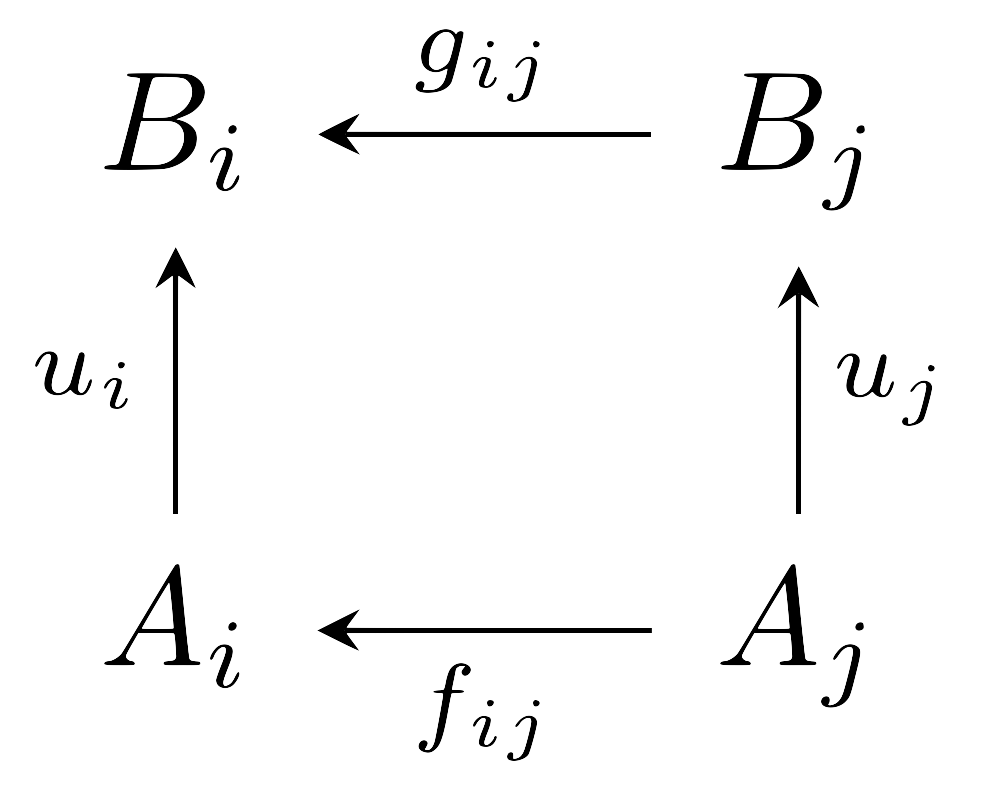
Definition 7 Let two inverse systems \(\bigl((A_i), (f_{ij})\bigr)\) and \(\bigl((B_i), (g_{ij})\bigr)\) be given. A family \((u_i)_{i\in I}\) of functions \(u_i:A_i\rightarrow B_i\) is called a morphism between inverse systems if for any \(i,j\), the equation
\[g_{ij}\circ u_j=u_i\circ f_{ij}\]holds.
In other words, the following diagram commutes for all \(i\leq j\):
Proposition 8 Let two inverse systems \(\bigl((A_i), (f_{ij})\bigr)\) and \(\bigl((B_i), (g_{ij})\bigr)\) be given, along with a morphism \((u_i:A_i\rightarrow B_i)\) between inverse systems. Then there exists a unique \(u:\varprojlim A_i\rightarrow \varprojlim B_i\) such that for each \(i\), \(g_i\circ u=u_i\circ f_i\) holds.
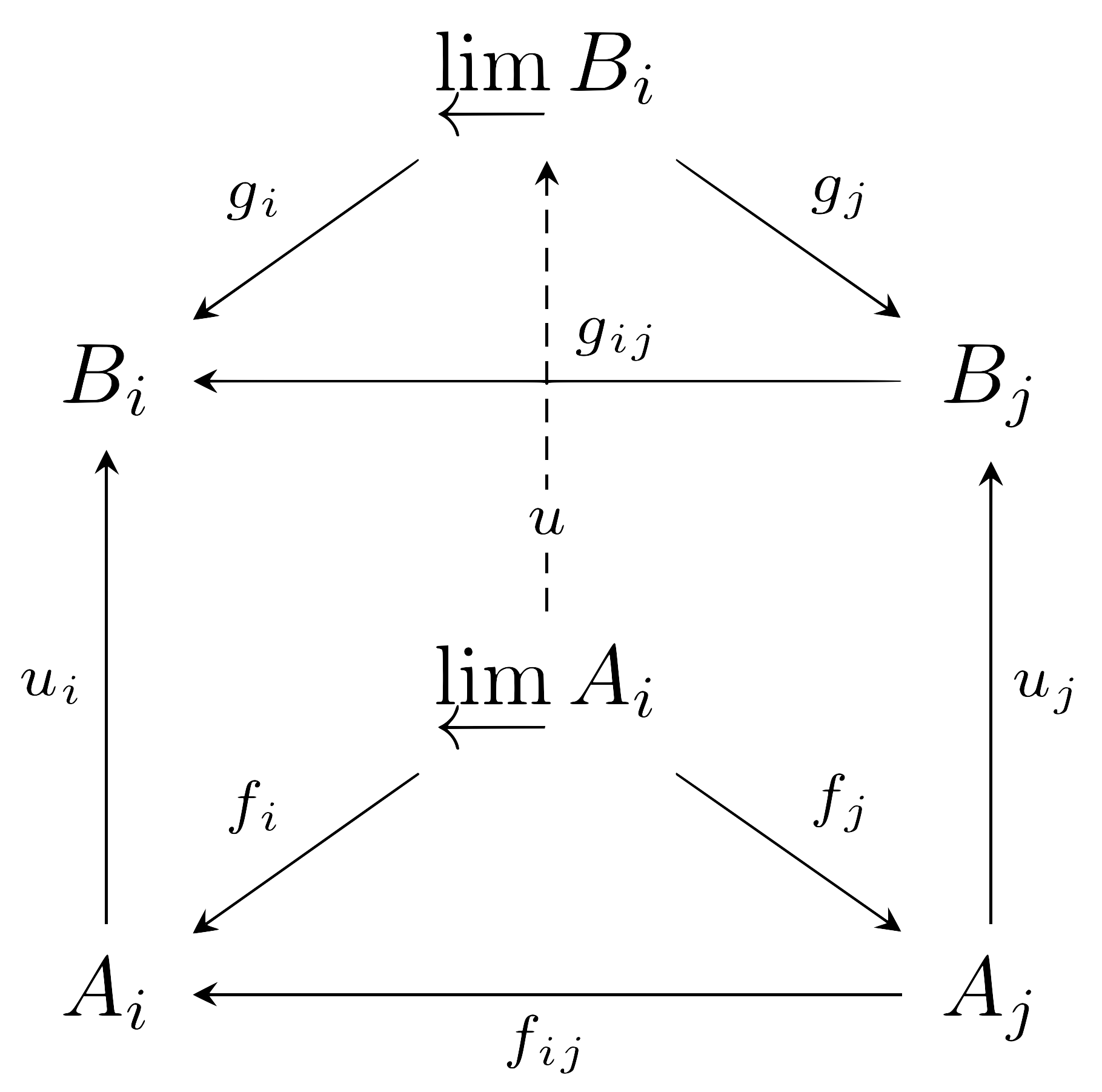
In other words, if the \(u_i\) satisfy appropriate conditions, they naturally induce a function \(u\) between inverse limits.
Proof
First, observe that the composition \(u_j\circ f_j\) produces a function from \(\varprojlim A_i\) to \(B_i\). Therefore, to properly define the function \(u\), we need to show that these functions satisfy the conditions for the universal property to apply. That is, we need to show that
\[(u_i\circ f_i)=g_{ij}\circ (u_j\circ f_j)\]Since the \(u_i\) are morphisms between inverse systems, by the previous definition,
\[g_{ij}\circ u_j=u_i\circ f_{ij}\]holds, and therefore
\[g_{ij}\circ (u_j\circ f_j)=(u_i\circ f_{ij})\circ f_j=u_i\circ f_i\]Thus, for all \(i\in I\), there exists a unique function \(u:\varprojlim A_i\rightarrow\varprojlim B_i\) such that
\[(u_i\circ f_i)=g_i\circ u\]and this equation is exactly what we wanted.
Therefore, such a function \(u\) is sometimes written as \(u=\varprojlim u_i\), with some abuse of notation. Meanwhile, by the uniqueness obtained from the previous proposition, the following also holds.
Corollary 9 Let three inverse systems \(\bigl((A_i), (f_{ij})\bigr)\), \(\bigl((B_i), (g_{ij})\bigr)\), and \(\bigl((C_i), (h_{ij})\bigr)\) be given, along with morphisms \((u_i:A_i\rightarrow B_i)\) and \((v_i:B_i\rightarrow C_i)\) between these systems. Then
\[\varprojlim(v_i\circ u_i)=\bigl(\varprojlim v_i\bigr)\circ\bigl(\varprojlim u_i\bigr)\]holds.
Definition 10 Let an inverse system \(\bigl((A_i), (f_{ij})\bigr)\) be given. If subsets \(X_i\) of \(A_i\) are given such that an inverse system can be formed by restricting \(f_{ij}\) to them, that is, if the condition
\[f_{ij}(X_j)\subseteq X_i\]holds for each \(i\leq j\), then the system \(\bigl((X_i), (f_{ij}\vert_{X_j})\bigr)\) is called an inverse system of subsets of the original system.
It is then easy to verify that
\[\varprojlim X_i=\bigl(\varprojlim A_i\bigr)\cap\prod_{i\in I} X_i\]holds.
We made this definition for the following proposition.
Proposition 11 Let two inverse systems \(\bigl((A_i), (f_{ij})\bigr)\) and \(\bigl((B_i), (g_{ij})\bigr)\) be given, along with a morphism \((u_i:A_i\rightarrow B_i)\) between inverse systems. For convenience, let \(u=\varprojlim u_i\). Then for each \(y=(y_i)\in \varprojlim B_i\), the sets \(u_i^{-1}(y_i)\) form an inverse system of subsets of \(A_i\), and the inverse limit is given by
\[\varprojlim u_i^{-1}(y_i)=u^{-1}(y)\]Proof
First, let us show that the \(u_i^{-1}(y_i)\) form an inverse system of subsets of \(A_i\). That is, for any \(x_j\in u_j^{-1}(y_j)\), we need to show that its image under \(f_{ij}\) to \(E_i\) belongs to \(u_i^{-1}(y_i)\). In other words, we need to show \(y_i=u_i(f_{ij}(x_j))\). By direct calculation,
\[u_i(f_{ij}(x_j))=g_{ij}(u_j(x_j))=g_{ij}(y_j)=y_i\]holds, so the claim is established.
On the other hand, \(x\in\varprojlim A_i\) satisfying \(u(x)=y\) means, by the definition of \(u\), exactly that \(u_i(x_i)=y_i\) holds for all \(i\), so the second claim also holds.
Therefore, if all \(u_i\) are injective, then \(u\) must also be injective.
Directed Systems and Direct Limits
Definition 12 Let \(I\) be a right directed set, and let a family \((A_i)_{i\in I}\) be given. Suppose that for each pair \((i,j)\) satisfying \(i\leq j\), a function \(f_{ij}:A_i\rightarrow A_j\) is defined, satisfying the following two conditions:
- If \(i\leq j\leq k\), then \(f_{ik}=f_{jk}\circ f_{ij}\),
- For each \(i\in I\), \(f_{ii}=\id_{E_i}\).
Then \(\bigl((A_i)_{i\in I}, (f_{ij})_{i\leq j}\bigr)\) is called a directed system.
Both inverse systems and directed systems have right directed sets as their indices. However, in inverse systems, the functions \(f_{ij}\) are defined to go from sets with larger indices to sets with smaller indices, while in directed systems, the functions \(f_{ij}\) are defined to go from smaller indices to larger indices.
Definition 13 A set \(\varinjlim A_i\) together with a family \((f_i)_{i\in I}\) of functions \(f_i: A_i\rightarrow \varinjlim A_i\) is called the direct limit or injective limit of \(\bigl((A_i)_{i\in I}, (f_{ij})_{i\leq j}\bigr)\) if for every \(i\leq j\),
\[f_i=f_{ij}\circ f_j\]holds, and additionally, the following universal property is satisfied:
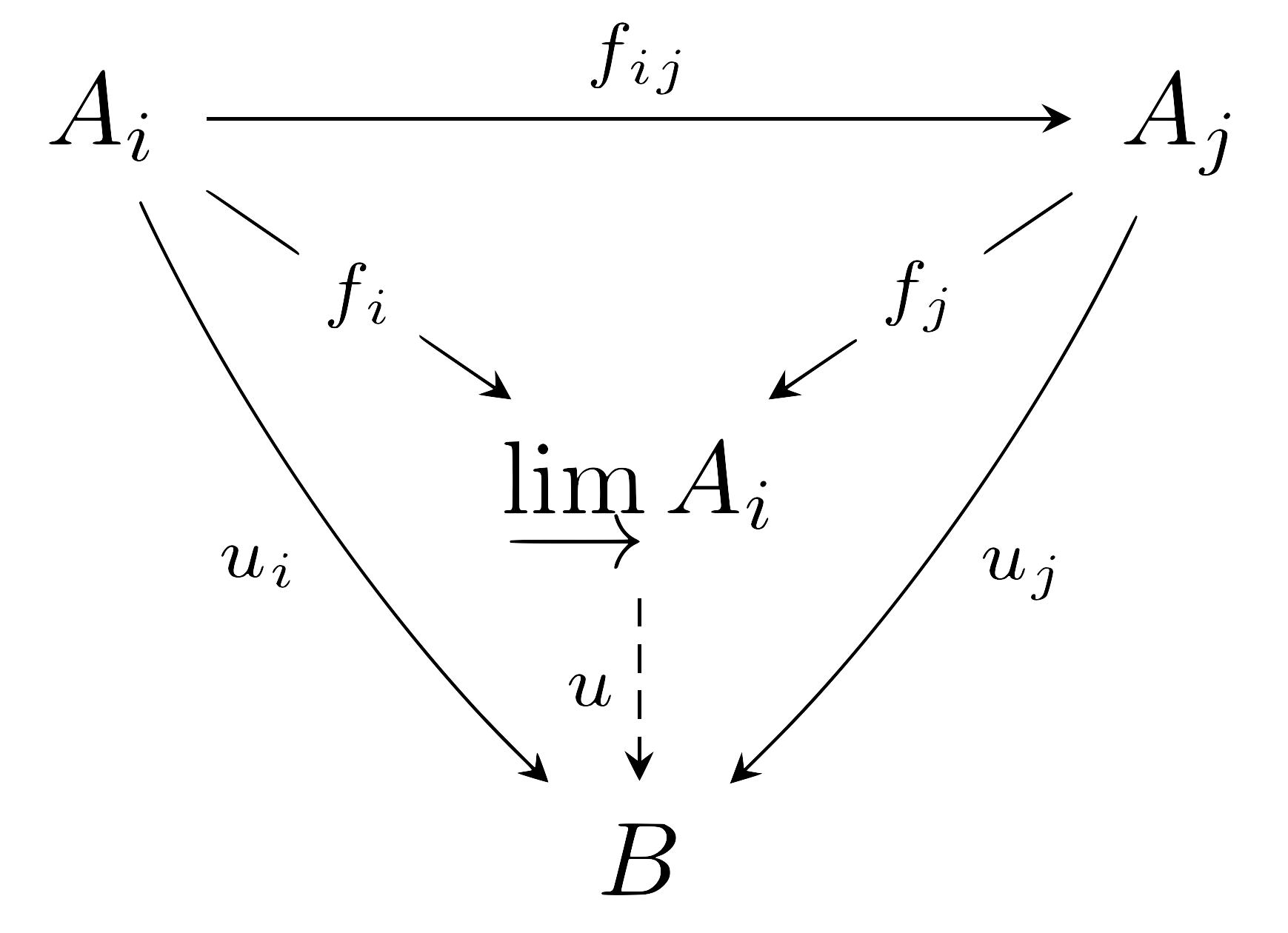
If some set \(B\) and a collection of functions \(u_i:A_i\rightarrow B\) are given such that for each \(i\leq j\), the equation
\[u_j\circ f_{ji}=u_i\]holds, then there exists a unique function \(u:\varprojlim A_i\rightarrow B\) such that for all \(i\in I\),
\[u_i=u\circ f_i\]is satisfied.
To construct an object and function with these properties, we need to use objects we already know. For a collection of sets \(A_i\), let \(S=\sum A_i\). If we identify \(A_i\) with its image through the inclusion \(A_i\hookrightarrow S\), then for any \(x\in S\), there exists a unique index \(i\) such that \(x\in A_i\). Let us denote this by \(\lambda(x)\). Then the relation
\(x\mathrel{R} y\) if there exists \(k\geq i=\lambda(x)\) and \(k\geq j=\lambda(y)\) such that \(f_{ki}(x)=f_{kj}(y)\)
can be easily verified to be an equivalence relation. Thus the quotient set \(A=S/R\) is well-defined, and the natural composition
\[f_i: A_i\hookrightarrow S\twoheadrightarrow S/R=A\]is also given.
Lemma 14 The \(\bigl(A, (f_i)\bigr)\) constructed above satisfies the universal property of the direct limit.
The theorems we explored while defining inverse limits can be easily adapted for direct limits. Rather than repeating them, it is more efficient to introduce some frequently used examples.
Example 15 Let two sets \(A\) and \(B\) be given. For a directed set \(I\), let \((A_i)\) be a family of subsets of \(A\) satisfying the condition
\[i\leq j\iff A_j\subseteq A_i\]For each \(i\), let \(F_i\) be the set of functions from \(A_i\) to \(B\). Then for \(A_i\) and \(A_j\) with \(i\leq j\), the natural function \(f_{ji}:A_i\rightarrow A_j\) can be defined by
\[f_{ji}(u)=u|_{A_j}\]In such situations, the elements of \(\varinjlim A_i\) are commonly called germs.
References
[Bou] N. Bourbaki, Theory of Sets. Elements of mathematics. Springer Berlin-Heidelberg, 2013.
댓글남기기