This post was translated from Korean by LLM (Kimi). The translation may contain errors or awkward sentences. The Korean original is the source of truth.
We defined the \(\Tor\) functors in [Homological Algebra] §Ext and Tor, ⁋Definition 2, and we saw that if \(B\) is a flat \(A\)-algebra, then the following canonical isomorphism
\[B\otimes_A\Tor_i^A(M,N)\cong\Tor_i^B(B\otimes_AM, B\otimes_AN)\]exists. This applies particularly well when \(B=S^{-1}A\).
Proposition 1 Let an \(A\)-module \(M\) and an ideal \(\mathfrak{a}\) of \(A\) be given. Then the multiplication map \(\mathfrak{a}\otimes_AM \rightarrow M\) being injective is equivalent to \(\Tor_1^A(A/\mathfrak{a}, M)=0\). \(M\) being flat is equivalent to the multiplication map \(\mathfrak{a}\otimes_AM \rightarrow M\) being injective for every finitely generated ideal \(\mathfrak{a}\).
Proof
Applying the \(\Tor\) long exact sequence to the short exact sequence
\[0 \rightarrow \mathfrak{a} \rightarrow A \rightarrow A/\mathfrak{a} \rightarrow 0\]we obtain
\[\cdots \rightarrow \Tor_1^A(A, M) \rightarrow \Tor_1^A(A/\mathfrak{a}, M) \rightarrow \mathfrak{a}\otimes_AM \rightarrow A\otimes_AM \rightarrow (A/\mathfrak{a})\otimes_AM \rightarrow 0.\]From this it is clear that \(\mathfrak{a}\otimes M \rightarrow M\) being injective is equivalent to \(\Tor_1^A(A/\mathfrak{a},M)=0\).
Now we must show the second claim. For this, we need to show that for any injection \(L \rightarrow N\), the map \(L\otimes_AM \rightarrow N\otimes_AM\) is injective. However, to show this it suffices to assume that \(N\) is finitely generated. Indeed, any element \(z\in N\otimes_AM\) can be written as a finite sum of elements of the form \(x\otimes y\), so we may assume that \(z\) lies in \(N'\otimes_A M\) for the finitely generated module \(N'\) formed by collecting these \(x\)’s.
Now we can choose a sequence of submodules between two finitely generated \(A\)-modules \(N\) and \(L\)
\[L=N_0 \subseteq N_1\subseteq\cdots\subseteq N_p=N\]such that each \(N_{i+1}/N_i\) is generated by a single element. Then there exists a suitable ideal \(\mathfrak{a}\) of \(A\) such that \(N_{i+1}/N_i\cong A/\mathfrak{a}\). Moreover, since the repeated inclusions yield an injection \(L\hookrightarrow N\), it is enough in the end to assume \(p=1\) and \(N/L\cong A/\mathfrak{a}\).
Recall also that, by the preceding discussion, it is enough to show that if \(\mathfrak{a}'\otimes_AM \rightarrow M\) is injective for every finitely generated ideal \(\mathfrak{a}'\), then \(\mathfrak{a}\otimes_AM \rightarrow M\) is injective for every ideal \(\mathfrak{a}\).
Now applying the \(\Tor\) long exact sequence to the short exact sequence
\[0 \rightarrow L \rightarrow N \rightarrow N/L \rightarrow 0\]we obtain
\[\cdots \rightarrow \Tor_1^A(N/L, M) \rightarrow L\otimes_AM \rightarrow N\otimes_AM \rightarrow (N/L)\otimes_AM \rightarrow 0,\]and since \(\Tor_1^A(N/L,M)=\Tor_1^A(A/\mathfrak{a},M)\) is \(0\), we obtain the desired result.
From this, we obtain the following corollaries in several special cases.
Corollary 2 Let \(\mathbb{K}\) be a field, \(A=\mathbb{K}[t]/(t^2)\) a ring, and \(M\) an \(A\)-module. Then \(M\) being a flat \(A\)-module is equivalent to the multiplication map \(\times t: M \rightarrow tM\) inducing an isomorphism \(M/tM \rightarrow tM\).
Proof
Since the only ideal of \(A\) is \((t)\), \(M\) being flat is equivalent to the map \((t)\otimes_A M \rightarrow M\) being injective. On the other hand, \(\times t: A \rightarrow (t)\) is an \(A\)-linear map whose kernel is \((t)\). More explicitly, this \(A\)-linear isomorphism is given by the formula
\[A/(t)\cong \mathbb{K} \rightarrow (t);\qquad a+(t)\mapsto at.\]From this we obtain the isomorphism
\[M/tM\cong A/(t)\otimes_A M \cong (t)\otimes_A M.\]On the other hand, the multiplication map \((t)\otimes_AM \rightarrow M\) is obtained via the \(A\)-bilinear map
\[(t)\times M \rightarrow M;\qquad (ta, x)\mapsto (ta)x,\]and composing this with the above isomorphism yields the map \(M/tM \rightarrow M\) which, for any \(x+tM\in M/tM\), is given by
\[x+tM \mapsto (1+(t))\otimes x\mapsto t\otimes x\mapsto tx.\]That is, the map \(M/tM \rightarrow M\) is exactly the map into \(tM\) obtained by multiplying by \(t\), and since it is obvious that the image of this map is \(tM\), the map \(\times t: M/tM \rightarrow tM\) being an isomorphism is equivalent to \((t)\otimes_AM \rightarrow M\) being injective, which in turn is equivalent to \(M\) being flat by Proposition 1.
Corollary 3 Fix an element \(a\in A\) that is not a zero-divisor. If \(M\) is a flat \(A\)-module, then \(a\) is not a zero-divisor on \(M\). If \(A\) is a PID, the converse also holds.
Proof
If \(M\) is a flat \(A\)-module, then \((a)\otimes_AM \rightarrow M\) is injective, so \(a\) is a non-zerodivisor on \(M\). On the other hand, if \(A\) is a PID, every ideal of \(A\) is generated by a single non-zerodivisor, so in particular \(\mathfrak{a}\otimes_AM \rightarrow M\) is injective for every ideal \(\mathfrak{a}\).
In general, the expression of an element of a tensor product is not unique. The following lemma clarifies this to some extent.
Lemma 4 Fix two \(A\)-modules \(M\) and \(N\), and assume that \(N\) is generated by \(\{y_j\}_{j\in J}\). Now let an arbitrary element of \(M\otimes_AN\) be expressed as a finite sum
\[\sum_{j\in J} x_j\otimes y_j.\]Then this element being zero is equivalent to the existence of elements \(\{x_j'\}_{j\in J}\) of \(M\), an index set \(I\), and \(a_{ij}\in A\) such that the equations
\[\sum_{i\in I} a_{ij}x_i'=x_j\quad\text{for all $j$},\qquad \sum_{j\in J} a_{ij}y_j=0\quad\text{for all $i$}\]hold.
Proof
First, if there exist \(x_j'\)’s and \(a_{ij}\)’s satisfying the given conditions, then
\[\sum_{j\in J} x_j\otimes y_j=\sum_{j\in J}\left(\left(\sum_{i\in I}a_{ij}x_i'\right)\otimes y_j\right)=\sum_{i\in I} x_i'\otimes\left(\sum_{j\in J} a_{ij} y_j\right)=0,\]so the reverse direction is easily obtained.
To prove the forward direction, let us first consider the case where \(N\) is a free module and \(\{y_j\}_{j\in J}\) is a basis of \(N\). Then, considering the isomorphism
\[M\otimes_AN\cong\bigoplus_{j\in J} (M\otimes_A Ay_j)\cong \bigoplus_{j\in J} M\]([Algebraic Structures] §Direct Products, Direct Sums, and Tensor Products of Modules, ⁋Theorem 6), the element \(\sum_j x_j\otimes y_j\) corresponds to \((x_j)_{j\in J}\), so this element being zero is equivalent to all \(x_j\) being zero.
Now for an arbitrary module \(N\), we can choose a suitable free \(A\)-module \(F\) and \(\varepsilon: F \rightarrow N\) so that the basis \(\{f_j\}_{j\in J}\) of \(F\) is sent to \(\{y_j\}_{j\in J}\) via \(\varepsilon\). ([Multilinear Algebra] §Bases, ⁋Definition 1) Then we obtain the short exact sequence
\[0 \longrightarrow\ker\varepsilon \longrightarrow F \overset{\varepsilon}{\longrightarrow} N \longrightarrow 0,\]and viewing \(\ker \varepsilon\) as a quotient of a free module \(G\) via [Multilinear Algebra] §Bases, ⁋Proposition 2, we obtain the exact sequence
\[G \rightarrow \ker\varepsilon \rightarrow 0.\]Through these we obtain a free presentation of \(N\)
\[G \overset{\eta}{\longrightarrow} F \overset{\varepsilon}{\longrightarrow} N \longrightarrow 0.\]On the other hand, since \(M\otimes_A-\) is right exact, we obtain the exact sequence
\[M\otimes_A G \overset{\id_M\otimes\eta}{\longrightarrow} M\otimes_AF \overset{\id_M\otimes \varepsilon}{\longrightarrow} M\otimes_AN \longrightarrow 0,\]and by hypothesis \(\sum_{j\in J} x_j\otimes f_j\) is sent to \(0\) by \(\id_M\otimes\varepsilon\). Therefore, by exactness in \(M\otimes_AF\), we can choose suitable \(x_i'\in M\) and \(z_i\in G\) such that
\[\sum_{i\in I} x_i'\otimes\eta(z_i)=(\id_M\otimes\eta)\left(\sum_i x_i'\otimes z_i\right)=\sum_j x_j\otimes f_j.\]Moreover, using the basis \(\{f_j\}_{j\in J}\) of \(F\) we can write
\[\eta(z_i)=\sum_{j\in J} a_{ij}f_j,\qquad\text{$(a_{ij})_{j\in J}$ finitely supported for all $i$}.\]Substituting this into the above equation yields
\[\sum_{j\in J} x_j\otimes f_j=\sum_{i\in I} x_i'\otimes\eta(z_i)=\sum_{i\in I}\sum_{j\in J}a_{ij}x_i'\otimes f_j,\]whence
\[0=\sum_{j\in J} x_j \otimes f_j-\sum_{i\in I}\sum_{j\in J} a_{ij}x_i'\otimes f_j=\sum_{j\in J} \left(x_j-\sum_{i\in I} a_{ij}x_i'\right)\otimes f_j,\]and therefore, by the result proved above for the free module case, we know that \(x_j=\sum_{i\in I} a_{ij}x_i'\). Now considering the image of \(\eta(z_i)\) under \(\varepsilon\), we have
\[0=(\varepsilon\circ\eta)(z_i)=\varepsilon\left(\sum_{j\in J} a_{ij}f_j\right)=\sum_{j\in J} a_{ij}y_j,\]which gives the desired result.
More generally, the following holds.
Corollary 5 An \(A\)-module \(M\) being flat is equivalent to the following condition.
Whenever \(x_i\in M\) and \(a_i\in A\) satisfy \(0=\sum_{i\in I} a_ix_i\), there exist an index set \(J\), elements \(x_j'\in M\), and \(b_{ij}\in A\) such that the two equations
\[\sum_{j\in J} b_{ij} x_j'=x_i\quad\text{for all $i$},\qquad \sum_{i\in I} b_{ij} a_i=0\quad\text{for all $j$}\]hold.
Proof
By the result of Proposition 1, \(M\) being flat is equivalent to the multiplication map
\[\mathfrak{a}\otimes_A M \rightarrow M\]being injective for every finitely generated ideal \(\mathfrak{a}\). This is equivalent to saying that if
\[\sum_i a_i\otimes x_i\in \mathfrak{a}\otimes_AM\]lies in the kernel of the above multiplication map, then this element must be \(0\); now examining when this element is \(0\) using Lemma 4 yields the desired result.
On the other hand, flatness can also be described using the language of diagrams in a form similar to [Homological Algebra] §Resolutions, ⁋Definition 1.
Corollary 6 For an \(A\)-module \(M\), the following are all equivalent.
- \(M\) is a flat \(A\)-module.
-
For any finitely generated free module \(F\), any morphism \(u:F \rightarrow M\), and any monogeneous submodule \(K\) of \(\ker u\), there exists the following diagram
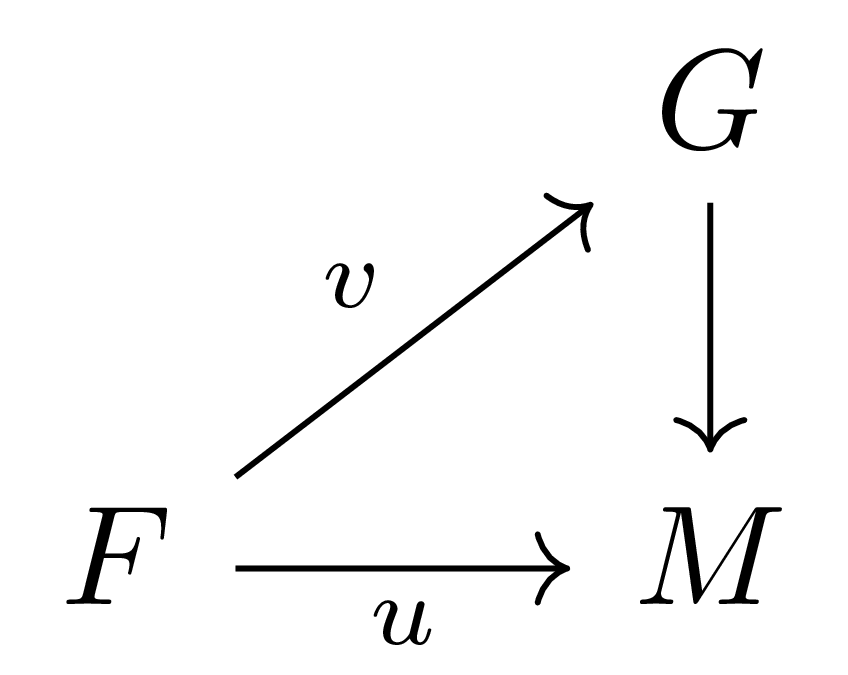
such that \(K\subseteq \ker v\).
- Condition 2 still holds if the hypothesis is weakened by replacing the monogeneous submodule of \(\ker u\) with a finitely generated submodule.
Proof
That the first and second conditions are equivalent is obvious from Corollary 5. Hence it suffices to assume the second condition and prove only the third: we choose \(v_1:F \rightarrow G\) killing the monogenous submodule generated by \(x_1\) among the generators \(x_1,\ldots, x_n\) of \(K\), and then repeat the same process for the remaining generators \(v_1(x_2),\ldots, v_1(x_n)\) of \(v_1(K)\).
If \(M\) is finitely presented, there exists an exact sequence
\[0 \rightarrow K \rightarrow F \rightarrow M \rightarrow 0,\]where \(F\) is a finitely generated free \(A\)-module and \(K\) is also finitely generated. If \(M\) is flat, then by the above corollary \(\im v\subseteq G\) is mapped isomorphically onto \(M\) via \(G \rightarrow M\). Hence \(G \rightarrow M\) splits, and from this we see that \(M\) is a direct summand of \(G\). That is, a finitely presented flat module is the same as a finitely presented projective module. ([Multilinear Algebra] §Projective Modules, Injective Modules, and Flat Modules, ⁋Proposition 4)
Corollary 7 Fix a field \(\mathbb{K}\) and \(A=\mathbb{K}[\x]\), and let \(E\) be a flat \(A\)-algebra. If \(E/\x E\) is a domain and \(S\) is the set of elements of the form \(1-\x f\) for \(f\in E\), then \(S^{-1}E\) is a domain.
Proof
First, let us reduce the given statement to a simpler form. Since localization preserves \(\otimes\), replacing \(E\) by \(S^{-1}E\) still yields a flat \(A\)-algebra. Moreover, if \(E/\x E\) is a domain, then \(S^{-1}E/\x S^{-1}E\) is also a domain, so we may assume from the outset that \(E=S^{-1}E\). In this situation, the choice of \(S\) as in the hypothesis amounts to assuming that every element of \(E\) of the form \(1-\x f\) is a unit.
Now, under the above conditions, let \(\mathfrak{a}\) and \(\mathfrak{b}\) be ideals of \(E\) satisfying \(\mathfrak{a}\mathfrak{b}=0\); we must show that \(\mathfrak{a}=0\) or \(\mathfrak{b}=0\). Since \(\mathfrak{a}\mathfrak{b}=0\), we may enlarge \(\mathfrak{a}\) and \(\mathfrak{b}\) if necessary so that they are mutual annihilators. Now \(\mathfrak{a}\mathfrak{b}=0\) modulo \(\x\), and since \(E/\x E\) is a domain we may assume \(\mathfrak{b}\subseteq (\x)\). Then \(\x\) is a non-zerodivisor in \(E\) and \(\mathfrak{a}(\mathfrak{b}:(\x))\x=0\), so \((\mathfrak{b}:(\x))\) annihilates \(\mathfrak{a}\). That is, \((\mathfrak{b}:(\x))\subseteq \mathfrak{b}\), and therefore \(\mathfrak{b}=\x\mathfrak{b}\). Now we obtain the desired result from §Integral Extensions, ⁋Lemma 7.
References
[Eis] David Eisenbud. Commutative Algebra: with a view toward algebraic geometry. Springer, 1995.
댓글남기기