This post was translated from Korean by LLM (Kimi). The translation may contain errors or awkward sentences. The Korean original is the source of truth.
Projective and Injective Resolutions
We defined projective and injective modules in [Multilinear Algebra] §Projective, Injective, and Flat Modules, ⁋Definition 3. Rephrasing this in the language of diagrams, we obtain the notions of projective object and injective object in a general abelian category.
Definition 1 Fix an abelian category \(\mathcal{A}\).
-
An object \(P\) of \(\mathcal{A}\) is a projective object if, whenever a diagram
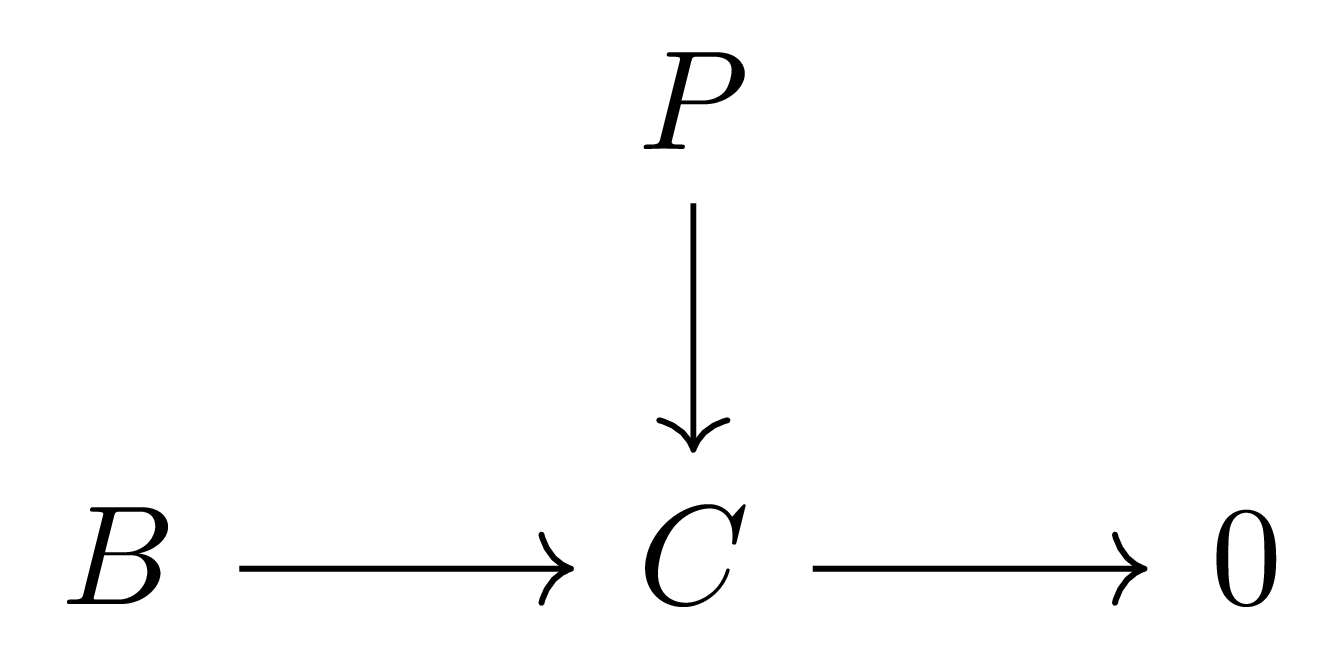
is given, there exists at least one morphism \(P \rightarrow B\) making the following diagram
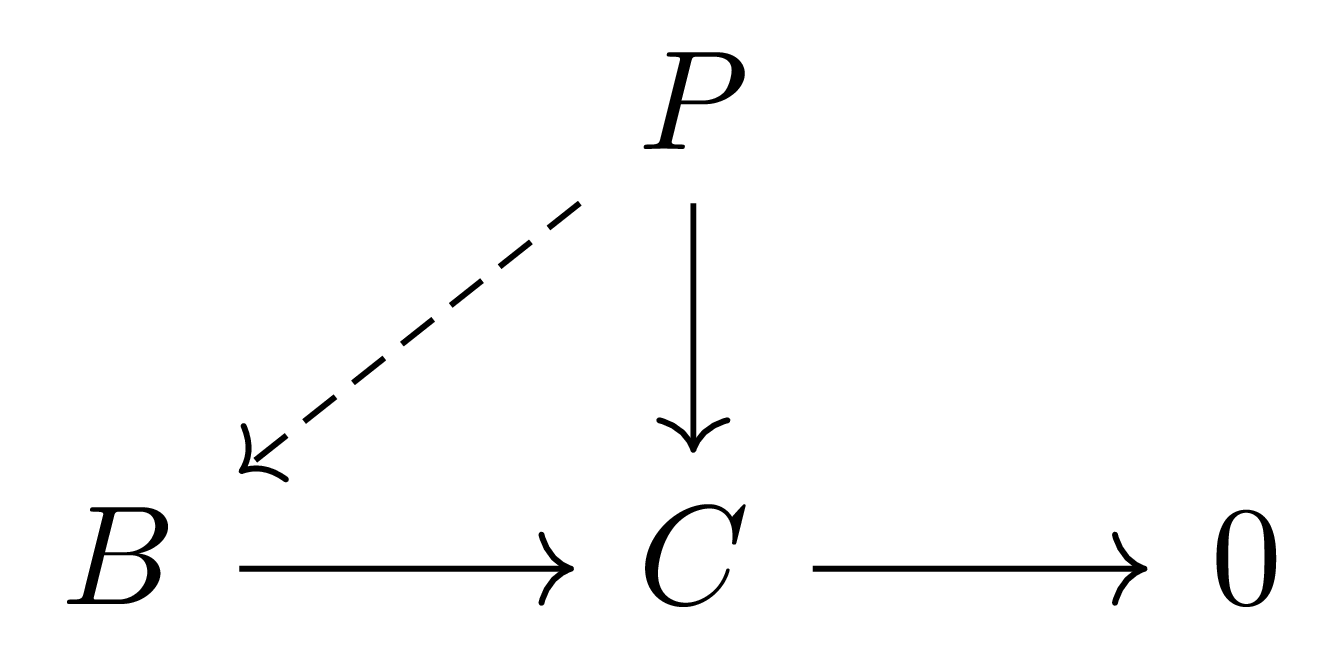
commute. If for every object \(A\) in \(\mathcal{A}\) there exists a projective object \(P\) such that \(P \rightarrow A \rightarrow 0\) can be made exact, we say that \(\mathcal{A}\) has enough projectives.
-
An object \(I\) of \(\mathcal{A}\) is an injective object if, whenever a diagram
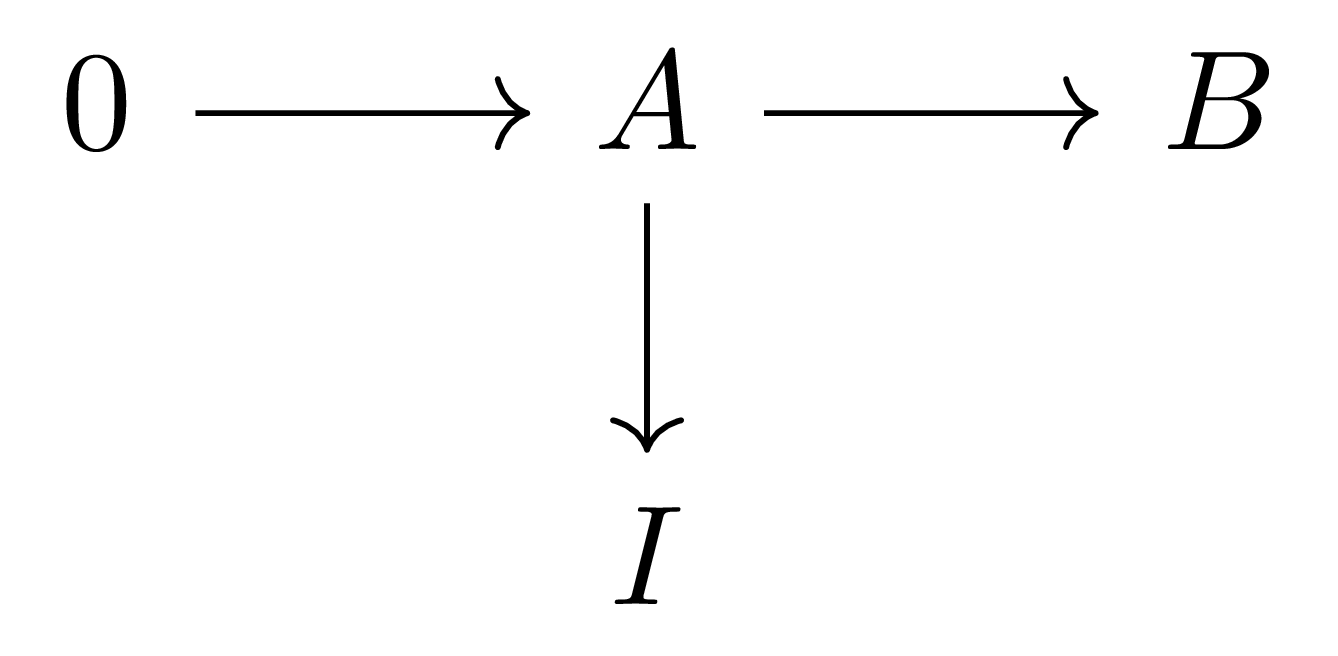
is given, there exists at least one morphism \(B \rightarrow I\) making the following diagram
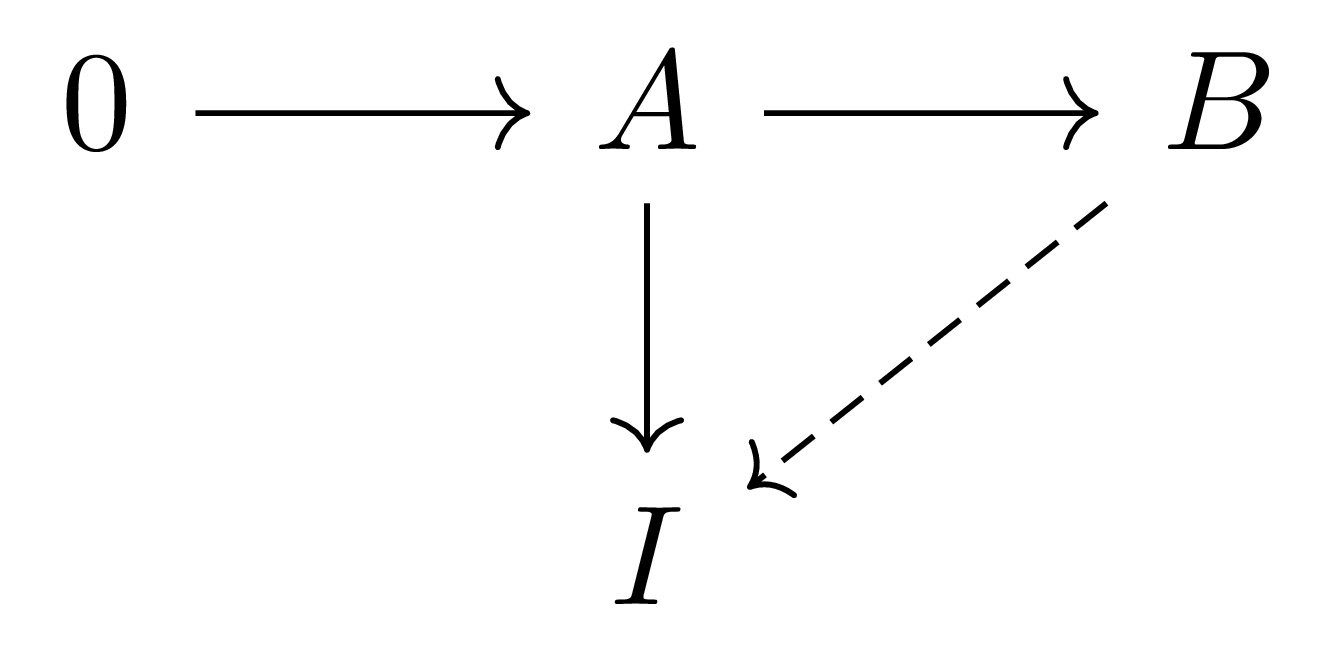
commute. If for every object \(A\) in \(\mathcal{A}\) there exists an injective object \(I\) such that \(0 \rightarrow A \rightarrow I\) can be made exact, we say that \(\mathcal{A}\) has enough injectives.
We also make the following definition.
Definition 2 Let \(M\) be an object of an abelian category \(\mathcal{A}\).
-
A left resolution of \(M\) is a chain complex \(P_\bullet\) together with an augmentation map \(\epsilon: P_0 \rightarrow M\) such that the chain complex
\[\cdots \longrightarrow P_2 \longrightarrow P_1 \longrightarrow P_0 \overset{\epsilon}{\longrightarrow} M \longrightarrow 0\]is exact. If each \(P_i\) is a projective object, we call this a projective resolution.
-
A right resolution of \(M\) is a cochain complex \(I^\bullet\) together with an augmentation map \(\eta: M \rightarrow I^0\) such that the cochain complex
\[0 \longrightarrow M \overset{\eta}{\longrightarrow} I^0 \longrightarrow I^1 \longrightarrow I^2 \longrightarrow \cdots\]is exact. If each \(I^i\) is an injective object, we call this an injective resolution.
A projective object in \(\mathcal{A}\) is an injective object in \(\mathcal{A}^\op\). Likewise, if \(\mathcal{A}\) has enough projectives then \(\mathcal{A}^\op\) has enough injectives. Moreover, a projective resolution of \(M\) in \(\mathcal{A}\) is the same as an injective resolution of \(M\) in \(\mathcal{A}^\op\). Therefore, it suffices to prove the following proposition only for projective resolutions.
Proposition 3 If an abelian category \(\mathcal{A}\) has enough projectives, then every object \(M\) in \(\mathcal{A}\) has a projective resolution. Likewise, if an abelian category \(\mathcal{A}\) has enough injectives, then every object \(M\) in \(\mathcal{A}\) has an injective resolution.
Proof
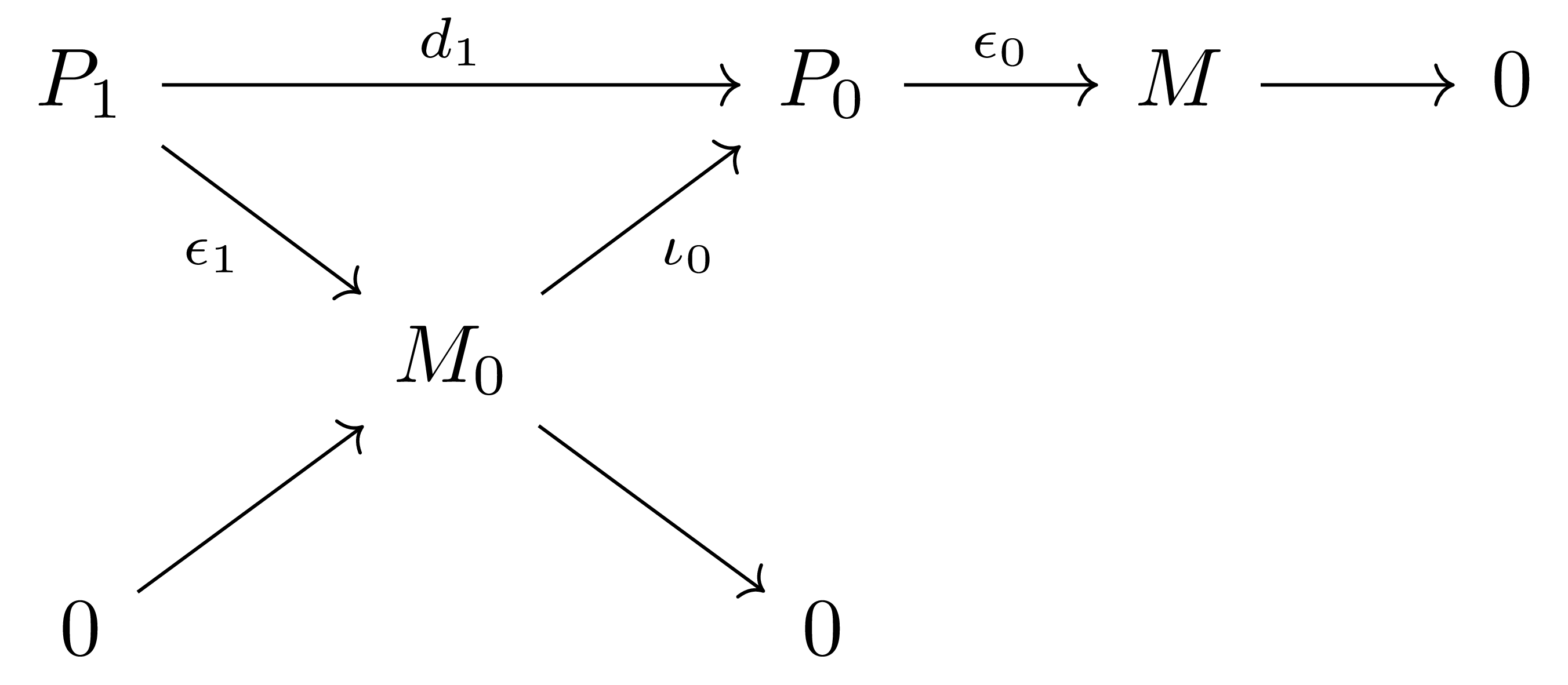
First, since \(\mathcal{A}\) has enough projectives, we can choose a surjection \(\epsilon_0:P_0 \rightarrow M\). Let \(M_0=\ker \epsilon_0\). Then since \(\mathcal{A}\) has enough projectives, we can choose a surjection \(\epsilon_1:P_1 \rightarrow M_0\). Drawing the diagram up to the composite \(d_1=\iota_0\circ\epsilon_1\) of \(\epsilon_1: P_1 \rightarrow M_0\) and the inclusion \(\iota_0: M_0 \rightarrow P_0\), we obtain the following.
Proceeding in this way, whenever \(\epsilon_n:P_n \rightarrow M_{n-1}\) is given we set \(M_n=\ker \epsilon_n\) to obtain the following commutative diagram.
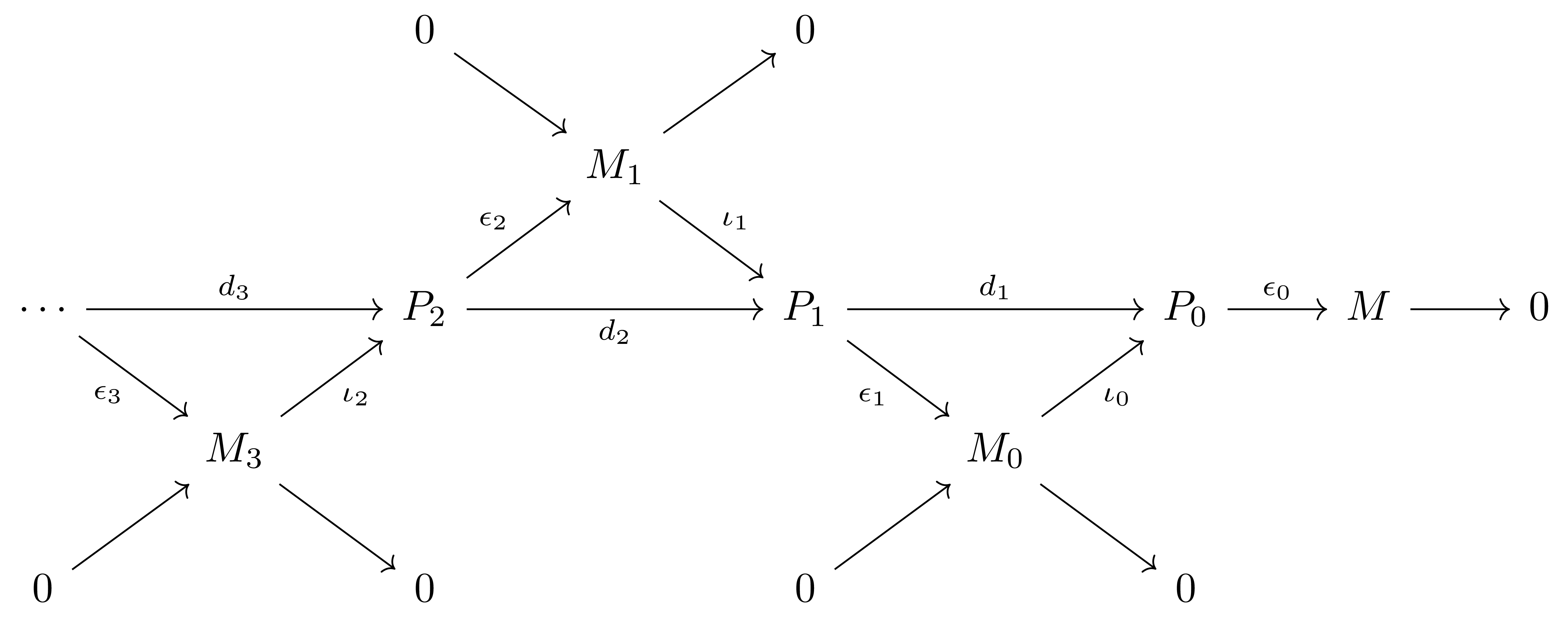
Then the complex obtained in the middle,
\[\cdots \overset{d_3}{\longrightarrow} P_2 \overset{d_2}{\longrightarrow} P_1 \overset{d_1}{\longrightarrow} P_0 \overset{\epsilon_0}{\longrightarrow} M \longrightarrow 0\]gives the following equalities:
\[\im(d_n)=\im(\iota_{n-1}\circ\epsilon_n)=\im(\iota_{n-1})=\ker(\epsilon_{n-1})=\ker(\iota_{n-2}\circ\epsilon_{n-1})=\ker(d_{n-1})\]Here, the equality \(\im(\iota_{n-1}\circ\epsilon_n)=\im(\iota_{n-1})\) uses the fact that \(\epsilon_n\) is surjective, and the equality \(\ker(\epsilon_{n-1})=\ker(d_{n-1})\) uses the fact that \(\iota_{n-2}\) is injective. Therefore \(P_\bullet\) is a projective resolution of \(M\).
One of our goals in this post is to prove that every \(A\)-module always has a projective resolution and an injective resolution. Using Proposition 3, it suffices to prove that \(\lMod{A}\) has enough projectives and enough injectives. That \(\lMod{A}\) has enough projectives is obvious.
Proposition 4 The category \(\lMod{A}\) has enough projectives.
Proof
This is obvious by [Multilinear Algebra] §Bases, ⁋Proposition 2 and [Multilinear Algebra] §Projective, Injective, and Flat Modules, ⁋Proposition 4.
However, since we know nothing about \(\lMod{A}^\op\), the fact that \(\lMod{A}\) has enough injectives does not follow from the above result. Therefore, the following proposition requires a separate proof.
Proposition 5 The category \(\lMod{A}\) has enough injectives.
Proof
It is not difficult to show that a right adjoint preserves injective objects. Then the coextension of scalars \(\Ab \rightarrow \lMod{A}\) obtained from the ring homomorphism \(\mathbb{Z}\rightarrow A\) is the right adjoint of restriction of scalars, so an injective object in \(\Ab\) becomes an injective object in \(\lMod{A}\). ([Algebraic Structures] §Change of Scalars, ⁋Proposition 6) Thus, for the desired proof it suffices to prove that \(\Ab\) has enough injectives. For any \(A\in\Ab\), this is done by defining
\[I(A)=\prod_{f\in\Hom_\Ab(A, \mathbb{Q}/\mathbb{Z})} \mathbb{Q}/\mathbb{Z}\]and \(e_A:A \rightarrow I(A)\) by \(a\mapsto (f(a))_{f\in\Hom(A, \mathbb{Q}/\mathbb{Z})}\).
Uniqueness of Resolutions
Meanwhile, the uniqueness of projective and injective resolutions follows from the following stronger theorem.
Theorem 6 Let a projective resolution \(P_\bullet \rightarrow M\) and any \(u:M \rightarrow N\) be given. Then for every left resolution \(Q_\bullet \rightarrow N\), there exists a chain map \(f:P_\bullet \rightarrow Q_\bullet\) making the following diagram
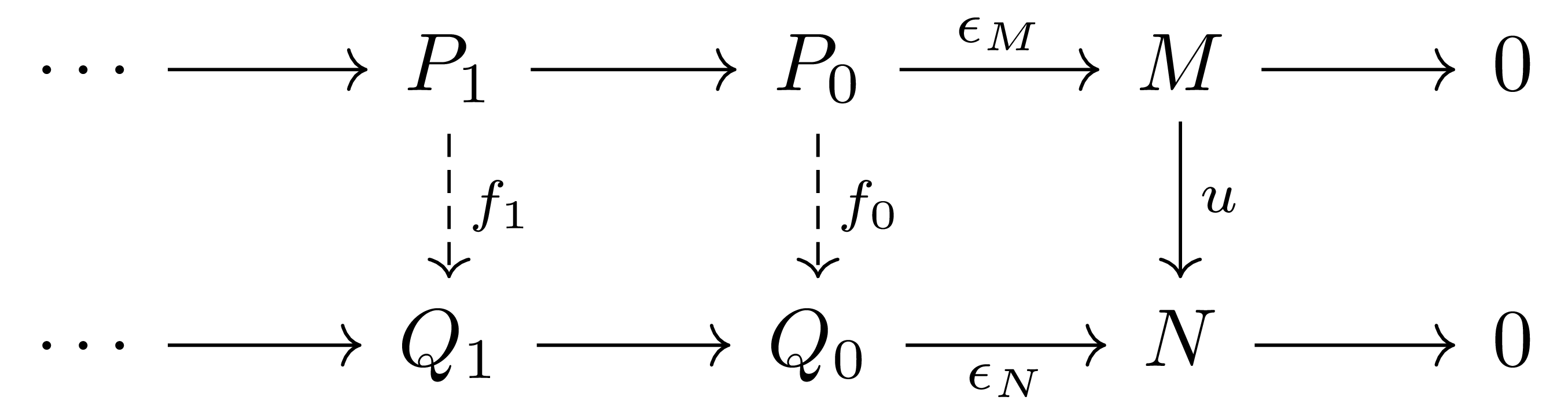
commute, uniquely up to homotopy.
Similarly, let an injective resolution \(N \rightarrow I^\bullet\) and any \(u: M \rightarrow N\) be given. Then for every right resolution \(M \rightarrow J^\bullet\), there exists a chain map \(f:J^\bullet \rightarrow I^\bullet\) making the following diagram
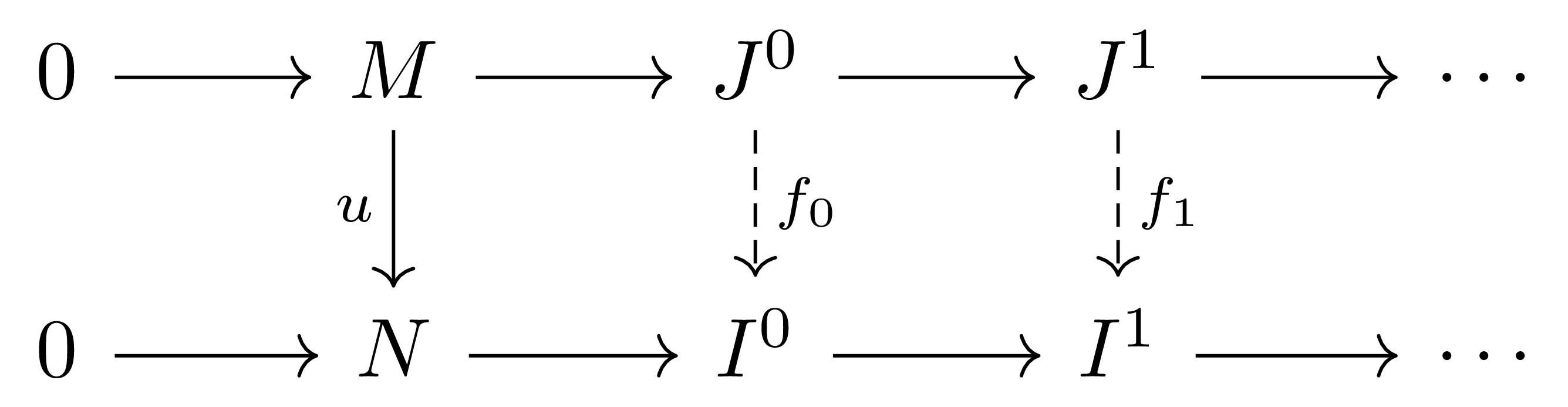
commute.
Proof
Finally, we conclude by proving the following lemma, which will be used importantly in the next post.
Lemma 7 Let the following short exact sequence
\[0 \longrightarrow A'\overset{i}{\longrightarrow}A\overset{p}{\longrightarrow}A'' \longrightarrow 0\]be given, and let \(P_\bullet'\), \(P_\bullet''\) be projective resolutions of \(A'\), \(A''\). Then the chain complex \(P_\bullet\) defined by \(P_n=P_n'\oplus P_n''\) is a projective resolution of \(A\), and there exists a short exact sequence of these complexes
\[0 \rightarrow P' \rightarrow P \rightarrow P'' \rightarrow 0\]Proof
First, drawing the given situation as a diagram, we obtain the following.
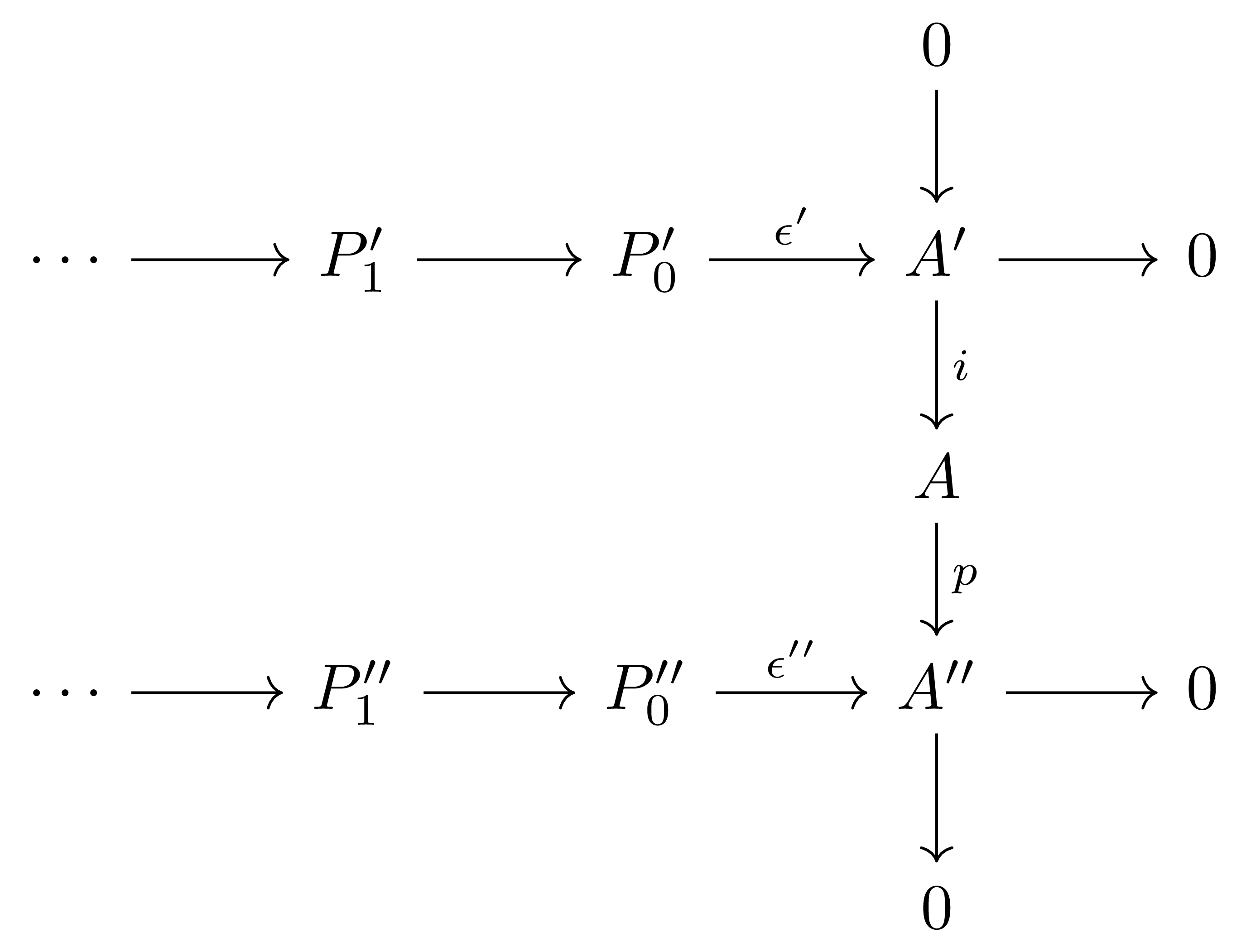
Now from the condition that \(P_0''\) is projective, we can define \(P_0'' \rightarrow A\). On the other hand, \(P_0' \rightarrow A\) is already given as the composite of \(i_A\) and \(\epsilon'\), so considering their direct sum we obtain \(\epsilon:P_0 \rightarrow A\). Now from §Diagram chasing, ⁋Lemma 5 we obtain the following diagram
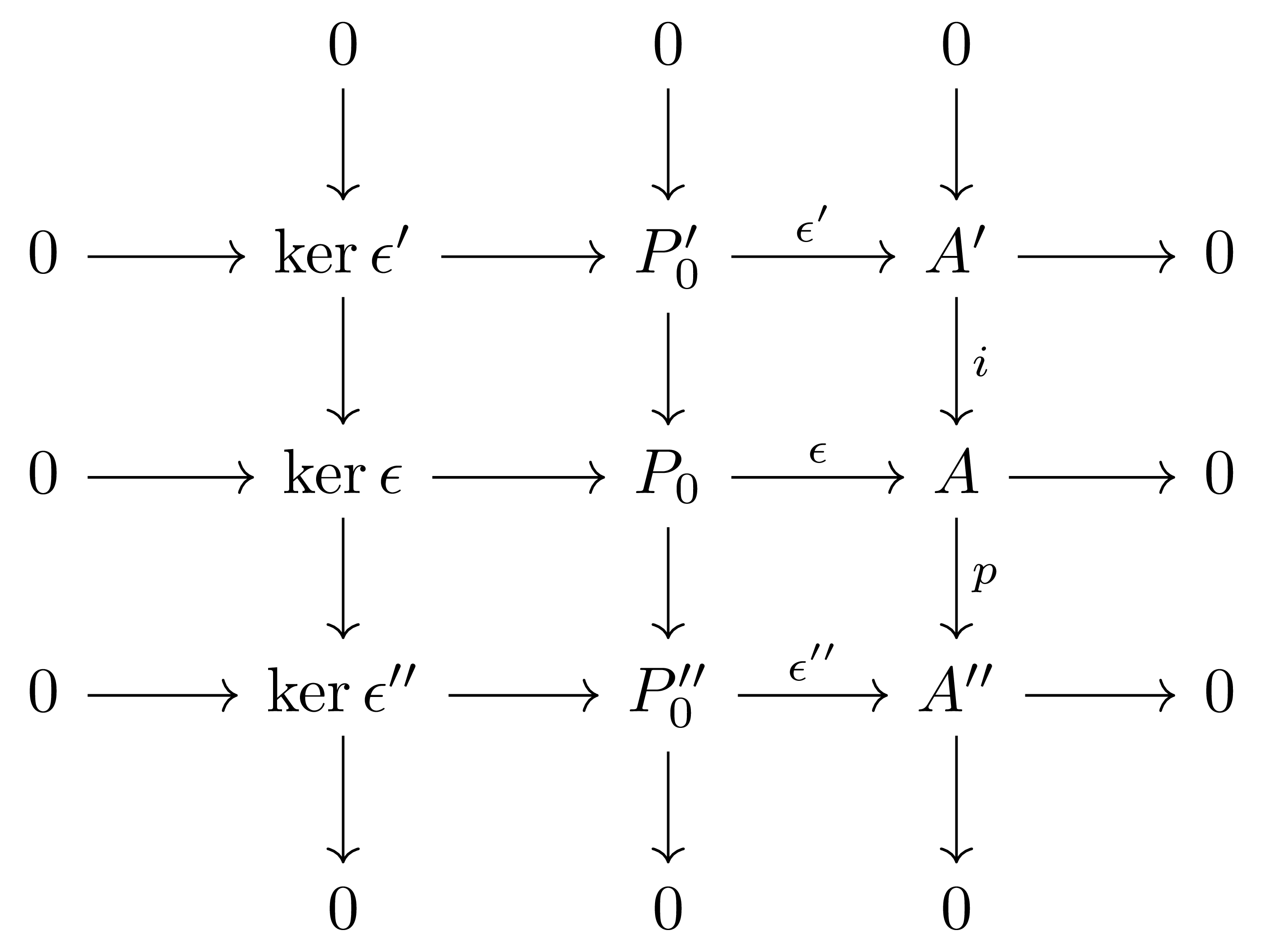
and in particular we obtain the following diagram
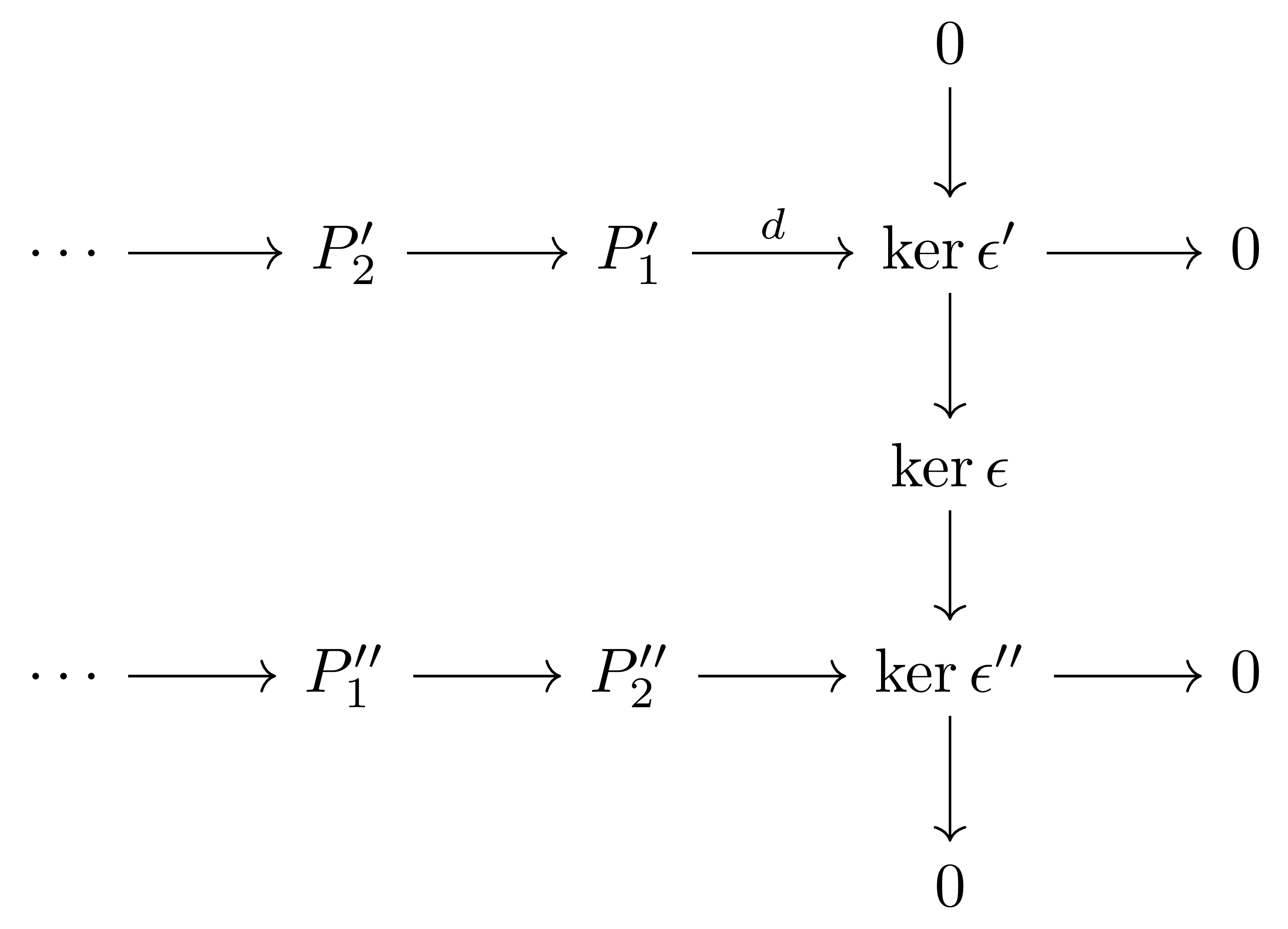
Repeating this process, we obtain \(P_\bullet\).
댓글남기기