
This post was translated from Korean by LLM (Kimi). The translation may contain errors or awkward sentences. The Korean original is the source of truth.
In this post, we assume that \(A\) is Noetherian and \(M\) is a finitely generated \(A\)-module.
Primary Submodules
Definition 1 A submodule \(N\) of \(M\) is a primary submodule if \(\Ass(M/N)\) consists of a single prime ideal. In this case, if \(\Ass(M/N)=\{\mathfrak{p}\}\), we call \(N\) a \(\mathfrak{p}\)-primary submodule. If \(\Ass(M)\) consists of a single prime ideal, we call \(M\) a coprimary submodule.
That is, if \(M/N\) is a coprimary submodule, then \(N\) is a primary submodule. Also, from §Associated Primes, ⁋Lemma 5, we know that a finite intersection of arbitrary \(\mathfrak{p}\)-primary submodules is \(\mathfrak{p}\)-primary.
The following now holds.
Proposition 2 For a ring \(A\) and a prime ideal \(\mathfrak{p}\), the following are all equivalent.
- The \(A\)-module \(M\) is a \(\mathfrak{p}\)-coprimary module.
- \(\mathfrak{p}\) is minimal among prime ideals containing \(\ann(M)\), and elements outside \(\mathfrak{p}\) are not zero divisors on \(M\).
- For some \(k\), \(\mathfrak{p}^k\) annihilates \(M\), and elements outside \(\mathfrak{p}\) are not zero divisors on \(M\).
Proof
First, assuming the first condition holds, by definition \(\mathfrak{p}\) is the unique associated prime ideal of \(M\). Now, by condition 1 of §Associated Primes, ⁋Theorem 7, \(\mathfrak{p}\) must be minimal among prime ideals containing \(\ann(M)\), and by condition 2, elements outside \(\mathfrak{p}\) are not zero divisors on \(M\).
Now assume the second condition holds. Then elements of \(A\setminus \mathfrak{p}\) are not zero divisors on \(M\), so it suffices to prove the claim after localizing at \(M_\mathfrak{p}\). That is, we may assume that \((A, \mathfrak{p})\) is a local ring, and now from the assumption that \(\mathfrak{p}\) is minimal over \(\ann(M)\) and §Properties of Localization, ⁋Corollary 8, we obtain the desired result.
Finally, assuming the third condition holds, it is clear that \(\mathfrak{p}\) is minimal among prime ideals containing \(\ann M\); hence, by the first condition of §Associated Primes, ⁋Theorem 7, \(\mathfrak{p}\) is an associated prime ideal of \(M\). Also, since all elements outside \(\mathfrak{p}\) are not zero divisors, by the second condition of §Associated Primes, ⁋Theorem 7, we know that any associated prime is always contained in \(\mathfrak{p}\). That is, \(\mathfrak{p}\) is the unique associated prime ideal of \(M\).
Primary Decomposition
Our goal in this post is to prove the following theorem.
Theorem 3 (Primary decomposition) Any submodule \(M'\) of \(M\) is an intersection of primary submodules. That is, for prime ideals \(\mathfrak{p}_1,\ldots, \mathfrak{p}_n\) and \(\mathfrak{p}_k\)-primary submodules \(M_k\), we can write \(M'=\bigcap_{k=1}^n M_k\). We call this a primary decomposition, and then the following hold.
- An associated prime of \(M/M'\) is one of the \(\mathfrak{p}_k\).
- If in the expression of \(M'\), none of the \(M_k\) are superfluous, then the \(\mathfrak{p}_i\) are exactly the associated primes of \(M/M'\).
- If there is no way to express \(M'\) using fewer \(M_k\), then the associated primes of \(M/M'\) are exactly one \(\mathfrak{p}_k\) per index. Moreover, if \(\mathfrak{p}_i\) is minimal among prime ideals containing the annihilator ideal of \(M/M'\), then \(M_i\) becomes the \(\mathfrak{p}_i\)-primary component of \(M'\).
-
For a given minimal primary decomposition and any multiplicative subset \(S\) of \(A\), let \(\mathfrak{p}_1,\ldots, \mathfrak{p}_m\) be the prime ideals not meeting \(S\). Then
\[S^{-1}M'=\bigcap_{i=1}^m S^{-1}M_i\]is a minimal primary decomposition of \(S^{-1}M\) over \(S^{-1}A\).
To prove this, we first define the irreducible decomposition of a module.
Definition 4 A submodule \(N\) of an \(A\)-module \(M\) is called irreducible if there do not exist \(N_1,N_2\supsetneq N\) with \(N=N_1\cap N_2\).
Then the following holds.
Lemma 5 (Noether) Any submodule of \(M\) can be expressed as an intersection of irreducible submodules.
Proof
We argue by contradiction. Since \(M\) is Noetherian, we can choose a maximal submodule among those that cannot be expressed as an intersection of irreducible submodules. Call it \(N\). Then \(N\) is not an irreducible submodule, so there exist \(N_1,N_2\supsetneq N\) with \(N=N_1\cap N_2\). But by the maximality of \(N\), both \(N_1\) and \(N_2\) can be expressed as intersections of irreducible submodules, and therefore so can \(N\), which is a contradiction.
From this, we know that for any submodule \(M'\) of \(M\), an irreducible decomposition of \(M'\),
\[M'=\bigcap_{k=1}^n M_k,\qquad \text{$M_k$ irreducible}\]always exists.
Lemma 6 The above irreducible decomposition is a primary decomposition.
Proof
To see this, it suffices to show that any irreducible submodule \(P\) is a primary submodule, which is the same as showing that \(M/P\) is coprimary. Assume for contradiction that \(M/P\) has two associated primes \(\mathfrak{p},\mathfrak{q}\). Then \(M/P\) has submodules isomorphic to \(A/\mathfrak{p}\) and \(A/\mathfrak{q}\), respectively. Then by definition, the annihilator of any nonzero element of \(A/\mathfrak{p}\) is \(\mathfrak{p}\), and the annihilator of any nonzero element of \(A/\mathfrak{q}\) is \(\mathfrak{q}\); hence they have only \(0\) as a common element. That is, the zero submodule \(0\) of \(M/P\) is a reducible submodule. From this, \(P\) becomes a reducible submodule in \(M\), yielding a contradiction.
Therefore, any submodule of \(M\) always has a primary decomposition. We must now prove the remaining parts of Theorem 3. As in the proof of the preceding lemma, to prove these it suffices to work with \(M/M'\), so without loss of generality we may assume \(M'=0\).
Proof of Theorem 3
First, to show the first result, suppose a primary decomposition of the zero submodule \(0\) of \(M\),
\[0=\bigcap_{k=1}^n M_k\]is given. Then, by generalizing the exact sequence of [Multilinear Algebra] §Exact Sequences, ⁋Proposition 7, we have
\[M\subseteq \bigoplus_{k=1}^n M/M_k\]so from §Associated Primes, ⁋Lemma 5, we know that any prime of \(\Ass M\) is obtained among the \(\mathfrak{p}_k\).
Now let us show the second result. Then in particular, for each \(j\),
\[\bigcap_{k\neq j} M_k\neq 0\]holds. Then since \(M_j\cap \bigcap_{k\neq j}M_k=0\),
\[\bigcap_{k\neq j} M_k=\left(\bigcap_{k\neq j} M_k\right)\bigg/\left(M_k\cap \bigcap_{k\neq j}M_k\right)\cong \left(\bigcap_{k\neq j} M_k + M_j\right)\bigg/M_j\subseteq M/M_j\]so \(\bigcap_{k\neq j} M_k\) is \(\mathfrak{p}_j\)-coprimary. From this we obtain the desired result.
Now let us show the third result. In general, since the intersection of \(\mathfrak{p}\)-primary submodules is also \(\mathfrak{p}\)-primary, to satisfy the given condition the \(\mathfrak{p}_k\) must all be distinct prime ideals. Now assume that the \(\mathfrak{p}_k\) are minimal among those containing the annihilator ideal, and let us show that \(\Ass(M/M_k)=\{\mathfrak{p}_k\}\). To do this, we must show that for any nonzero \(x+M_k\in M/M_k\), \(\ann(x)=\mathfrak{p}_k\) holds; hence, by §Localization, ⁋Proposition 5, it suffices to show that the kernel of \(\varepsilon: M \rightarrow M_{\mathfrak{p}_k}\) is \(M_k\).
Consider the following commutative diagram
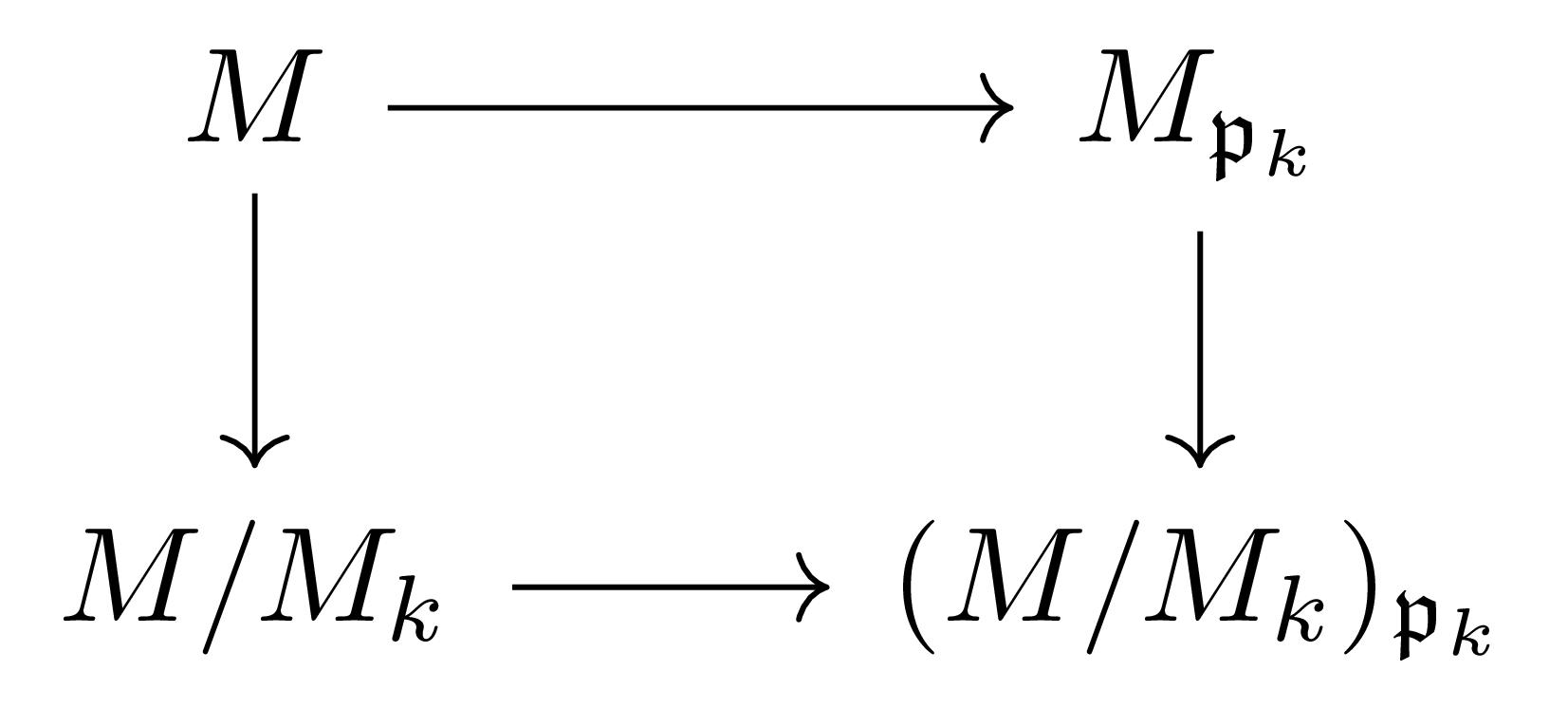
Then since the kernel of \(M \rightarrow M/M_k\) is \(M_k\), to prove the desired claim it suffices to show that both \(M_{\mathfrak{p}_k}\rightarrow (M/M_k)_{\mathfrak{p}_k}\) and \(M/M_k \rightarrow (M/M_k)_{\mathfrak{p}_k}\) are injective. First, that \(M/M_k \rightarrow (M/M_k)_{\mathfrak{p}_k}\) is injective is clear from the fact that \(M_k\) is \(\mathfrak{p}_k\)-primary. Then, as we saw at the beginning,
\[M \rightarrow \bigoplus_{k=1}^n M/M_k\]is injective, and therefore the localization of this map
\[M_{\mathfrak{p}_k} \rightarrow \left(\bigoplus_{k=1}^n M/M_k\right)_{\mathfrak{p}_k}\]is also injective. On the other hand, for each \(j\neq k\), \(M/M_j\) is \(\mathfrak{p}_j\)-coprimary, and by minimality \(\mathfrak{p}_j\) is not contained in \(\mathfrak{p}_i\), so \((M/M_j)_{\mathfrak{p}_k}=0\) holds, and the map obtained in this way is exactly \(M_{\mathfrak{p}_k}\rightarrow (M/M_k)_{\mathfrak{p}_k}\), so we obtain the desired result.
The last claim is almost obvious.
Primary Decomposition and Factorization
Meanwhile, the following theorem shows that primary decomposition generalizes the notion of factorization that we already know.
Theorem 7 For a Noetherian domain \(A\), the following hold.
- Suppose \(f\in A\) is factored as \(f=u p_1^{e_1}\cdots p_n^{e_n}\). Here \(u\) is a unit and the \(p_i\) are elements such that the \((p_i)\) are pairwise distinct prime ideals. Then \((f)=\bigcap(p_i^{e_i})\) is a minimal primary decomposition of \((f)\).
- That \(A\) is a UFD is equivalent to all minimal prime ideals over principal ideals being principal.
Proof
References
[Eis] David Eisenbud. Commutative Algebra: with a view toward algebraic geometry. Springer, 1995.
댓글남기기