This post was translated from Korean by LLM (Kimi). The translation may contain errors or awkward sentences. The Korean original is the source of truth.
Now we examine additional properties of localization. The first goal of this post is to prove that there is a close relationship between the localization of modules and the localization of rings that we studied in the previous post. Throughout this post, we fix a ring \(A\), a multiplicative subset \(S\) of \(A\), and an \(A\)-module \(M\).
Localization and Hom, Tensor
We begin by proving a lemma. Defining an \(A\)-module homomorphism \(S^{-1}A\times_A M \rightarrow S^{-1}M\) by \((r/u, x)\mapsto rx/u\), this is an \(A\)-bilinear map, and hence induces an \(A\)-linear map \(S^{-1}A\otimes_A M \rightarrow S^{-1}M\). ([Algebraic Structures] §Direct Products, Direct Sums, and Tensor Products of Modules, ⁋Theorem 5)
Lemma 1 The \(A\)-linear map defined above is an isomorphism.
Proof
It suffices to construct an inverse. To this end, first define a map from \(M\times S\) to \(S^{-1}A\otimes_AM\) by
\[(x,s)\mapsto \frac{1}{s}\otimes x.\]Then this defines a well-defined \(A\)-linear map from \(S^{-1}M\) to \(S^{-1}A\otimes_AM\). To see this, it suffices to show that this map respects the equivalence relation defined on \(M\times S\). Thus, suppose two elements of \(M\times S\) satisfy \((x,s)\sim (x',s')\). Then there exists some \(t\in S\) such that \(tsx'=ts'x\) holds, and from this we obtain
\[\frac{1}{tss'}\otimes ts'x=\frac{1}{tss'}\otimes tsx'\]holds. Since \(ts',ts\in A\), moving \(ts'\) and \(ts\) on the left-hand side and right-hand side to the left of \(\otimes\) respectively yields
\[\frac{1}{s}\otimes x=\frac{1}{s'}\otimes x'.\]That this map is \(A\)-linear and is the inverse of the \(A\)-linear map \(S^{-1}A\otimes_A M \rightarrow S^{-1}M\) defined above is obvious.
In particular, using this we can also show the functoriality of localization of modules. For any \(u: M \rightarrow M'\), we define \(S^{-1}M \rightarrow S^{-1}M'\) by identifying both sides of
\[S^{-1}\otimes_A u: S^{-1}\otimes_AM \rightarrow S^{-1}\otimes_AM'\]with localization. In general, tensor products are right exact, but in this case it becomes an exact functor.
Proposition 2 \(S^{-1}A\) is a flat \(A\)-module. ([Multilinear Algebra] §Projective Modules, Injective Modules, Flat Modules, ⁋Definition 7)
Proof
Suppose an injective \(A\)-linear map \(u:M \rightarrow M'\) is given; we must show that \(S^{-1}A\otimes_A u\) is injective. By Lemma 1, it suffices to show that the linear map \(S^{-1}M \rightarrow S^{-1}M'\) is injective. For any \(x/s\in S^{-1}M\), suppose its image \(u(x)/s\) in \(S^{-1}M'\) is zero. Then from \(u(x)/s=0/1\) there exists some \(t\in S\) such that
\[tu(x)=u(tx)=0\]holds, and since \(u\) is injective we must have \(tx=0\) in \(M\). Then in \(S^{-1}M\),
\[\frac{x}{s}=\frac{tx}{ts}=\frac{0}{ts}=0,\]so we obtain the desired result.
Properties Determined by Localization
By Proposition 2 above, if \(u:M \rightarrow M'\) is injective (resp. surjective, bijective), then the induced map \(S^{-1}M \rightarrow S^{-1}M'\) is also such. Proposition 4 can be thought of as a kind of (strong) converse. To establish this, we first prove the following lemma.
Lemma 3 Let \(M\) be an \(A\)-module and let \(\epsilon_\mathfrak{m}:M \rightarrow M_\mathfrak{m}\) be the localization at a maximal ideal \(\mathfrak{m}\) of \(A\). Then an element \(x\) of \(M\) is zero if and only if \(\epsilon_\mathfrak{m}(x)=0\) for all maximal ideals \(\mathfrak{m}\) of \(A\).
Proof
One direction is obvious, so it suffices to prove the converse. Assume that \(\epsilon_\mathfrak{m}(x)=0\) for every maximal ideal \(\mathfrak{m}\). This is equivalent to \(\ann(x)\) not being contained in \(\mathfrak{m}\). Then by the given condition, \(\ann(x)\) is an ideal not contained in any maximal ideal of \(A\), and the only such ideal is \(A\) itself. Thus \(\ann(x)=A\), which completes the proof.
Therefore the following holds.
Proposition 4 An \(A\)-linear map \(u:M \rightarrow N\) is a monomorphism (resp. epimorphism, isomorphism) if and only if \(u_\mathfrak{m}: M_\mathfrak{m} \rightarrow N_\mathfrak{m}\) is such for every maximal ideal \(\mathfrak{m}\).
The proof of this follows by applying Lemma 3 to the kernel and cokernel.
The following proposition will be used frequently hereafter, so it is worth remembering the statement even if one does not pay attention to the proof.
Proposition 5 Fix a ring \(A\) and an \(A\)-algebra \(E\). Then for any \(A\)-modules \(M,N\), the following \(E\)-module homomorphism
\[\alpha: E\otimes_A\Hom_A(M,N) \rightarrow\Hom_E(E\otimes_A M, E\otimes_AN);\qquad (1\otimes f)\mapsto \id_E\otimes_A f\]is well-defined. In particular, if \(E\) is a flat \(A\)-module and \(M\) is finitely presented, then \(\alpha\) is an isomorphism.
Proof
That \(\alpha\) is well-defined is obvious. Now suppose \(E\) is a flat \(A\)-module and \(M=A\). Then the given
\[\alpha: E\otimes_A\Hom_A(A, N) \rightarrow\Hom_E(E\otimes_AM, E\otimes_AN)\]fits into the following commutative diagram
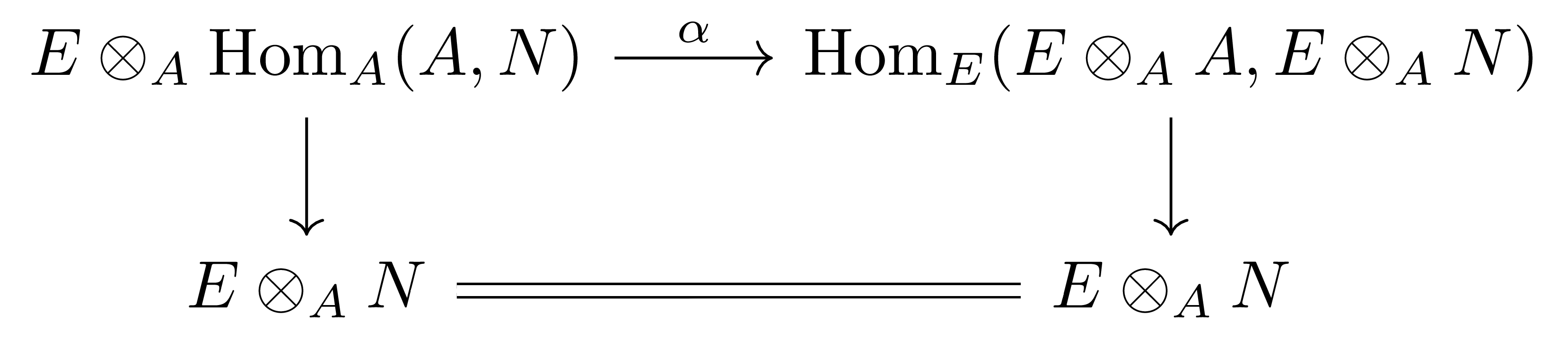
so the proposition holds. Here the vertical maps come from the isomorphisms
\[\Hom_A(A,N)\cong N,\qquad \Hom_E(E\otimes_A,E\otimes_AN)\cong\Hom_E(E,E\otimes_AN)\cong E\otimes_AN.\]After that, since \(\Hom\) and \(\otimes\) commute with finite direct sums, this proposition also holds for a flat \(A\)-module \(E\) and any finitely generated free \(A\)-module \(M\), and finally for the case where \(M\) is finitely presented, taking the free presentation
\[F \rightarrow G \rightarrow M \rightarrow 0\]and using the four lemma on the following commutative diagram

suffices.
In particular, suppose the following short exact sequence
\[0 \rightarrow M \rightarrow L \rightarrow N \rightarrow 0\]is given. Then this exact sequence is a splitting exact sequence if and only if for every \(A\)-module \(K\),
\[0 \rightarrow \Hom_\rMod{A}(K,M) \rightarrow \Hom_\rMod{A}(K,L)\rightarrow \Hom_\rMod{A}(K,N) \rightarrow 0\]is a splitting exact sequence, and examining the proof of [Multilinear Algebra] §Hom and Tensor Products, ⁋Proposition 1, we see that in fact if the above sequence is exact only when \(K=N\), that is, if
\[\Hom_\rMod{A}(N,L) \rightarrow \Hom_\rMod{A}(N,N) \rightarrow 0\]is surjective, then the original exact sequence \(0 \rightarrow M \rightarrow L \rightarrow N \rightarrow 0\) is a splitting exact sequence. Therefore we obtain the following.
Corollary 6 Suppose any short exact sequence
\[0 \rightarrow M \rightarrow L \rightarrow N \rightarrow 0\]is given. If \(N\) is finitely presented and for every maximal ideal \(\mathfrak{m}\),
\[0 \rightarrow M_\mathfrak{m} \rightarrow L_\mathfrak{m} \rightarrow N_\mathfrak{m} \rightarrow 0\]is a splitting exact sequence, then the original exact sequence splits.
Radical of an Ideal
Strictly speaking, the following result has nothing to do with localization, but since multiplicative subsets are used in its proof we mention it here and move on.
Proposition 7 Let \(A\) be a ring and \(S\) a multiplicative subset. Suppose \(\mathfrak{a}\) is maximal among ideals disjoint from \(S\). Then \(\mathfrak{a}\) is a prime ideal.
Proof
Let \(a_1,a_2\) be two elements of \(A\); we show that if \(a_1,a_2\not\in \mathfrak{a}\) then \(a_1a_2\not\in \mathfrak{a}\). By the maximality of \(\mathfrak{a}\), the two ideals \(\mathfrak{a}+(a_1)\) and \(\mathfrak{a}+(a_2)\) must meet \(S\), so there exist suitable \(b_1,b_2\in A\) and \(x_1,x_2\in \mathfrak{a}\) such that \(a_ib_i+x_i\in S\). Since \(S\) is closed under multiplication, the element
\[(a_1b_1+x_1)(a_2b_2+x_2)=a_1a_2b_1b_2+a_1b_1x_2+a_2b_2x_1+x_1x_2\]must also belong to \(S\). If contrary to the conclusion \(a_1a_2\in \mathfrak{a}\), then all four terms on the right-hand side lie in \(\mathfrak{a}\), contradicting the assumption that \(\mathfrak{a}\) and \(S\) are disjoint.
In a similar vein we obtain the following.
Corollary 8 For an ideal \(\mathfrak{a}\) of a ring \(A\), define the radical \(\sqrt{\mathfrak{a}}\) of \(\mathfrak{a}\) by the formula
\[\sqrt{\mathfrak{a}}=\{a\mid a^k\in \mathfrak{a}\text{ for some $k\in \mathbb{N}$}\}.\]Then
\[\sqrt{\mathfrak{a}}=\bigcap_\text{\scriptsize$\mathfrak{p}$ prime containing $\mathfrak{a}$} \mathfrak{p}\]holds.
Proof
One direction is obvious, and conversely, if \(a\not\in \sqrt{\mathfrak{a}}\) then setting \(S=\{a^k\mid k\geq 1\}\) and applying §Localization, ⁋Proposition 10 suffices.
References
[Eis] David Eisenbud. Commutative Algebra: with a view toward algebraic geometry. Springer, 1995.
댓글남기기