This post was translated from Korean by LLM (Kimi). The translation may contain errors or awkward sentences. The Korean original is the source of truth.
In the previous post we saw several criteria for determining when an \(A\)-module \(M\) is flat, and in this post we examine a criterion for determining this specifically through localization. The following theorem shows that it suffices to check §Flatness, ⁋Proposition 1 only for the maximal ideal.
Theorem 1 Fix a Noetherian local ring \((A, \mathfrak{m})\), and assume that \((E, \mathfrak{n})\) is a local Noetherian \(A\)-algebra satisfying \(\mathfrak{m}E\subseteq \mathfrak{n}\). Then for a finitely generated \(E\)-module \(M\), \(M\) being a flat \(A\)-module is equivalent to \(\Tor_1^A(A/\mathfrak{m}, M)=0\).
Proof
If \(M\) is a flat \(A\)-module then \(\Tor_1^A(A/\mathfrak{m}, M)=0\) is exactly the content of §Flatness, ⁋Proposition 1, so it suffices to show the converse.
To show the converse, we likewise use §Flatness, ⁋Proposition 1, assume the given condition, and show that for any ideal \(\mathfrak{a}\) of \(A\) the multiplication map \(m:\mathfrak{a}\otimes_AM \rightarrow M\) is injective. To this end, assume \(x\in \mathfrak{a}\otimes_AM\) lies in the kernel \(\ker m\) of the multiplication map, and let us show \(x=0\). First, from the \(E\)-module structure defined on \(M\) we naturally obtain an \(E\)-module structure on \(\mathfrak{a}\otimes_AM\) as well, and from the assumption \(\mathfrak{m}E\subseteq \mathfrak{n}\) we know that for any \(n\) the formula
\[\mathfrak{m}^n(\mathfrak{a}\otimes_AM )\subseteq \mathfrak{n}^n(\mathfrak{a}\otimes_AM)\]holds. On the other hand, since these are finitely generated \(E\)-modules, §Blowup Algebra, ⁋Corollary 8 gives
\[\bigcap \mathfrak{m}^n(\mathfrak{a}\otimes_AM)=\bigcap \mathfrak{n}^n(\mathfrak{a}\otimes_AM)=0\]Therefore, to show \(x=0\) it suffices to show that \(x\in \mathfrak{m}^n(\mathfrak{a}\otimes_AM)\) holds for all \(n\). On the other hand, \(\mathfrak{m}^n(\mathfrak{a}\otimes_AM)\) can be identified with \((\mathfrak{m}^n \mathfrak{a})\otimes_AM\), and applying §Blowup Algebra, ⁋Lemma 7 to the following \(\mathfrak{m}\)-stable filtration
\[\mathfrak{m}\supseteq \mathfrak{m}^2\supseteq\cdots\]and \(M'=\mathfrak{a}\), the following filtration
\[\mathfrak{m}\cap \mathfrak{a}\supseteq \mathfrak{m}^2 \cap\mathfrak{a}\supseteq\cdots\]is also \(\mathfrak{m}\)-stable, so there exists a suitable \(N\) such that whenever \(m>N\),
\[\mathfrak{m}^{m+i}\cap \mathfrak{a}=\mathfrak{m}^i(\mathfrak{m}^m\cap \mathfrak{a})\]holds for all \(i\). Thus whenever any \(n\) is given, if we choose \(t>N+n\) then
\[\mathfrak{m}^t\cap \mathfrak{a}=\mathfrak{m}^n(\mathfrak{m}^{t-n}\cap \mathfrak{a})\subseteq \mathfrak{m}^n \mathfrak{a}\]and instead of showing that \(x\in (\mathfrak{m}^na)\otimes_AM\) holds for arbitrary \(n\), we may show that \(x\in (\mathfrak{m}^t\cap \mathfrak{a})\otimes_AM\) holds for arbitrary \(t\).
Now applying \(-\otimes_AM\) to the following short exact sequence
\[0 \rightarrow \mathfrak{m}^t\cap \mathfrak{a} \rightarrow \mathfrak{a} \rightarrow \frac{\mathfrak{a}}{\mathfrak{m}^t\cap \mathfrak{a}} \rightarrow 0\]we obtain the following exact sequence
\[(\mathfrak{m}^t\cap \mathfrak{a})\otimes_AM \rightarrow \mathfrak{a}\otimes_AM \rightarrow \frac{\mathfrak{a}}{\mathfrak{m}^t\cap \mathfrak{a}}\otimes_AM \rightarrow 0\]and in this situation it suffices to show that \(x\) becomes \(0\) when mapped to \((\mathfrak{a}/\mathfrak{m}^t\cap \mathfrak{a})\otimes_AM\). On the other hand, considering the following commutative diagram
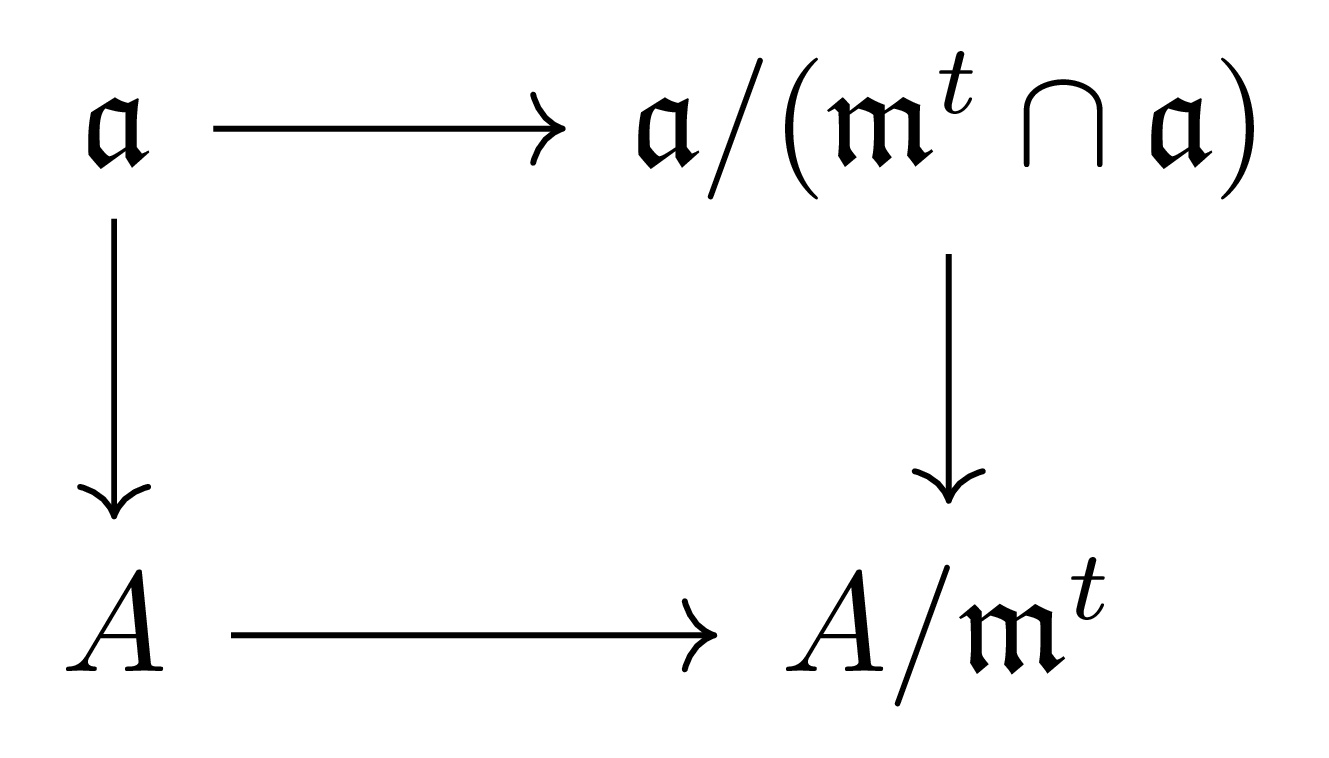
and applying \(-\otimes_AM\) to obtain the following commutative diagram
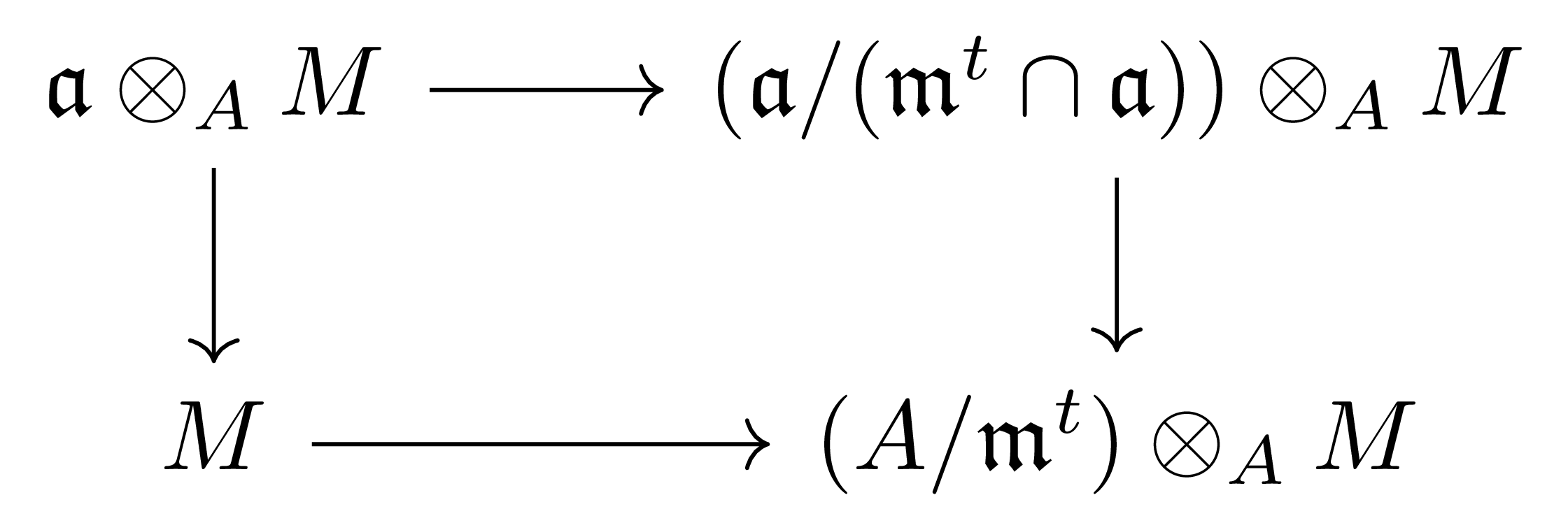
the left map \(\mathfrak{a}\otimes_AM \rightarrow M\) is the multiplication map \(m\), and therefore \(x\in\ker m\) is sent to \(0\) through the composition in the \(\llcorner\) direction. Thus it suffices to show that the right map \((\mathfrak{a}/(\mathfrak{m}^t\cap I))\otimes_AM \rightarrow (A/\mathfrak{m}^t)\otimes_AM\) is injective. Through the isomorphism
\[\frac{\mathfrak{a}}{\mathfrak{m}^t\cap \mathfrak{a}}\cong \frac{\mathfrak{a}+\mathfrak{m}^t}{\mathfrak{m}^t}\]the map \(\mathfrak{a}/(\mathfrak{m}^t\cap \mathfrak{a}) \rightarrow A/\mathfrak{m}^t\) giving this is exactly the left map of the following short exact sequence
\[0 \rightarrow \frac{\mathfrak{a}+\mathfrak{m}^t}{\mathfrak{m}^t} \rightarrow \frac{A}{\mathfrak{m}^t}\rightarrow \frac{A}{\mathfrak{a}+\mathfrak{m}^t} \rightarrow 0\]Therefore, from the \(\Tor\) long exact sequence
\[\cdots \Tor_1^A(A/(\mathfrak{a}+\mathfrak{m}^t), M) \rightarrow \frac{\mathfrak{a}+\mathfrak{m}^t}{\mathfrak{m}^t}\otimes_AM \rightarrow \frac{A}{\mathfrak{m}^t}\otimes_AM \rightarrow\]what we must show is \(\Tor_1^A(A/(\mathfrak{a}+\mathfrak{m}^t), M)=0\).
Now \(A/(\mathfrak{a}+\mathfrak{m}^t)\) is annihilated by \(\mathfrak{m}^t\), and since \(\mathfrak{m}^t\) is finitely generated, through this we know that \(A/(\mathfrak{a}+\mathfrak{m}^t)\) has finite length. Therefore, if we show more generally that \(\Tor_1^A(N, M)=0\) holds whenever any \(A\)-module \(N\) of finite length is given, we obtain what we want.
We proceed by induction. If \(N\) has length \(1\) then by the discussion after §Jordan-Hölder Theorem, ⁋Definition 1 we must have \(N=A/\mathfrak{m}\), and thus \(\Tor_1^A(N, M)=0\) coincides exactly with the hypothesis of the theorem. Choose an \(A\)-module \(N\) of finite length and any proper submodule \(N'\) of \(N\). Then applying the \(\Tor\) long exact sequence to the exact sequence
\[0 \rightarrow N' \rightarrow N \rightarrow N/N' \rightarrow 0\]we obtain
\[\cdots \rightarrow\Tor_1^A(N', M) \rightarrow \Tor_1^A(N, M) \rightarrow \Tor_1^A(N/N', M) \rightarrow \cdots\]Now by the inductive hypothesis \(\Tor_1^A(N', M)=\Tor_1^A(N/N',M)=0\), so we obtain the desired result.
On the other hand, if \(M\) is a flat \(A\)-module then for any \(A/(a)\)-module \(N\),
\[(M/aM)\otimes_{A/(a)}N=(A/(x)\otimes_A M)\otimes_{A/(a)} N\cong M\otimes_AN\]so \(M/aM\) is a flat \(A/(a)\)-module without any additional conditions. In Corollary 3 we prove the converse of this claim assuming the conditions of Theorem 1. For this we first need the following lemma.
Lemma 2 Let an \(A\)-module \(M\) be given, and let \(a\in A\) be a non-zerodivisor on both \(A\) and \(M\). Then for any \(A/(a)\)-module \(N\),
\[\Tor_i^{A/(a)}(N, M/aM)=\Tor_i^A(N,M)\]holds.
Proof
Considering a free resolution of the \(A\)-module \(M\)
\[\cdots \rightarrow F_2 \rightarrow F_1 \rightarrow F_0\tag{1}\]by definition the \(i\)-th homology of the following chain complex
\[\cdots \rightarrow N\otimes_A F_2 \rightarrow N\otimes_AF_1 \rightarrow N\otimes_A F_0\]is \(\Tor_i^A(M,N)\). On the other hand, consider the following complex obtained by applying \(A/(a)\otimes_A-\) to (1)
\[\cdots \rightarrow F_2/aF_2 \rightarrow F_1/aF_1 \rightarrow F_0/aF_0 \rightarrow M/aM \rightarrow 0\tag{2}\]Then the homology of this complex is given by
\[\Tor_i^A(A/(a), M)=\begin{cases} M/aM&\text{if $i=0$}\\ 0&\text{otherwise}\end{cases}\]so this becomes a free resolution of \(M/aM\). Therefore, to compute \(\Tor_i^{A/(a)}(N, M/aM)\) using (2), we obtain the desired result through the following isomorphism
\[N\otimes_{A/(a)} F_i/aF_i=N\otimes_{A/(a)} ((A/(a))\otimes_A F_i)\cong N\otimes_A F_i\]Using this we can show the following.
Corollary 3 Fix a Noetherian local ring \((A, \mathfrak{m})\), and assume that \((E, \mathfrak{n})\) is a local Noetherian \(A\)-algebra satisfying \(\mathfrak{m}E\subseteq \mathfrak{n}\). If \(a\in \mathfrak{m}\) is a non-zerodivisor in \(A\) and simultaneously a zerodivisor on the finitely generated \(E\)-module \(M\), then \(M\) being a flat \(A\)-module is equivalent to \(M/aM\) being a flat \(A/(a)\)-module.
Proof
Assume \(M/aM\) is a flat \(A/(a)\)-module. For the residue field \(A/\mathfrak{m}\) of \(A\), from the assumption
\[\Tor_1^{A/(a)}(A/\mathfrak{m}, M/aM)=0\]holds, and now applying Lemma 2 we know that \(\Tor_1^A(A/\mathfrak{m}, M)=0\) holds. Therefore by Theorem 1, \(M\) is a flat \(A\)-module.
Rees algebra
Definition 4 For a ring \(A\) and an ideal \(\mathfrak{a}\), the Rees algebra is
\[A[\mathfrak{a}t]=\bigoplus_{n=0}^\infty \mathfrak{a}^n t^n\subseteq A[t]\]Also, in the same situation the extended Rees algebra is defined as
\[A[\mathfrak{a}t, t^{-1}]=\bigoplus_{n=-\infty}^\infty \mathfrak{a}^nt^n\subseteq A[t, t^{-1}]\]Then the following corollary is almost obvious.
Proposition 5 Fix a field \(\mathbb{K}\) and a \(\mathbb{K}\)-algebra \(A\). Then the Rees algebra \(A[\mathfrak{a}t, t^{-1}]\) is a flat \(\mathbb{K}[t]\)-module. Also, if \(\bigcap \mathfrak{a}^i=0\), then elements of the form \(1-t s\) (\(s\in S\)) are all non-zerodivisors in \(A[\mathfrak{a}t, t^{-1}]\).
댓글남기기