This post was translated from Korean by LLM (Kimi). The translation may contain errors or awkward sentences. The Korean original is the source of truth.
The goal of this post is to define differentials algebraically.
Kähler Differential Modules
Definition 1 Let a ring \(A\), an \(A\)-algebra \(E\), and an \(E\)-module \(M\) be given. Then we call \(A\)-linear maps satisfying the following Leibniz rule
\[d(xy)=y\,dx+x\,dy\]for all \(x,y\in E\) \(A\)-derivations, and denote the set of all such maps by \(\Der_A(E,M)\).
One of the basic properties of derivations is that \(\Der_A(E,M)\) carries an \(E\)-module structure: for any \(x\in E\) and \(d\in \Der_A(E, M)\), defining the \(A\)-linear map \(x d\) by the formula
\[xd: E \rightarrow M;\qquad y\mapsto x\,d(y)\]yields, for any \(y_1,y_2\in E\), the identity
\[(xd)(y_1y_2)=x\,d(y_1y_2)=x\, (y_1\,dy_2+y_2\,dy_1)=y_1(xd)(y_2)+y_2(xd)(y_1).\]Moreover, given any \(A\)-derivation \(d: E \rightarrow M\) and any \(E\)-linear map \(u:M \rightarrow M'\), the composition
\[u\circ d: E \rightarrow M'\]is again an \(A\)-derivation, as can be seen from the following equation:
\[(u\circ d)(y_1y_2)=u(y_1\,dy_2+y_2\,dy_1)=y_1u(dy_2)+y_2u(dy_1)=y_1(u\circ d)(y_2)+y_2(u\circ d)(y_1).\]Thus, \(\Der_A(E, -)\) is a functor from \(\lMod{E}\) to itself.
Lemma 2 The functor \(\Der_A(E, -)\) is representable. That is, there exists an \(E\)-module \(\Omega_{E/A}\) such that there is a natural isomorphism between the two functors from \(\lMod{E}\) to itself:
\[\Der_A(E,-)\cong\Hom_E(\Omega_{E/A},-)\]The representing object \(\Omega_{E/A}\) is defined as follows.
Definition 3 For an \(A\)-algebra \(E\), the Kähler differential module of \(E\) over \(A\) is the \(E\)-module generated by \(\{df\mid f\in E\}\) subject to the following relations
\[\text{$d(xy)=x\,dy+y\,dx$ for all $x,y\in E$},\qquad \text{$d(ax+by)=a\,dx+b\,dy$ for all $x,y\in E$ and $a,b\in A$}\]and is denoted by \(\Omega_{E/A}\). The \(A\)-linear derivation \(d:E \rightarrow \Omega_{E/A}\) defined by \(f\mapsto df\) is called the universal \(A\)-derivation.
Then one can easily verify that \(\Omega_{E/A}\) satisfies the desired universal property (Lemma 2). Moreover, thinking of \(\Omega_{E/A}\) as a functor taking an \(A\)-algebra \(A \rightarrow E\) and producing \(\Omega_{E/A}\), the following functoriality also holds.
Proposition 4 Suppose we are given the commutative diagram of ring homomorphisms
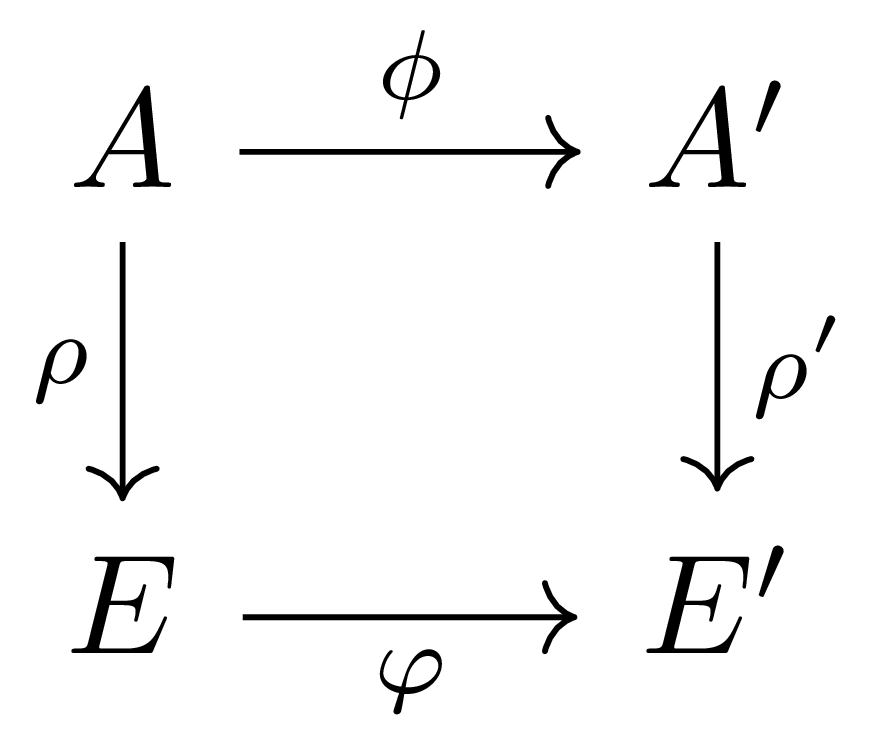
and regard \(E\) and \(E'\) as an \(A\)-algebra and an \(A'\)-algebra via \(\rho\) and \(\rho'\), respectively. Then there exists a unique \(E\)-linear map \(\Omega_{\varphi/\phi}:\Omega_{E/A} \rightarrow \Omega_{E'/A'}\) making the following diagram
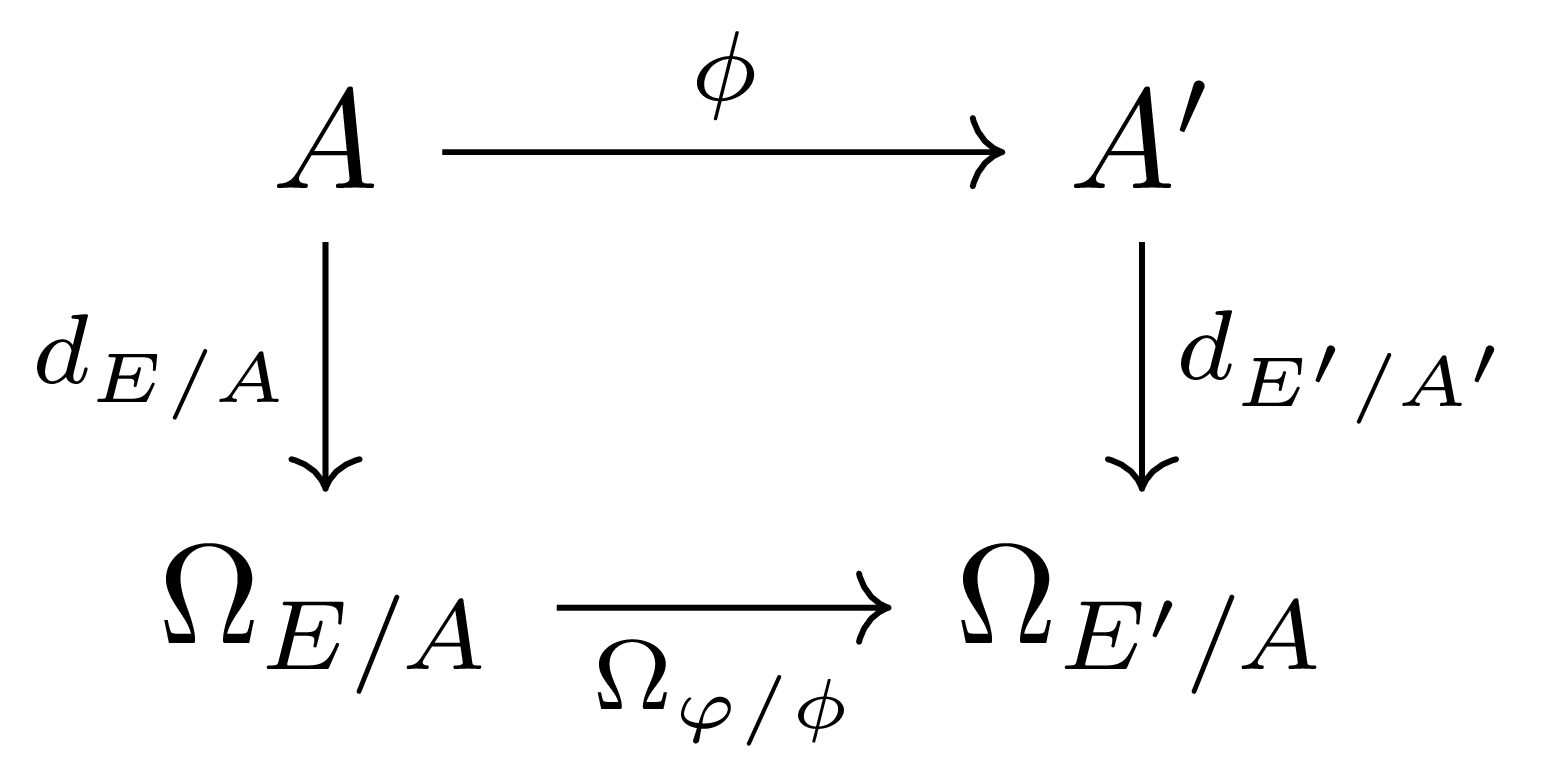
commute.
Proof
Since \(d_{E'/A'}\circ \phi\) is an \(A\)-derivation, this is immediate from Lemma 2.
On the other hand, since \(\Omega_{E'/A'}\) is an \(E'\)-module, by [Algebraic Structures] §Change of Base Ring, ⁋Proposition 5 we have
\[\Hom_{E'}(\varphi_! \Omega_{E/A},\Omega_{E'/A'})\cong\Hom_E(\Omega_{E/A}, \varphi^\ast\Omega_{E'/A'}).\]Then the map \(\Omega_{E/A} \rightarrow \Omega_{E'/A'}\) obtained from Proposition 4 above is, strictly speaking, a map \(\Omega_{E/A} \rightarrow \varphi^\ast\Omega_{E'/A'}\), and thus there exists a unique corresponding \(E'\)-linear homomorphism
\[\Omega_{\varphi/\phi}': \varphi_!\Omega_{E/A}=\Omega_{E/A}\otimes_EE' \rightarrow \Omega_{E'/A'}\]Fundamental sequences
In particular, let us take \(\phi:A \rightarrow A'\) to be \(\id_A:A \rightarrow A\). Then the \(E'\)-linear homomorphism constructed above depends only on the \(A\)-linear map \(\varphi:E \rightarrow E'\), and takes the form
\[\Omega_{\varphi/A}':\Omega_{E/A}\otimes_EE' \rightarrow \Omega_{E'/A}\]On the other hand, viewing \(E'\) as an \(E\)-algebra via \(\varphi:E \rightarrow E'\), the Kähler differential module \(\Omega_{E'/E}\) of \(E'\) over \(E\) is defined. The universal \(E\)-derivation \(d_{E'/E}: E \rightarrow \Omega_{E'/E}\) is also an \(A\)-derivation, so by Lemma 2 again it coincides with the following:
\[d_{E'/E}=E' \overset{d_{E'/A}}{\longrightarrow}\Omega_{E'/A}\overset{\Omega_\varphi}{\longrightarrow}\Omega_{E'/E}\]Proposition 5 (Cotangent sequence) The sequence of \(E'\)-linear maps
\[\Omega_{E/A}\otimes_EE'\overset{\Omega_{\varphi/A}'}{\longrightarrow}\Omega_{E'/A}\overset{\Omega_\varphi}{\longrightarrow}\Omega_{E'/E} \longrightarrow 0\]is exact.
Proof
Another important exact sequence is obtained in the special case where \(\varphi:E \rightarrow E'\) is surjective. In this case, the first isomorphism theorem yields
\[E/\ker \varphi\cong E'\]For convenience, write \(K=\ker\varphi\). Then, considering the restriction of \(d_{E/A}:E \rightarrow \Omega_{E/A}\) to \(K\), denoted \(d_{E/A}\vert_K: K \rightarrow \Omega_{E/A}\), we may consider the following \(E\)-linear map
\[K\overset{d\vert_K}{\longrightarrow}\Omega_{E/A}\overset{}{\longrightarrow}\Omega_{E/A}\otimes_EE'\]One can verify that the kernel of the above composition contains \(K^2\), and thus we obtain an \(E\)-linear map
\[\bar{d}:K/K^2 \rightarrow \Omega_{E/A}\otimes_EE'\]Proposition 6 In the above situation, the following sequence
\[K/K^2 \overset{\bar{d}}{\longrightarrow}\Omega_{E/A}\otimes_EE' \rightarrow\Omega_{E'/A} \longrightarrow 0\]is exact.
댓글남기기