This post was translated from Korean by LLM (Kimi). The translation may contain errors or awkward sentences. The Korean original is the source of truth.
Definition of Completion
Given an abelian group \(G\) and a decreasing sequence of its subgroups
\[\mathcal{J}:\qquad G=H_0\supseteq H_1\supseteq\cdots\]the quotient maps \(G/ H_{i+1} \rightarrow G/H_{i}\) are well defined, and more generally by taking appropriate compositions we obtain maps \(\rho_{ji}:G/H_j \rightarrow G/H_i\) whenever \(j>i\). From this data we obtain the inverse limit
\[\widehat{G}_\mathcal{J}=\varprojlim_i G/H_i=\left\{(g_1,g_2,\ldots)\in \prod G/H_i\,\middle\vert\,\text{$\rho_{ji}(g_j)=g_i$ for all $j>i$}\right\}\]together with the canonical morphisms \(\rho_i:\widehat{G}_{\mathcal{J}} \rightarrow G/ H_i\), which satisfy \(\rho_{ji}\circ\rho_j=\rho_i\) for all \(j>i\). For notational convenience, when \(\mathcal{J}\) is clear from context we also write simply \(\widehat{G}\).
Then, as we saw in [Category Theory] §Limits, ⁋Example 5, these can be viewed as categorical limits, and therefore also satisfy the following universal property.
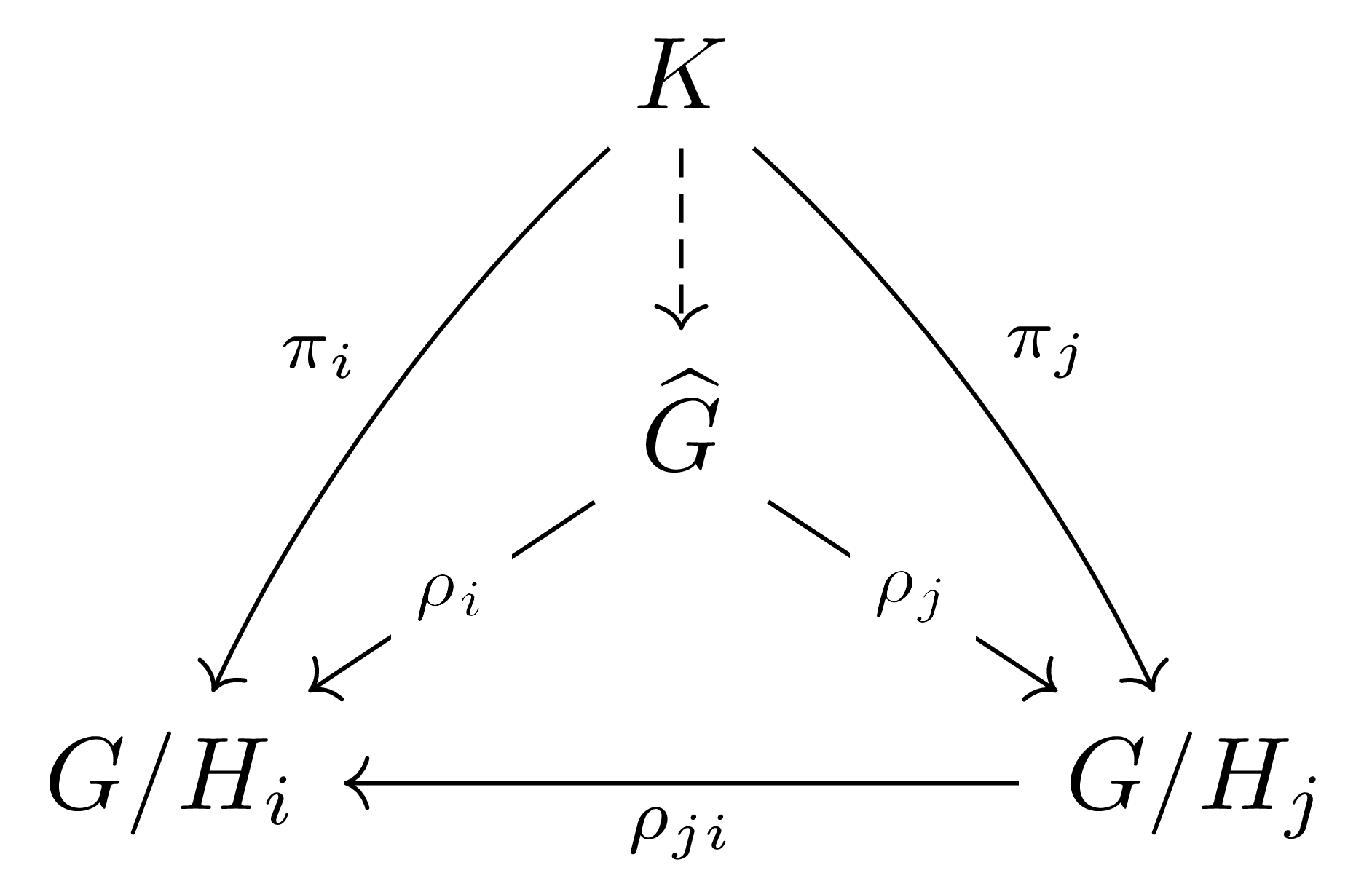
Whenever maps \(K \rightarrow G/H_i\) satisfying \(\rho_{ji}\circ\pi_j=\pi_i\) are given, there exists a unique \(\pi:K \rightarrow \widehat{G}\) making the following diagram
commute.
If \(G\) is given a ring structure and the \(H_i\) are ideals, then \(\widehat{G}\) also carries a natural ring structure. The situation we will examine is as follows.
Definition 1 Fix a ring \(A\) and an ideal \(\mathfrak{a}\). Then for an \(\mathfrak{a}\)-filtration of ideals of \(A\)
\[\mathcal{J}:\qquad A=\mathfrak{a}_0\supseteq \mathfrak{a}_1\supseteq \mathfrak{a}_2\cdots\]we call
\[\widehat{A}=\varprojlim_i A/\mathfrak{a}_i\]the completion of \(A\) defined by this filtration. If the natural map \(A \rightarrow \widehat{A}\) is an isomorphism, we call \(A\) a complete ring with respect to this filtration.
In particular, if the above filtration is of the form
\[A\supseteq\mathfrak{a}\supseteq \mathfrak{a}^2\cdots\]we call it the \(\mathfrak{a}\)-adic completion of \(A\). In this case, if \(\mathfrak{a}\) is a maximal ideal then \(\widehat{A}\) becomes a local ring with unique maximal ideal \(\widehat{\mathfrak{a}}\), so we call \(\widehat{A}\) a complete local ring.
First, the natural map \(\rho:A \rightarrow \widehat{A}\) is obtained by applying the universal property to the canonical morphisms \(\pr_i: A \rightarrow A/\mathfrak{a}_i\). Then by definition
\[x\in\ker\rho\iff\rho(x)=0\iff \rho_i(\rho(x))=0\text{ for all $i$}\iff \pr_i(x)=0\text{ for all $i$}\iff x\in \mathfrak{a}_i\text{ for all $i$}\]and thus \(\rho\) is injective if and only if \(\bigcap \mathfrak{a}_i=0\).
Now let us write \(\widehat{\mathfrak{a}}_i\) for the kernel of the canonical morphism \(\rho_i:\widehat{A}\rightarrow A/\mathfrak{a}_i\). Then by definition \(\mathfrak{a}_i=\rho^{-1}(\widehat{\mathfrak{a}}_i)\), and since the \(\pr_i\) are surjective and \(\pr_i=\rho_i\circ\rho\), the \(\rho_i\) are all surjective; hence by the first isomorphism theorem
\[\widehat{A}/\widehat{\mathfrak{a}}_i\cong A/\mathfrak{a}_i\]holds. Therefore the descending chain of ideals of \(\widehat{A}\)
\[\widehat{A}=\widehat{\mathfrak{a}}_0\supseteq \widehat{\mathfrak{a}}_1\supseteq\cdots\tag{1}\]forms an \(\mathfrak{a}\)-filtration, and from the above isomorphism
\[\widehat{A}=\varprojlim_i A/\mathfrak{a}_i\cong\varprojlim_i \widehat{A}/\widehat{\mathfrak{a}}_i\]we see that \(\widehat{A}\) is complete with respect to the given filtration. In addition, the above isomorphism also gives the isomorphism
\[\gr_\mathcal{J}A\cong\gr_{\widehat{\mathcal{J}}}\widehat{A}\]\(\mathfrak{a}\)-adic Topology
Meanwhile, the process of constructing \(\widehat{A}\) from \(A\) can also be examined by endowing it with a special kind of topology. First, suppose a topological abelian group \(G\) is given. Fixing an element \(g\) of \(G\), the translation map \(T_g\) defined by it is continuous, so the neighborhood filter at each point of \(G\) is completely determined by the neighborhood filter at \(0\in G\). Of course this process can also be reversed.
As in the previous section, suppose a decreasing sequence of subgroups of \(G\)
\[G=H_0\supseteq H_1\supseteq\cdots\]is given. Then defining
\[\mathcal{N}(0)=\{U\subseteq G\mid\text{$G_n\subseteq U$ for some $n$}\}\]we know that this satisfies all the conditions of [Topology] §Open Sets, ⁋Proposition 6. Now, for any \(g\in G\) and \(U\in \mathcal{N}(0)\), by setting \(g+U\in \mathcal{N}(g)\) we obtain a topology on \(G\).
Applying this specifically to the situation of Definition 1, we call the topology defined by the above process the \(\mathfrak{a}\)-adic topology. Here, \(0\in A\) has a countable local base
\[\mathfrak{a}\supseteq \mathfrak{a}^2\supseteq\cdots\tag{2}\]so the topology on \(A\) defined in this way is first countable.
Returning to a general topological abelian group \(G\), we can weaken the condition of ##ref## to define the following.
Definition 2 For a topological group \((G, +, 0)\), a sequence \((x_i)_{i\in \mathbb{N}}\) of elements of \(G\) is called a Cauchy sequence if for every neighborhood \(U\) of \(0\) there exists a natural number \(N\) such that the statement
\[m,n>N \implies x_m-x_n\in U\]holds.
Then, just as in ##ref## completion was defined as the collection of equivalence classes of Cauchy filters, when two Cauchy sequences \((x_m)\), \((y_n)\) are given we can decide when they are to be regarded as the same, and through that define the (topological) completion. However, what interests us is the first countable topological group \(A\) defined by the filtration (2) above, and since a first countable space is sequential, for convenience we assume in the following definition that \(G\) is a first countable space and use Cauchy sequences instead of Cauchy filters.
Definition 3 Two Cauchy sequences \((x_m)\), \((y_n)\) in a topological group \((G, +, 0)\) are called equivalent if for every neighborhood \(U\) of \(0\) there exists a natural number \(N\) such that the statement
\[m,n>N \implies x_m-y_n\in U\]holds. We call the set obtained by endowing the set of all Cauchy sequences in a first countable topological group \(G\) with this equivalence relation the completion of \(G\), and denote it by \(\widehat{G}\).
Now, for an open neighborhood \(U\) of \(0\in G\), define
\[\widehat{U}=\{[(x_n)]\in \widehat{G}:\text{for any $(y_n)\in [(x_n)]$, $y_n\in U$ for all but finitely many $n$}\}\]Then by a short calculation, one can check that the collection \(\mathcal{N}(0)\) of subsets of \(\widehat{G}\) having the \(\widehat{H}_i\) as a coinitial subset satisfies all the conditions of [Topology] §Open Sets, ⁋Proposition 6, and thus we can define a topology on \(\widehat{G}\). By definition \(\widehat{G}\) is also first countable, and one can see that the map \(G \rightarrow \widehat{G}\) sending \(x\in G\) to the constant sequence \((x_i=x)\) is continuous. Moreover, this map is exactly the same as the \(G \rightarrow \widehat{G}\) defined in the previous section.
Basic Properties of Completion
Now let us look at the basic properties of completion. By Definition 3 above, any element of \(\widehat{A}\) can be thought of as a Cauchy sequence in the \(\mathfrak{a}\)-adic topology on \(A\). Then for elements \(b_j\) satisfying \(b_j\in \mathfrak{a}^j\), writing
\[a_i=\sum_{j=1}^i b_j\tag{3}\]the sequence \((a_i)\) is a Cauchy sequence in \(\widehat{A}\), and therefore the limit
\[\sum_{j=1}^\infty b_j\]defines an element of \(\widehat{A}\). Conversely, given any element \((a_n')\) of \(\widehat{A}\), using the local base (2) of \(0\) we can find a Cauchy sequence equivalent to this element and of the form (3).
Example 4 If \(A=\mathbb{K}[\x]\) and \(\mathfrak{a}=(\x)\), then \(\widehat{A}\) is the ring of formal power series \(\mathbb{K}[[\x]]\).
The ring \(\mathbb{K}[[\x]]\) is a discrete valuation ring with unique nonzero prime ideal \(\mathfrak{m}=(\x)\). That is, any element not in \((\x)\) is a unit, which essentially follows from the formula
\[\frac{1}{1+\x}=1-\x+\x^2-\cdots\]The above equality, or the following equivalent equality
\[(1+\x)(1-\x+\x^2-\cdots)=1\]as in the above discussion, for the partial sum up to degree \(i\) of \(1-\x+\x^2-\cdots\)
\[1-\x+\x^2-\cdots+(-1)^i\x^i\]we have
\[(1+\x)(1-\x+\x^2-\cdots+(-1)^i\x^i)=1+(-1)^i\x^i\in \mathfrak{m}^i\]and therefore this product is obtained from the fact that it is equivalent to the constant sequence \((1)\).
Generalizing this calculation, we obtain the following two results.
Proposition 5 Suppose \(A\) is complete with respect to an ideal \(\mathfrak{a}\). Then the set
\[U=\{1+a\mid a\in \mathfrak{a}\}\]consists of units of \(A\), and \(U\) is multiplicatively closed.
Proof
Replace \(\x\) by \(a\) in the above argument.
Corollary 6 For a local ring \((A, \mathfrak{m})\), the ring \(A[[\x_1,\ldots, \x_n]]\) is also a local ring, and its unique maximal ideal is \(\mathfrak{m}+(\x_1,\ldots, \x_n)\).
Proof
Elements outside \(\mathfrak{m}+(\x_1,\ldots,\x_n)\) have a nonzero constant term, so by Proposition 5 we can show that they are units.
In addition, the following holds.
Proposition 7 Let a filtration of ideals of \(A\)
\[A=\mathfrak{a}_0\supseteq \mathfrak{a}_1\supseteq\cdots\]and the associated graded ring \(\gr A\) with respect to this filtration be given. If \(A\) is complete with respect to this filtration, then for an ideal \(\mathfrak{a}\) of \(A\) and its elements \(a_1,\ldots, a_n\), if \(\initial(\mathfrak{a})\) is generated by \(\initial(a_1),\ldots, \initial(a_n)\), then \(\mathfrak{a}\) is also generated by \(a_1,\ldots, a_n\).
Proof
Let \(\mathfrak{a}'\) be the ideal generated by the elements \(a_1,\ldots, a_n\), and let us show that \(\mathfrak{a}=\mathfrak{a}'\). Without loss of generality we may assume that all these elements are nonzero. Also, if \(a_k\in \mathfrak{a}_i\) held for all \(i\), then under the canonical morphism \(A \rightarrow \widehat{A}\) the element \(a_k\) would be sent to \(0\in \widehat{A}\), and since \(A\) is complete this would mean \(a_k=0\); thus we can choose a suitable \(d\) such that \(a_k\not\in \mathfrak{a}_i\) for all \(k\).
On the other hand, from the assumption that \(\initial(\mathfrak{a})\) is generated by the \(\initial(a_k)\), for any \(a\in \mathfrak{a}\) there exist elements \(\beta_k\in \gr_\mathfrak{a}A\) satisfying the equation
\[\initial(a)=\sum_{k=1}^n \beta_k\initial(a_k)\tag{4}\]and considering degrees in the above equation, the \(\beta_k\) are homogeneous and their degrees must satisfy
\[\degree(\beta_k)=\degree (\initial(a))-\degree(\initial(a_k))>\degree(\initial(a))-d\]Therefore, for elements \(b_k\in A\) satisfying \(\initial(b_k)=\beta_k\), the element \(a-\sum_k b_k a_k\) lies in \(\mathfrak{m}_{\degree(\initial(a))+1}\). Repeating this process, we can choose \(a'\in \mathfrak{a}'\) such that
\[a-\underbrace{\sum_k b_k a_k-\cdots}_{=a'} \in \mathfrak{a}_{d+1}\]Since \(a'\) is generated by the \(a_k\) anyway, showing that \(a\) is generated by the \(a_k\) is the same as showing that \(a-a'\) is generated by the \(a_k\). In other words, without loss of generality we may assume that \(a\) lies in \(\mathfrak{a}_{d+1}\).
Now let us revisit equation (4) under this assumption. Writing \(\degree(\initial(a))=e\), we saw above that the degree of \(\beta_k\) must be at least \(e-d\). Therefore we can choose the \(b_k\) from \(\mathfrak{a}_{e-d}\), and by the same logic as above we know that
\[a-\sum_{k=1}^n b_ka_k\]lies in \(\mathfrak{a}_{e-d+1}\). Iterating this, we can choose elements \(b_k^{(l)}\in \mathfrak{a}_{e-d+l}\) such that
\[a-\sum_{k=1}^n\sum_{l=0}^j b_k^{(l)}a_k\in \mathfrak{a}_{e+j+1}\]Since \(A\) is complete, the infinite sum
\[\sum_{l=0}^\infty b_k^{(l)}\]can be regarded as an element \(c_k\) of \(A\). Then
\[a-\sum_{k=1}^n c_k a_k\in \bigcap \mathfrak{a}_i=0\]and we obtain the desired result.
References
[AM] M.F. Atiyah and I.G. Macdonald, Introduction to commutative algebra, Basic Books, 1969.
[Eis] David Eisenbud. Commutative Algebra: with a view toward algebraic geometry. Springer, 1995.
댓글남기기