
In this article, we examine methods to convert \(A\)-modules to \(B\)-modules or vice versa via a ring homomorphism \(\phi:A \rightarrow B\). Therefore, since abbreviating scalar multiplication and operations as before could cause confusion, we will denote multiplication maps as before by omitting \(\cdot\), and denote actions by \(\cdot\) (or \(\cdot_A\) and \(\cdot_B\)).
Restriction of Scalars
Let a \(B\)-module \(\rho_N:B\otimes N \rightarrow N\) be given. Then considering the composition

the map \(\phi^\ast\rho_N:A\otimes N \rightarrow N\) satisfies all the conditions that an action must satisfy, and thus defines an \(A\)-module structure on \(N\). Moreover, considering the diagram
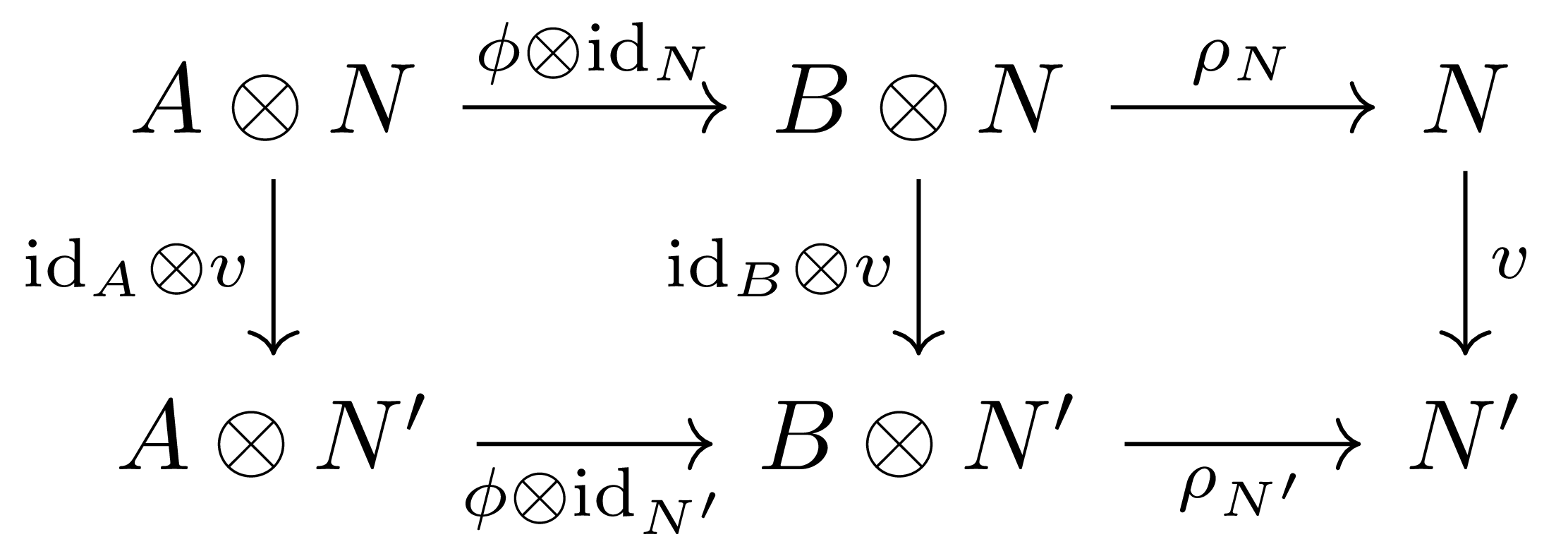
we see that this correspondence of \(A\)-modules is functorial.
Definition 1 For a ring homomorphism \(\phi:A \rightarrow B\), the functor defined as above is denoted by \(\phi^\ast: \lMod{B} \rightarrow \lMod{A}\) and called the restriction of scalars.
That is, this is simply defining the action of \(A\) on \(N\) by using a given \(B\)-module \(\rho_N: B\otimes N \rightarrow N\):
\[\alpha\cdot_A y:=\phi(\alpha)\cdot_B y\]Consider in particular the case \(N=B\). As sets, \(\phi^\ast B\) and \(B\) are identical, so we can verify the relationship between the original ring homomorphism \(\phi:A \rightarrow B\) and the action of \(\phi^\ast B\); in this case, we can verify that \(\phi\) becomes an \(A\)-linear map.
Example 2 The forgetful functor \(U: \lMod{B} \rightarrow\Ab\) is induced by the (unique) ring homomorphism \(\mathbb{Z}\rightarrow B\).
Extension of Scalars
We will now define two functors from \(\lMod{A}\) to \(\lMod{B}\). For convenience, fix an \(A\)-module \(M\).
Consider the tensor product \(\phi^\ast B\otimes_AM\) of the two \(A\)-modules \(\phi^\ast B\) and \(M\). On this, we can define an action \(\cdot_B\) of \(B\) by the formula
\[\beta'\cdot_B(\beta\otimes_A x)=(\beta'\beta)\otimes_A x\]That this is indeed an action can be obtained through straightforward calculation, or can be thought of as obtained from the composition
\(B\otimes_\mathbb{Z}(\phi^\ast B\otimes_AM)\cong (B\otimes_\mathbb{Z}\phi^\ast B)\otimes_AM \overset{\mu_B}{\longrightarrow} \phi^\ast B\otimes_AM\)1. Also, for any \(A\)-linear map \(u:M \rightarrow M'\), we can verify that \(\id_{\phi^\ast B}\otimes_A u\) defines a \(B\)-linear map between the two \(B\)-modules thus defined.
Definition 3 The functor \(\phi^\ast B\otimes_A-:\lMod{A} \rightarrow \lMod{B}\) defined above is simply denoted by \(\phi_!\) and called the extension of scalars.
Coextension of Scalars
As before, fix an \(A\)-module \(M\). This time, we consider homomorphisms between the two \(A\)-modules \(\phi^\ast B\) and \(M\). Define a \(B\)-module structure on the abelian group
\[\Hom_A(\phi^\ast B,M)\]by
\[\beta\cdot g: (\beta'\mapsto g(\beta'\beta))\]For any \(\alpha\in A\) and any \(\beta'\in \phi^\ast B\),
\[(\beta\cdot g)(\alpha\cdot \beta')=g(\phi(\alpha)\beta'\beta)=g(\alpha\cdot(\beta'\beta))=\alpha\cdot g(\beta'\beta)=\alpha\cdot (\beta\cdot g)(\beta')\]so \(\beta\cdot g\) is also an \(A\)-linear map. Through some calculation, we can verify that this is also functorial, and thus the following is defined.
Definition 4 The functor \(\Hom_A(\phi^\ast B,-): \lMod{A} \rightarrow \lMod{B}\) is called the coextension of scalars and denoted by \(\phi_\ast\).
Adjoint Functors
There are certain adjoint relationships among the three functors defined above. First, we show the following lemma.
Lemma 5 For a right \(B\)-module \(N_1\) and a left \(B\)-module \(N_2\), consider the two abelian groups \(\phi^\ast N_1\otimes_A \phi^\ast N_2\) and \(N_1\otimes_B N_2\). Then there exists a unique bilinear map \(\Phi:\phi^\ast N_1\otimes_A \phi^\ast N_2 \rightarrow N_1\otimes_BN_2\) such that any \(y_1\otimes_A y_2\in \phi^\ast N_1\otimes_A\phi^\ast N_2\) is sent to \(y_1\otimes_B y_2\in N_1\otimes_BN_2\).
If \(A\) is a commutative ring, then \(\Phi\) becomes an \(A\)-linear map \(\phi^\ast N_1\otimes_A\phi^\ast N_2 \rightarrow\phi^\ast(N_1\otimes_BN_2)\).
Proof
Define the function from \(\phi^\ast N_1\times\phi^\ast N_2\) to \(N_1\otimes_B N_2\) by \((y_1,y_2)\mapsto y_1\otimes_B y_2\), and show that this behaves well with respect to the scalar multiplication of \(A\). Since the scalar multiplication of \(A\) on \(\phi^\ast N_1,\phi^\ast N_2\) is defined as a \(B\)-action via \(\phi(\alpha)\), for any \(\alpha\in A\),
\[(\alpha\cdot_A y_1,y_2)=(\phi(\alpha)\cdot_B y_1, y_2)\mapsto (\phi(\alpha)\cdot_B y_1)\otimes_B y_2=y_1\otimes_B(\phi(\alpha)\cdot_B y_1)\]holds, and therefore \((\alpha\cdot_A y_1,y_2)\) and \(y_1,\alpha\cdot_Ay_2\) are sent to the same element, so the proof is complete by the universal property of tensor products.
The following propositions can be proved in the general case, but for convenience, we assume that \(A, B\) are both commutative rings.
Proposition 5 An adjunction \(\phi_!\dashv\phi^\ast\) exists.
Proof
Fix arbitrary \(A\)-module \(M\) and \(B\)-module \(N\). First, for any \(v\in\Hom_B(\phi_!M,N)\), the composition of functions

gives a function \(M \rightarrow N\). Here, \(M \rightarrow A\otimes_AM \rightarrow \phi^\ast B\otimes_AM\) is a composition of \(A\)-linear maps, and \(v:\phi^\ast B\otimes M \rightarrow N\) is a \(B\)-linear map. First, for any \(\alpha\in A\) and \(x\in M\), looking at the composition of \(A\)-linear maps,
\[\alpha\cdot_Ax\mapsto \alpha\otimes_A x\mapsto \phi(\alpha)\otimes_A x\]and for the \(B\)-linear map \(f\), using
\[\phi(\alpha)\otimes_A x=(\phi(\alpha)1)\otimes_A x=\phi(\alpha)\cdot_B(1\otimes_A x)\]we have
\[v(\phi(\alpha)\otimes_A x)=v(\phi(\alpha)\cdot_B(1\otimes_A x))=\phi(\alpha)\cdot_B v(1\otimes_A x)\]That is, regarding \(N\) as an \(A\)-module through restriction of scalars, we see that the above composition is an \(A\)-linear map.
Conversely, let any \(u\in\Hom_A(M, \phi^\ast N)\) be given. Then the composition

gives a function \(\phi_!M \rightarrow N\). For any \(\beta'\in B\) and \(\beta\otimes_A x\in \phi^\ast B\otimes_AM\),
\[\Phi(\id_{\phi^\ast B}\otimes_A u(\beta'\cdot_B(\beta\otimes_Ax)))=\Phi((\beta'\beta)\otimes_Ax)=(\beta'\beta)\otimes_B x\]and this is sent to \((\beta'\beta)\cdot_Bx=\beta'\cdot_B(\beta\cdot_Bx)\) via \(B\otimes_BN\cong N\). That is, the function defined above is a \(B\)-linear map.
We can now verify that the two functions defined above are inverses of each other, and moreover, that they define a natural equivalence.
Also, the following adjoint pair can be proved in a similar way.
Proposition 6 An adjunction \(\phi^\ast\dashv\phi_\ast\) exists.
Thus \(\phi^\ast:\lMod{B} \rightarrow\lMod{A}\) is both a left adjoint and a right adjoint, and therefore commutes with all limits and colimits.
-
Strictly speaking, to make the first isomorphism in this formula meaningful, we need to use the fact that \(B\) is an \((A,\mathbb{Z})\)-bimodule. ↩
댓글남기기