Products of Groups
We know how to define products in any category \(\mathcal{A}\). ([Category Theory] §Limits, ⁋Example 6) The following lemma shows that any product in the category \(\Grp\) always exists.
Lemma 1 \(\Grp\) is a cartesian monoidal category.
Proof
First, we already defined the product set \(\prod_{i\in I} G_i\) satisfying the universal property of products in \(\Set\) in [Set Theory] §Product of Sets, ⁋Definition 1. For notational convenience, we denote elements \(f:I\rightarrow \bigcup G_i\) of \(\prod_{i\in I}G_i\) as tuples \((a_i)_{i\in I}\).
Now, for any two elements \(x=(x_i)_{i\in I},y=(y_i)_{i\in I}\) of the set \(\prod_{i\in I}G_i\), define
\[xy=(x_i)_{i\in I}(y_i)_{i\in I}=(x_iy_i)_{i\in I}\]Then \(\prod_{i\in I}G_i\) has a group structure under this operation, with identity element \((e_i)_{i\in I}\) and the inverse of \(x=(x_i)_{i\in I}\) being \((x_i^{-1})_{i\in I}\). Also, for any \(j\in I\),
\[\pr_j(xy)=\pr_j(x_iy_i)_{i\in I}=x_jy_j=\pr_j(x)\pr_j(y)\]so \(\pr_j\) is a group homomorphism.
Now we prove that \((G=\prod_{i\in I}G_i,(\pr_i)_{i\in I})\) defined in this way satisfies the universal property. For this, it suffices to show that the function \(f:H\rightarrow G\) obtained from the universal property of product sets is a group homomorphism. Now for any \(x,y\in H\) and any \(i\in I\),
\[f(xy)=(f_i(xy))_{i\in I}=(f_i(x)f_i(y))_{i\in I}=(f_i(x))_{i\in I}(f_i(y))_{i\in I}=f(x)f(y)\]so \(f\) is a group homomorphism, and thus the above \((G=\prod_{i\in I}G_i,(\pr_i)_{i\in I})\) satisfies the universal property.
The following corollaries are also immediate from the universal property of products.
Corollary 2 For a family of groups \((G_i)\), their product is uniquely determined up to unique isomorphism.
Proof
In any category, terminal objects are unique up to unique isomorphism.
Corollary 3 Let \((G_i)\) and \((H_i)\) be families of groups with the same index set \(I\), and suppose group homomorphisms \(f_i:G_i\rightarrow H_i\) are given for each \(i\). Then there exists a unique group homomorphism \(f:\prod G_i\rightarrow\prod H_i\) making the following diagram
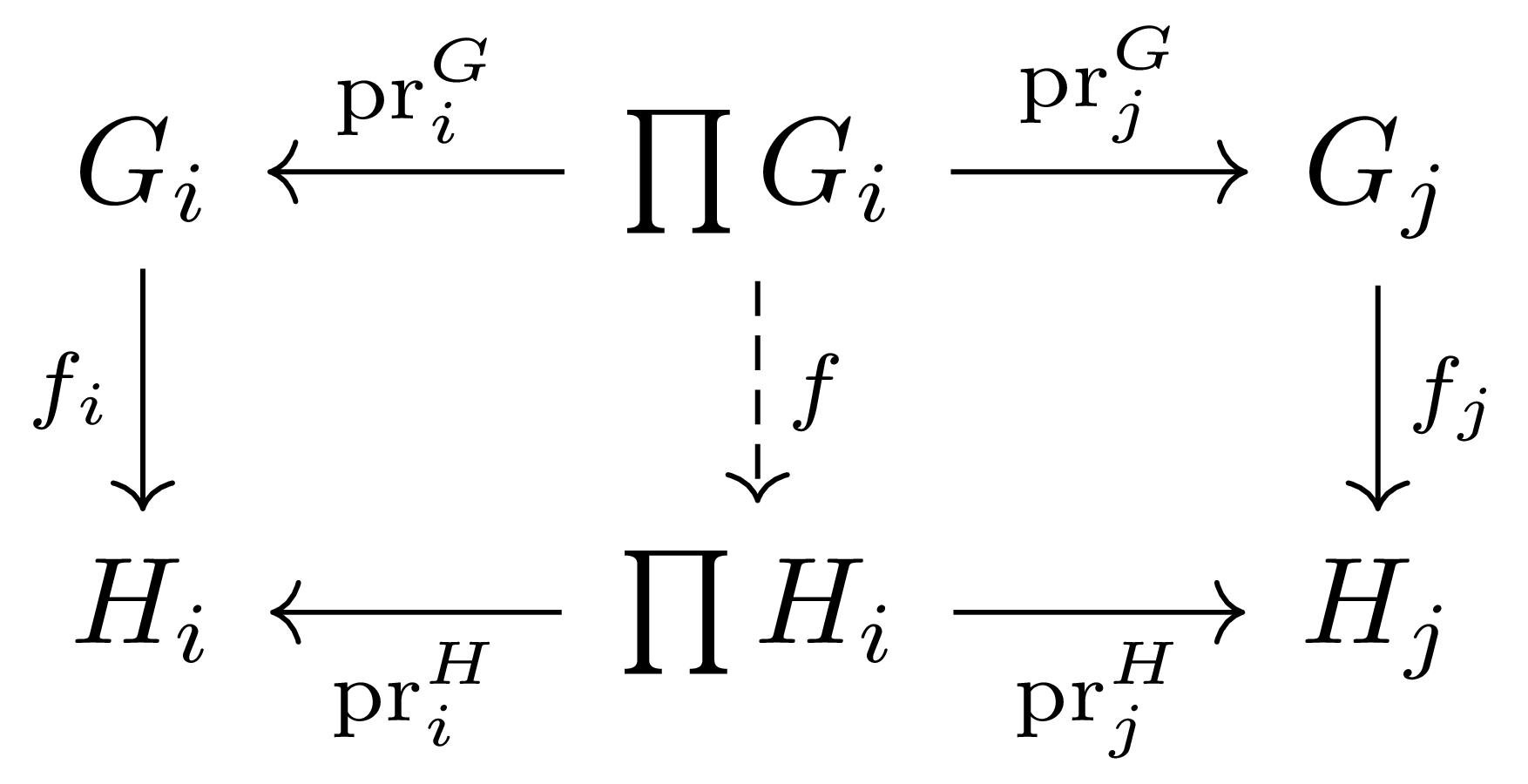
commute. Moreover, \(\ker f=\prod\ker f_i\) and \(\im f=\prod\im f_i\).
Proof
\(\prod H_i\) is the terminal object of the collection of cones satisfying the given conditions. ([Category Theory] §Limits, §§Universal Property of Limits) By the commutative diagram defined in this way,
\[x\in\ker f\iff f(x)=e\iff \forall i(\pr_i^H(f(x))=e_i)\iff \forall i((f_i\circ \pr_i^G)(x)=e_i)\iff \forall i(\pr_i^G(x)\in\ker f_i)\]so \(\ker f=\prod\ker f_i\) holds.
Similarly, for \(y\in\prod H_i\), \(y\in\im f\) if and only if there exists \(x\in H_i\) such that \(y=f(x)\), and for such \(x\),
\[\pr_i^H(y)=\pr_i^H(f(x))=f_i(\pr_i^G(x))\in\im f_i\]so \(\im f=\prod\im f_i\) also holds.
Corollary 4 Let a family of groups \((G_i)_{i\in I}\) be given. If for each \(i\in I\), \(H_i\) are normal subgroups of \(G_i\), then \(\prod H_i\) is also a normal subgroup of \(\prod G_i\), and its quotient group equals \(\prod (G_i/H_i)\).
Proof
Apply Corollary 3 to the canonical homomorphisms \(p_i:G_i\rightarrow G_i/H_i\).
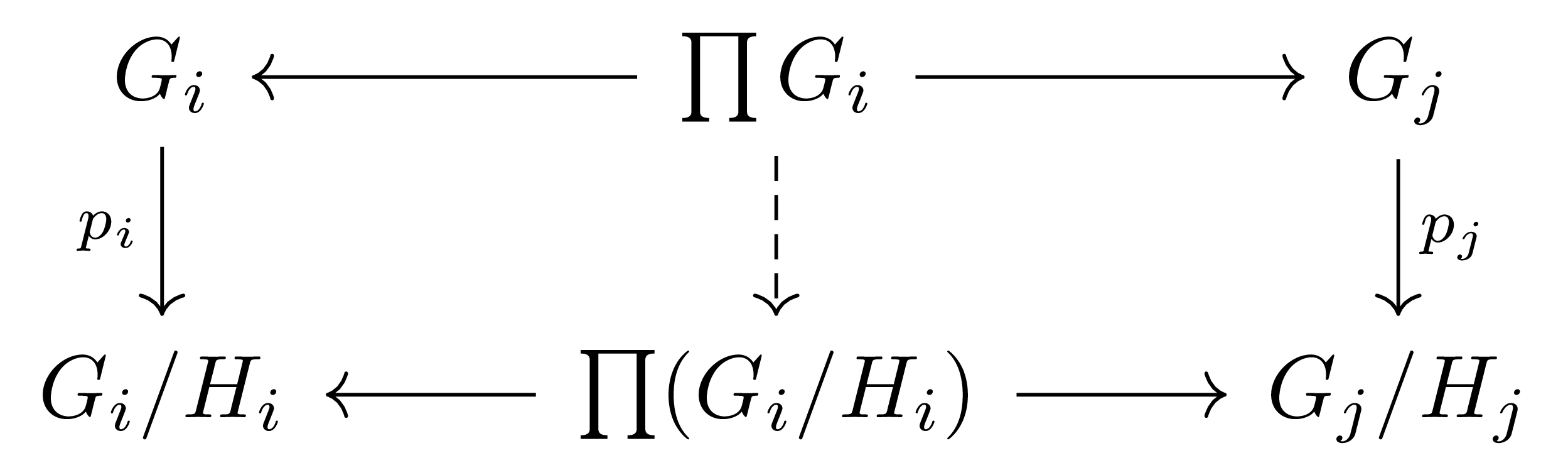
Each \(p_i\circ\pr_i\) is surjective as a composition of surjective homomorphisms, so by the previous corollary, \(\im p\) equals \(\prod(G_i/H_i)\). Also, the kernel of each \(p_i\) is \(H_i\). Therefore, by the first isomorphism theorem,
\[\biggl(\prod_{i\in I} G_i\biggr)\bigg/\biggl(\prod_{i\in I}H_i\biggr)\cong\prod_{i\in I} (G_i/H_i)\]holds.
Of course, even if \(H_i\) are subgroups (not necessarily normal) of \(G_i\), \(\prod H_i\) is a subgroup of \(\prod G_i\).
Corollary 5 Let a family of groups \((G_i)_{i\in I}\) be given. If for each \(i\in I\), \(H_i\leq G_i\), then \(\prod H_i\) is a subgroup of \(\prod G_i\).
Proof
Apply Corollary 3 to the inclusion homomorphisms \(\iota_i:H_i\hookrightarrow G_i\). Then \(\iota\) is injective and \(\prod H_i\) is precisely the image of \(\iota\), so it is a subgroup of \(\prod G_i\).
Partial Products
The above corollaries are particularly useful in the following situation.
Let \((G_i)_{i\in I}\) be a family of groups, and consider a subset \(J\) of \(I\). Then the product \(\prod_{j\in J}G_j\) is well-defined. On the other hand, consider the family of groups \((G_i')\) defined by
\[G_i'=\begin{cases} G_i&i\in J\\ \{e\}&i\not\in J\end{cases}\]and the group homomorphisms from \(G_i'\) to \(G_i\)
\[f_i=\begin{cases} \id_{G_i}&i\in J\\ \iota_i&i\not\in J\end{cases}\]It is not difficult to show that \(\prod_{i\in I}G_i'\cong\prod_{j\in J}G_j\), and therefore by Corollary 4,
\[\biggl(\prod_{i\in I}G_i\biggr)\bigg/\biggl(\prod_{j\in J}G_j\biggr)\cong\prod_{i\in I\setminus J} G_i\]holds.
References
[Bou] Bourbaki, N. Algebra I. Elements of Mathematics. Springer. 1998.
댓글남기기