
In the previous post, we examined the definition of a monoid. Notably, the natural numbers defined in set theory form a commutative monoid under addition. In this post, we introduce a method for obtaining an abelian group from a commutative semigroup.
First, consider the category \(\Ab\) of abelian groups. Since any abelian group can be regarded as a commutative monoid by forgetting the information about inverses, there exists a forgetful functor \(U: \Ab \rightarrow \cMon\). This functor is known to have a left adjoint \(K:\cMon \rightarrow \Ab\), and this adjunction can be expressed as the equation
\[\Hom_\Ab(K(M), G)\cong\Hom_\cMon(M, U(G))\]That is, given a commutative monoid \(M\) and a monoid homomorphism \(M\rightarrow U(G)\), we should be able to obtain a unique group homomorphism \(K(M)\rightarrow G\).
Universal Mapping Problem
We now need to demonstrate the existence of the left adjoint \(K\) described above. More generally, following our main reference [Bou], we examine the process of obtaining an abelian group from a commutative semigroup. Meanwhile, using the unit of the adjunction, we can spell out the properties that \(K\) must satisfy.
The abelian group \(K(S)\) and the semigroup homomorphism \(\eta_S:S\rightarrow K(S)\) form a pair satisfying the following property.
(Universal mapping problem) Whenever an abelian group \(G\) and a semigroup homomorphism \(f:S\rightarrow G\) are given, there exists a unique group homomorphism \(\bar{f}:K(S)\rightarrow G\) such that \(f=\bar{f}\circ\eta_S\).
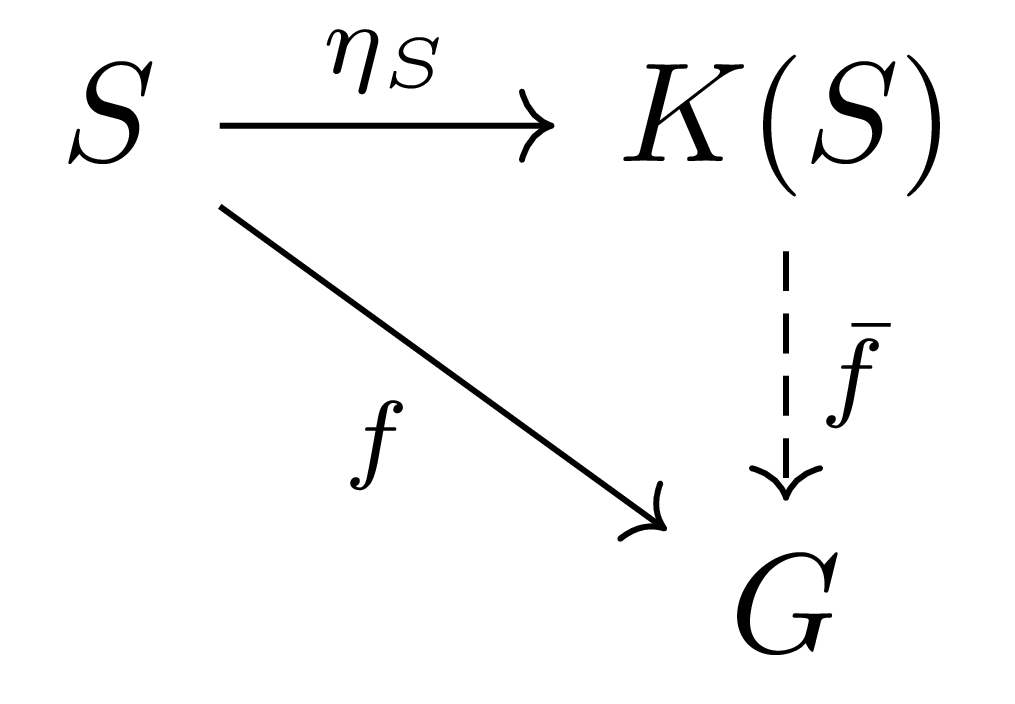
Intuitively, \(K(S)\) can be thought of as the smallest abelian group containing \((S,+)\).
The \(K(S)\) satisfying the above property is unique up to isomorphism.
Proposition 1 If an abelian group \(H\) and semigroup homomorphism \(\eta_S'\) satisfy the above universal mapping problem, then \(K(S)\cong H\) holds.
Proof
First, consider the following diagram.
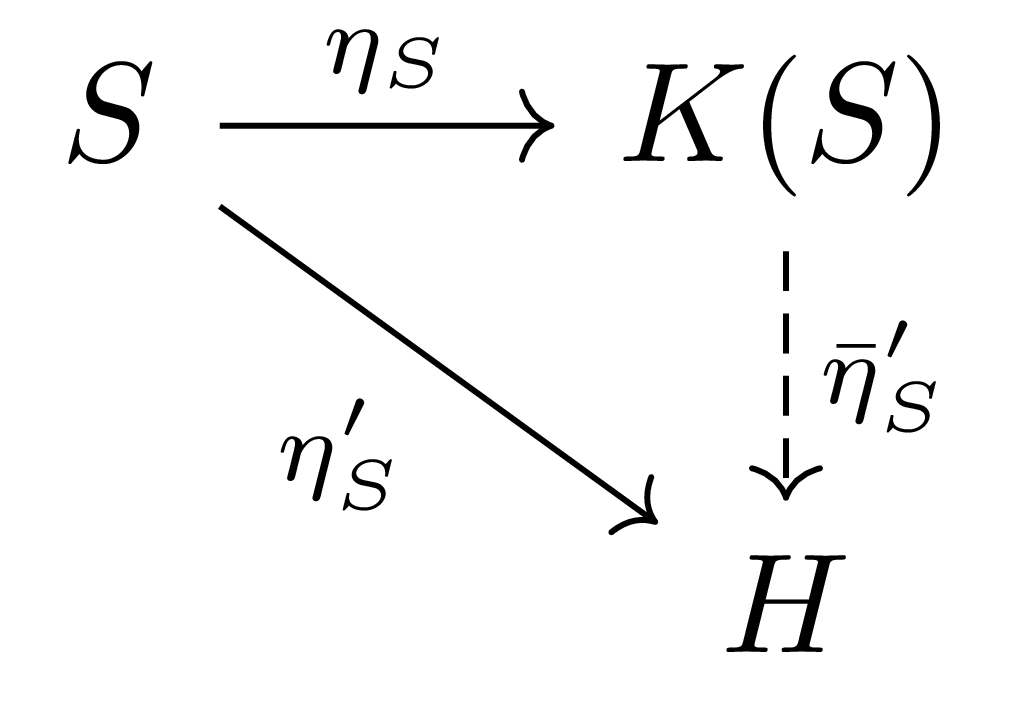
By the universal property, there exists \(\bar{\eta}_S': K(S)\rightarrow H\) such that \(\eta_S'= \bar{\eta}_S'\circ\eta_S\). On the other hand, from the following diagram
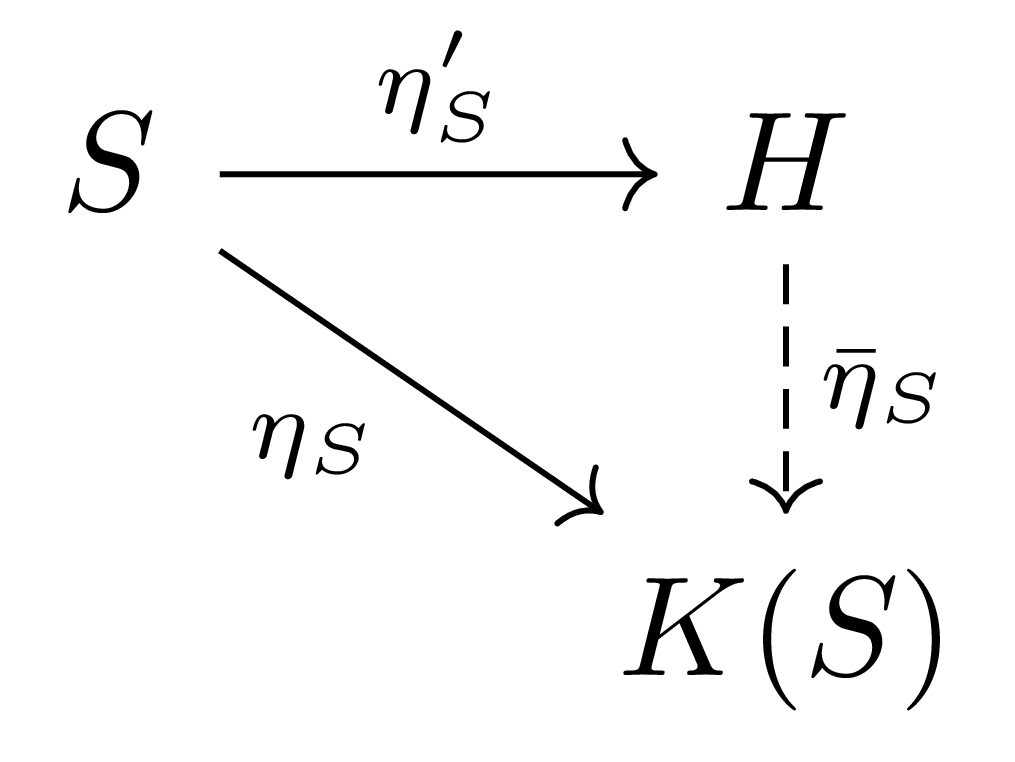
using the universal property for \(H\), there exists \(\bar{\eta}_S:H\rightarrow K(S)\) such that \(\eta_S=\bar{\eta}_S\circ\eta_S'\). Then
\[\bar{\eta}_S'\circ\bar{\eta}_S\circ\eta_S'=\bar{\eta}_S'\circ \eta_S=\eta=\id_{H}\circ \eta_S'\]and since \(f\) satisfying \(f\circ \eta_S'=\eta_S'\) is unique by the universal property, we have \(f=\id_H=\bar{\eta}_S'\circ \bar{\eta}_S\). Alternatively, in the language of diagrams, since the unique \(H\rightarrow H\) making the following diagram commute must be \(\id_H=\bar{\eta}_S'\circ \bar{\eta}_S\).
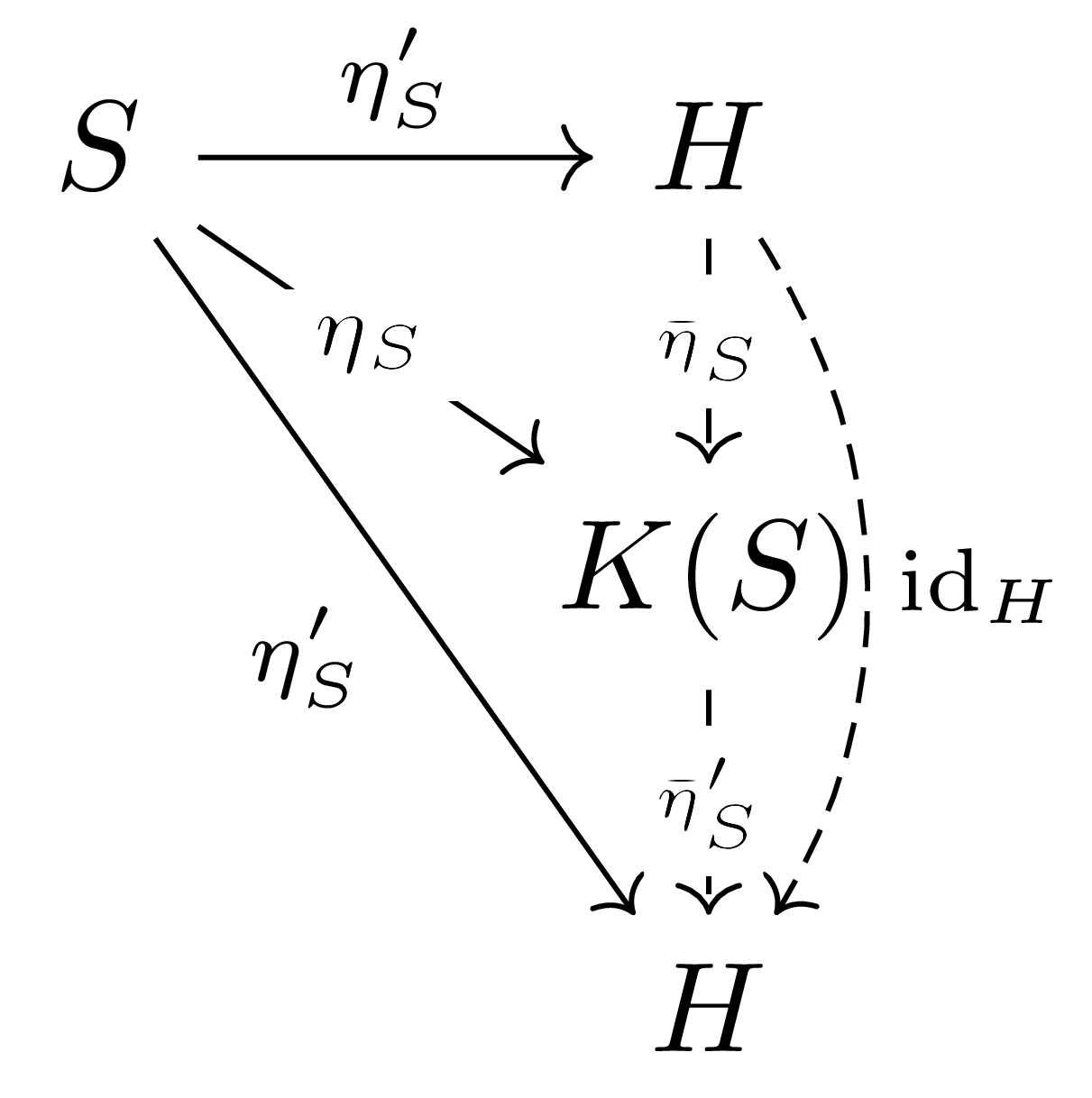
Similarly, we can show that \(\id_{K(S)}=\bar{\eta}_S\circ \bar{\eta}_S'\), and therefore \(K(S)\cong H\).
On the other hand, if \(S\) is already an abelian group, then \(K(S)\) should be \(S\) itself without adding any additional elements.
Proposition 2 If \(S\) is an abelian group, then the abelian group \(K(S)\) satisfying the above universal mapping problem satisfies \(K(S)\cong S\).
Proof
Since \(S\) and \(\id_S\) trivially satisfy the universal property, by Proposition 1, any abelian group satisfying the universal property must be isomorphic to \(S\).
The above propositions show that \(K(S)\) satisfying the universal mapping problem is the abelian group we are looking for, but they do not demonstrate that \(K(S)\) actually exists.
Definition of \(K(S)\)
The reason why \(S\) cannot be an abelian group is that inverses may not exist for all elements. Intuitively, this can be resolved by adding negatives.
Given a commutative semigroup \((S,+)\), consider the product semigroup \(S\times S\). (§Algebraic Structures, ⁋Example 5) If we think of the second component of \(S\times S\) as representing negatives, the equation
\[(a_1, b_1)+(a_2, b_2)=(a_1+a_2, b_1+b_2)\]can be thought of as representing
\[(a_1+a_2)-(b_1+b_2)=(a_1-b_1)+(a_2-b_2)\]Of course, in general, even if \(a\) and \(b\) are different, the value \(a-b\) can vary significantly, so we define an equivalence relation \(R\) on \(S\times S\) as follows.
\[(a_1, b_1)\equiv (a_2, b_2)\pmod{R}\iff a_1+b_2+c=a_2+b_1+c\text{ for some $c\in S$}\]First, we need to show that this relation is an equivalence relation.
Lemma 3 The relation \(R\) defined above is an equivalence relation compatible with the operation on the product semigroup \(S\times S\).
Proof
First, let us show that \(R\) is an equivalence relation. For any \((a,b)\in S\times S\),
\[a+b+c=a+b+c\]holds for any \(c\in S\), so \((a,b)\equiv(a,b)\). Suppose \((a_1,b_1)\equiv (a_2,b_2)\). That is, for some \(c\in S\),
\[a_1+b_2+c=a_2+b_1+c\]holds. But this is precisely the condition for \((a_2,b_2)\equiv (a_1,b_1)\), so \(R\) is symmetric. Finally, suppose \((a_1,b_1)\equiv(a_2,b_2)\) and \((a_2,b_2)\equiv (a_3,b_3)\). Then for some \(c\) and \(c'\),
\[a_1+b_2+c=a_2+b_1+c,\qquad a_2+b_3+c'=a_3+b_2+c'\]hold. Adding these two equations,
\[a_1+b_3+(a_2+b_2+c+c')=a_3+b_1+(a_2+b_2+c+c')\]so \((a_1,b_1)\equiv(a_3,b_3)\) holds. Thus \(R\) is an equivalence relation.
Now we need to show that \(R\) is compatible with the operation on \(S\times S\). For this, suppose \((a_1, b_1)\equiv(a_1',b_1')\) and \((a_2, b_2)\equiv (a_2',b_2')\). We need to show that \((a_1+a_2, b_1+b_2)\equiv(a_1'+a_2', b_1'+b_2')\). From the given conditions, there exist \(c_1\) and \(c_2\) such that
\[a_1+b_1'+c_1=a_1'+b_1+c_1,\qquad a_2+b_2'+c_2=a_2'+b_2+c_2\]hold. Adding these two equations,
\[(a_1+a_2)+(b_1'+b_2')+(c_1+c_2)=(a_1'+a_2')+(b_1+b_2)+(c_1+c_2)\]holds, so by definition \((a_1+a_2, b_1+b_2)\equiv(a_1'+a_2', b_1'+b_2')\pmod{R}\), and thus \(R\) is compatible with the operation on \(S\times S\).
Therefore, \((S\times S)/R\) becomes a commutative semigroup. Let us denote this by \(K(S)\).
Lemma 4 \(K(S)\) is an abelian group.
Proof
It suffices to show that \(K(S)\) has an identity element and inverses. Since we are thinking of \((a,b)\) as \(a-b\), the identity element will be of the form \((a,a)\), and the inverse of \((a,b)\) will be \(-(a-b)=b-a\), i.e., \((b,a)\). Let us prove this.
First, we show that for any \(c\in S\), \([(c,c)]\) is the identity element. For any \([(a,b)]\in K(S)\),
\[[(a,b)]+[(c,c)]=[(a+c, b+c)]\]holds. Since
\[(a+c)+b+d=(b+c)+a+d\]holds for any \(d\in S\), we have \((a+c, b+c)\equiv (a,b)\), and therefore \([(a+c, b+c)]=[(a,b)]\). By commutativity, \([(c,c)]+[(a,b)]=[(a,b)]\) also holds, so \([(c,c)]\) is the identity element of \(K(S)\).
On the other hand, for any \([(a,b)]\in K(S)\),
\[[(a,b)]+[(b,a)]=[(a+b,a+b)]\]so by the previous argument, \([(a,b)]+[(b,a)]\) is the identity element of \(K(S)\), as is \([(b,a)]+[(a,b)]\). Thus every element of \(K(S)\) has an inverse, so \(K(S)\) has a group structure.
Thus \(K(S)\) becomes the abelian group we were looking for. That is, \(K(S)\) satisfies the above universal mapping problem.
Proposition 5 For a commutative semigroup \((S, +)\), the abelian group \(K(S)\) constructed as above and the natural semigroup homomorphism \(\eta_S:S\rightarrow K(S)\) satisfy the universal property.
Proof
First, let us consider what the natural semigroup homomorphism from \(S\) to \(K(S)\) should be. Since we are treating \((a,b)\) in \(K(S)\) as \(a-b\), we see that \(a\) in \(K(S)\) corresponds to \((a+b)-b\), i.e., \([(a+b, b)]\). Therefore, let us define \(\eta_S\) by \(a\mapsto[(a+a, a)]\). Of course, choosing any \(b\) and defining \(a\mapsto[(a+b,b)]\) yields the same value.
To prove the universal property, suppose an arbitrary abelian group \(G\) and a semigroup homomorphism \(f:S\rightarrow G\) are given.
First, if \(\bar{f}:K(S)\rightarrow S\) satisfying the given property exists, then \(\bar{f}\) must be unique. For any \([(a,b)]\),
\[\begin{aligned}\bar{f}\left([(a,b)]\right)&=\bar{f}\left([(a+(a+b), b+(a+b))]\right)=\bar{f}\left([(a+a,a)]+[(b, b+b)]\right)\\ &\bar{f}\left([(a+a, a)]\right)+\bar{f}\left([(b,b+b)]\right)=\bar{f}\left(\eta_S(a)\right)-\bar{f}\left(\eta_S(b)\right)\\ &=f(a)-f(b)\end{aligned}\]so the function values at each element are uniquely determined.
Now, taking a hint from the uniqueness proof, let us define \(\bar{f}([(a,b)])\) as \(f(a)-f(b)\). First, this definition is well-defined. That is, if \((a_1,b_1)\equiv(a_2,b_2)\), then \(f(a_2)-f(b_2)=f(a_1)-f(b_1)\). Since \((a_1,b_1)\equiv(a_2,b_2)\), there exists \(c\in S\) such that \(a_1+b_2+c=a_2+b_1+c\), so
\[f(a_1)+f(b_2)+f(c)=f(a_1+b_2+c)=f(a_2+b_1+c)=f(a_2)+f(b_1)+f(c)\]Subtracting \(f(c)\) from both sides and rearranging,
\[f(a_1)-f(b_1)=f(a_2)-f(b_2)\]is obtained.
Also, \(\bar{f}\) is a group homomorphism. For any \([(a_1, b_1)]\) and \([(a_2,b_2)]\),
\[\begin{aligned}\bar{f}\left([(a_1,b_1)]+[(a_2, b_2)]\right)&=\bar{f}\left([(a_1+a_2, b_1+b_2)]\right)=f(a_1+a_2)-f(b_1+b_2)\\&=f(a_1)+f(a_2)-f(b_1)-f(b_2)=(f(a_1)-f(b_1))+(f(a_2)-f(b_2))\\&=\bar{f}\left([(a_1, b_1)]\right)+\bar{f}\left([(a_2,b_2)]\right)\end{aligned}\]holds.
Finally, that \(\bar{f}\) satisfies the given condition \(f=\bar{f}\circ\eta_S\) is obvious upon calculation.
Thus, we have obtained the desired abelian semigroup \(K(S)\). In particular, we can define integers rigorously.
Definition 6 For the monoid \((\mathbb{N},+)\), the abelian group obtained through the above process is denoted by \((\mathbb{Z},+)\).
Monoid of Fractions
In the above discussion, we obtained \(K(S)\) by adding inverses for all elements of \(S\). On the other hand, looking at Definition 6, what we actually do is add inverses only for elements of the subset \(\mathbb{N}\setminus\{0\}\) of \(\mathbb{N}\). This can also be obtained with slight modifications to the above discussions; we will omit the proofs and only sketch the process.
Consider a commutative monoid \(E\), a subset \(S\) of \(E\), and the submonoid \(S'\) of \(E\) generated by \(S\). Also, assume the operation of \(E\) is written as multiplication. Define the following relation on \(E\times S'\)
\[(a,p)\equiv (b,q)\pmod{R}\iff aqs=bps\text{ for some $s\in S'$}\]Then this relation is an equivalence relation compatible with the operation on \(E\times S'\), so \((E\times S')/R\) becomes a monoid.
Definition 7 The monoid \((E\times S')/R\) obtained as above is called the monoid of fractions of \(E\) with denominator \(S\), denoted by \(E_S\). Elements \((a,p)\) of this monoid are denoted by \(a/p\).
In this case, since \(E\) is a monoid, unlike the above discussion, it has an identity element \(1\). Then the homomorphism \(\eta_S\) in Proposition 5 can be explicitly thought of as \(a\mapsto a/1\).
References
[Bou] Bourbaki, N. Algebra I. Elements of Mathematics. Springer. 1998.
댓글남기기