This post was translated from Korean by LLM (Kimi). The translation may contain errors or awkward sentences. The Korean original is the source of truth.
In this post we discuss extensions of groups.
Group Extensions
Definition 1 For two groups \(G, F\), an extension \(\mathcal{E}\) of \(G\) by \(F\) is the following pair satisfying the condition \(\ker p=\im i\):
\[\mathcal{E}: F\overset{i}{\hookrightarrow}E\overset{p}{\twoheadrightarrow}G\]The intuition for this is the pair
\[\mathcal{E}_0: F \rightarrow F\oplus G \rightarrow G\]and we call this the trivial extension. However, in general, although the first isomorphism theorem gives the formula
\[G\cong E/\ker p=E/\im i\]one should be careful that this does not imply
\[E\cong (E/i(F))\oplus i(F)\]holds. In any case, from this computation we know that \(E\) being an extension of \(G\) by \(F\) is equivalent to the existence of a suitable normal subgroup \(F'\) of \(E\) such that \(F'\) is isomorphic to \(F\) and \(E/F'\) is isomorphic to \(G\).
Now, for fixed \(G\) and \(F\), the collection of all extensions of \(G\) by \(F\) forms a category. The morphisms in this category are given as follows.
Definition 2 For two extensions \(\mathcal{E}_1: F \rightarrow E_1 \rightarrow G\) and \(\mathcal{E}_2:F \rightarrow E_2 \rightarrow G\), a morphism from \(\mathcal{E}_1\) to \(\mathcal{E}_2\) is a map \(u:E_1 \rightarrow E_2\) making the following diagram commute:
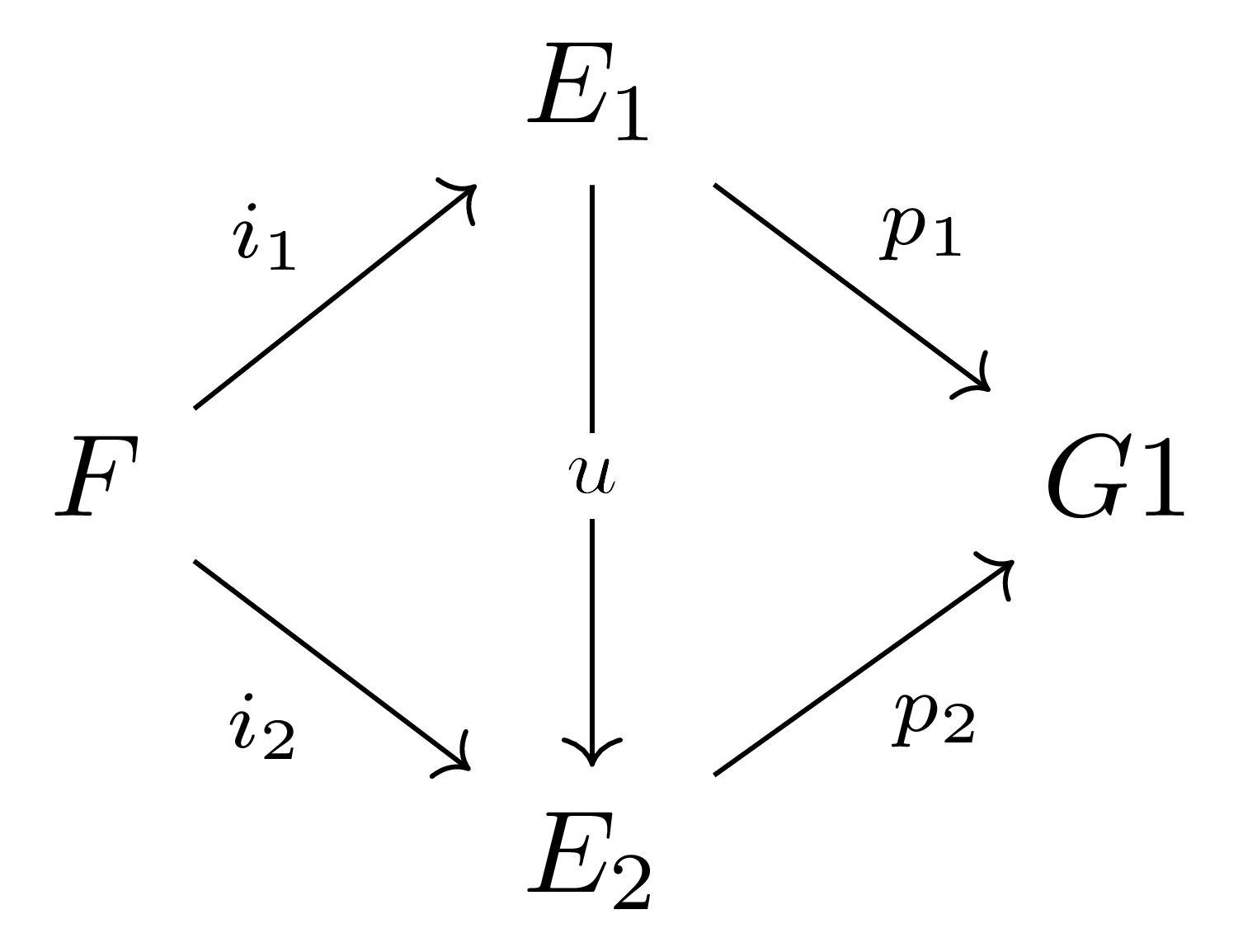
Then if \(u:E_1 \rightarrow E_2\) is an isomorphism as a group homomorphism, the inverse \(u^{-1}: E_2 \rightarrow E_1\) of \(u\) also satisfies the condition of Definition 2, and hence \(u\) is an isomorphism of extensions.
Extending the previous definition, we define the following.
Definition 3 If an extension \(\mathcal{E}:F \rightarrow E \rightarrow G\) of \(G\) by \(F\) is isomorphic to the extension
\[\mathcal{E}_0:F \rightarrow F\oplus G \rightarrow G\]then we call it the trivial extension.
Then the following holds.
Proposition 4 For an extension \(\mathcal{E}:F \rightarrow E \rightarrow G\), the following are all equivalent.
- \(\mathcal{E}\) is a trivial extension.
- A retraction \(r: E \rightarrow F\) exists.
- A section \(s: G \rightarrow E\) exists such that \(s(G)\) can be made to be contained in the centralizer of \(i(F)\).
Of course, here retraction and section mean group homomorphisms, not merely functions. ([Set Theory] §Retractions and Sections, ⁋Definition 2)
Proof of Proposition 4
First, assume the first condition and consider the following diagram:
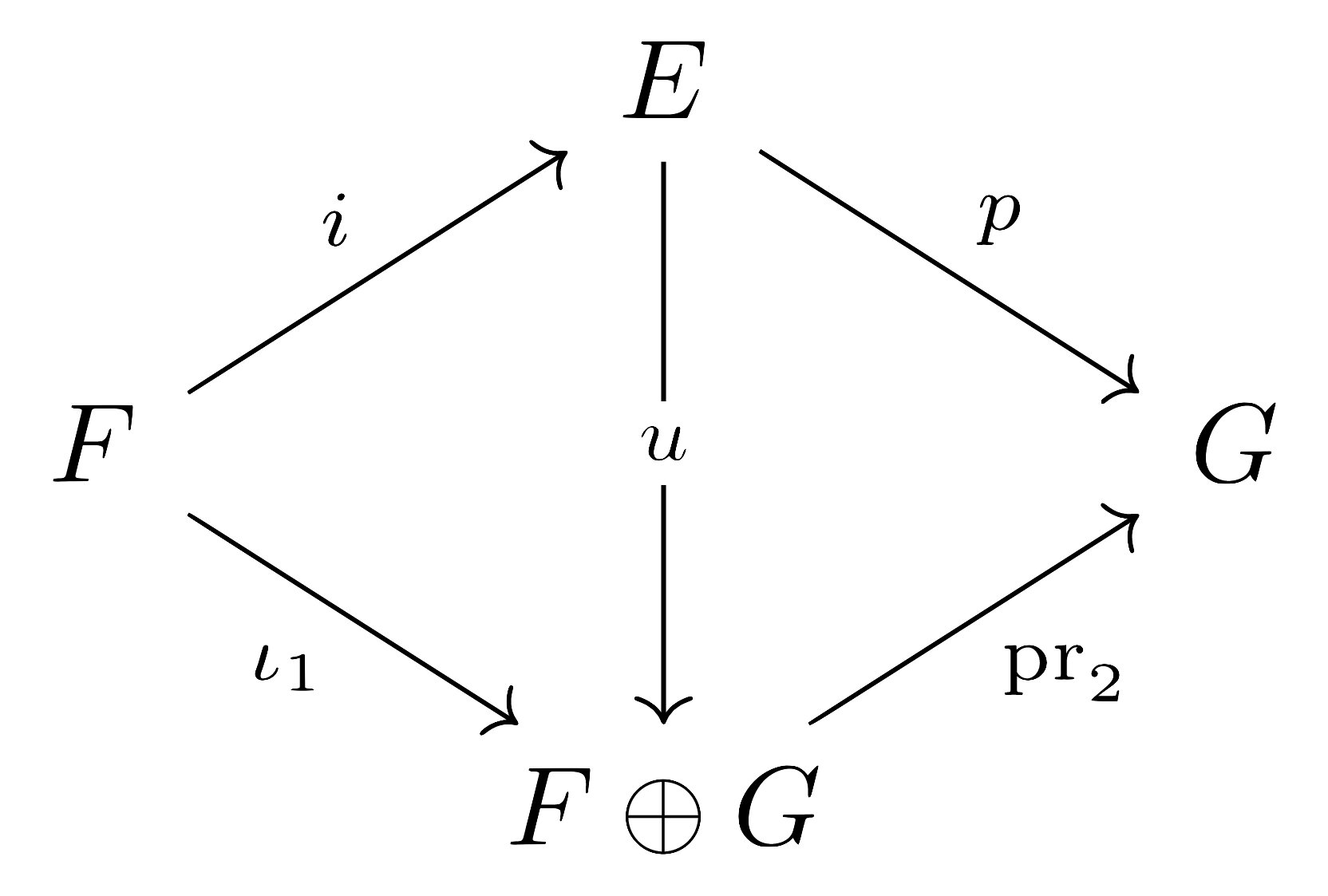
Then we define the retraction \(r:E \rightarrow F\) as \(\pr_1\circ u\), and \(s:G \rightarrow E\) as \(u^{-1}\circ\iota_2\).
Conversely, assume that the second condition holds. Then \((r,p): E \rightarrow F\oplus G\) becomes an isomorphism between the given extension and \(F \rightarrow F\oplus G \rightarrow G\). Similarly, assume the third condition. Then since \(s(G)\) is contained in the centralizer of \(i(F)\), we can construct a morphism from \(F\oplus G\) to \(E\) by taking the weak direct product of \(F\) and \(G\).
If \(i(F)\) is contained in the center \(C(E)\) of \(E\), then in the third condition we may ignore the relationship between \(s(G)\) and \(i(F)\). ([Algebraic Structures] §Group Actions, ⁋Definition 12)
Definition 5 An extension \(\mathcal{E}:F \rightarrow E \rightarrow G\) is called a central extension if the image of \(F\) in \(E\) is contained in the center of \(E\).
Semidirect Products of Groups
On the other hand, the reason that nontrivial extensions exist is that, as we saw above, for any normal subgroup \(N\) of a group \(G\), the formula
\[G\cong (G/N)\oplus N\]does not always hold. However, the converse is not always true either.
Definition 6 Let two groups \(N,H\) and a group homomorphism \(\tau:H \rightarrow \Aut(N)\) be given. Then the semi-direct product \(N\rtimes_\tau H\) of \(N\) and \(H\) with respect to \(\tau\) is the group given by the set \(N\times H\) with the following operation:
\[(x_1,y_1)(x_2,y_2)=(x_1\tau(y_1)(x_1), y_1y_2)\]Then one can show that \(N\rtimes_\tau H\) has a group structure under the above operation; in this case the identity element of \(N\rtimes_\tau H\) is \((e_N, e_H)\) and the inverse of \((x,y)\) is \(\tau(y^{-1})(x^{-1}), y^{-1})\). Moreover, the following holds.
Proposition 7 Define two maps \(i: N \rightarrow N\rtimes_\tau H\) and \(p: N\rtimes_\tau H\rightarrow H\) by the formulas
\[i(x)=(x, e_H),\qquad p(x,y)=y\]Then these maps are group homomorphisms, and the sequence
\[\mathcal{E}_\tau: N \overset{i}{\rightarrow} N\rtimes_\tau H\overset{p}{\rightarrow} H\]obtained from them is an extension of \(H\) by \(N\). Moreover, if we define a map \(s: H \rightarrow N\rtimes_\tau H\) by the formula
\[s(y)=(e_N, y)\]then \(s\) is a section of \(p\), and since it is contained in the centralizer of \(N\rtimes_\tau H\), by Proposition 4 the extension \(\mathcal{E}_\tau\) is trivial.
The proof of this is a straightforward computation.
Now suppose the \(N,H\) examined above are subgroups of a specific group \(G\). If \(N\) is a normal subgroup of \(G\), then for each \(h\in H\) the inner automorphism \(\rho_h\) is an automorphism of \(N\), and thus \(\rho: H \rightarrow \Aut(N)\) is defined. ([Algebraic Structures] §Group Actions, ⁋Definition 10) Then from the above proposition we obtain the following.
Corollary 8 Let \(G\) be a group, and let \(N\) be a normal subgroup of \(G\) and \(H\) a subgroup of \(G\). If \(N\cap H=\{e_G\}\) and \(NH=G\), then the group homomorphism defined by the formula
\[N\rtimes_\rho H \rightarrow G;\qquad (x,y)\mapsto xy\]is an isomorphism.
Proof
It suffices to construct an inverse. To do this, using the condition \(NH=G\) we need to find suitable \(x\in N\) and \(y\in H\) satisfying \(g=xy\) for an arbitrary element \(g\) of \(G\); this is generally impossible, but is possible because \(N\) is a normal subgroup of \(G\). The rest is a straightforward computation.
In this case we say that \(G\) is the (internal) semi-direct product of \(N\) and \(H\). The difference between the external semi-direct product and the internal semi-direct product is merely where we started from, and is not important.
References
[Bou] Bourbaki, N. Algebra I. Elements of Mathematics. Springer. 1998.
FTFGAG Sylow solvable S_5
댓글남기기