This post was translated from Korean by LLM (Kimi). The translation may contain errors or awkward sentences. The Korean original is the source of truth.
Commutators
In [Algebraic Structures] §Abelian Groups, ⁋Definition 3, we defined the subgroup \([H,H']\) consisting of commutators of two subgroups \(H,H'\) of an arbitrary group \(G\). In that post we only considered the case \(H=H'=G\), but since we will generalize it in this post, let us first examine the properties of commutators in more detail.
First, from \([h,h']^{-1}=[h',h]\) it follows that \([H,H']=[H',H]\) always holds. If \([H,H']=\{e\}\), then \(hh'=h'h\) for all \(h,h'\), so \(C_G(H)\subseteq H'\) and \(C_G(H')\subseteq H\); conversely, if either of these two conditions holds then \([H,H']=\{e\}\) is also obvious. Similarly, if \([H,H']\subseteq H\), then for arbitrary \(h,h'\)
\[h^{-1}h'^{-1}hh'\in H\implies h'^{-1}hh'^{-1}\in H\]and thus \(H'\subseteq N_G(H)\); the converse is again obvious. Finally, if both \(H\) and \(H'\) are normal subgroups of \(G\), then for any generator \([h,h']=h^{-1}h'^{-1}hh'\) of \([H,H']\) and any element \(x\) of \(G\),
\[x[h,h']x^{-1}=(xh^{-1}x^{-1})(xh'^{-1}x^{-1})(xhx^{-1})(xh'x^{-1})\]and by the assumption that each of \(H\) and \(H'\) is a normal subgroup, \([H,H']\) is also a normal subgroup of \(G\).
We collect results for this kind of computation in Lemma 1. Before that, to simplify notation, for the inner automorphism \(\rho_g: x\mapsto gxg^{-1}\) we write
\[\rho_{g^{-1}}(x)=x^g\]Then by [Algebraic Structures] §Group Actions, ⁋Proposition 9, for any \(g_1,g_2\in G\) and \(x\in G\),
\[(x^{g_1})^{g_2}=x^{g_1g_2}\]holds.
Lemma 1 For any \(x,y,z\in G\) the following hold.
- \(xy=yx[x,y]\).
- \(x^y=[y,x^{-1}]x\).
- \([x,yz]=[x,z][x,y]^z=[x,z][z,[y,x]][x,y]\).
- \([xy,z]=[x,z]^y[y,z]=[x,z][[x,z],y][y,z]\).
- \([x^y,[y,z]][y^z,[z,x]][z^x,[x,y]]=e\).
- \([x,yz][z,xy][y,zx]=e\).
- \([xy,z][yz,x][zx,y]=e\).
We omit the proof, since it consists of simply expanding each side. Using this, we can show the following.
Proposition 2 For three subgroups \(H, H', H''\) of a group \(G\) the following hold.
- \(H\) normalizes \([H,H']\).
- If \([H',H'']\) normalizes \(H\), then \([H,[H',H'']]\) equals the subgroup of \(G\) generated by elements of the form \([h,[h',h]]\).
-
If \(H, H', H''\) are all normal, then the following inequality
\[[H, [H',H'']]\subseteq[H'',[H',H]][H', [H'',H]]\]holds.
Proof
-
It suffices to show that for any generator \([h_1,h']\in [H,H']\) and any \(h_2\in H\), we have \([h_1,h']^{h_2}\in [H,H']\). By the fourth result of Lemma 1,
\[[h_1,h']^{h_2}=[h_1h_2,h'][h_2,h']^{-1}\]this holds, so we obtain the desired result.
-
For convenience, let \(K\) be the subgroup of \(G\) generated by elements of the form \([h,[h',h'']]\). Then \(K\subseteq [H,[H',H'']]\) is obvious, so what we must show is the reverse inclusion \([H,[H',H'']]\subseteq K\). Now \([H,[H',H'']]\) is generated by elements of the form \([h,[h_1',h_1'']\cdots[h_k',h_k'']]\), so we must show that elements of this form belong to \(K\).
\[[h, [h',h'']x]=[h,x][h, [h', h'']]^x=[h,x][x,[[h',h''],h]][h, [h',h'']]\]
In general, fix \(h\in H\), \(h'\in H'\), \(h''\in H''\), and \(x\in G\), and consider the element \([h,[h',h'']x]\). Then by the third result of Lemma 1,holds. Now from the assumption that \([H',H'']\) normalizes \(H\), we know that \([[h',h''],h]\) is an element of \(H\), so if \(x\) were an element of \([H',H'']\) then each term in the above expression is an element of \([H,[H',H'']]\). Therefore, by induction we can show that any generator of \([H,[H',H'']]\) belongs to \(K\).
-
Finally, if \(H, H', H''\) are normal, then all groups appearing in the third result are also normal subgroups. Therefore, by the second result it suffices to show that for any \(h,h',h''\) the element \([h,[h',h'']]\) belongs to the right-hand side. Now set \(u=h^{(h')^{-1}}\); then from the equation
\[[h, [h', h'']]=[u^{h'}, [h', h'']]=[(h'')^u, [u, h']]^{-1}[(h')^{h''},[h'',u]]^{-1}\]we obtain the desired result.
Lower Central Series and Nilpotent Groups
Definition 3 For a group \(G\), we define the lower central series \((C_n(G))_{n\geq 1}\) of \(G\) by the formulas
\[C_1(G)=G,\qquad C_{n+1}(G)=[G, C_n(G)]\]Then the following holds.
Proposition 4 For a group homomorphism \(f:G\rightarrow G'\), we always have \(f(C_n(G))\subseteq C_n(G')\). Moreover, if \(f\) is surjective then \(f(C_n(G))=C_n(G')\).
Proof
We proceed by induction on \(n\). Assume \(f(C_n(G))\subseteq C_n(G')\). Then elements of \(C_{n+1}(G)\) are generated by elements of the form
\[x^{-1}y^{-1}xy,\qquad x\in G, y\in C_n(G)\]and
\[f(x^{-1}y^{-1}xy)=f(x)^{-1}f(y)^{-1}f(x)f(y)\in [G, f(C_n(G))]\subseteq [G, C_n(G')]=C_{n+1}(G')\]so we obtain the desired result. If \(f\) is surjective, then \(f(G)=G'\) and in the above induction we may replace \(\subseteq\) with \(=\).
Meanwhile, since \(G\) is a normal subgroup of itself, by the same induction we see that all \(C_n(G)\) are normal subgroups of \(G\), and therefore \(C_{n+1}(G)\) is also a normal subgroup of \(C_n(G)\).
Proposition 5 For any group \(G\) and any natural numbers \(m,n\), the inclusion
\[[C_m(G), C_n(G)]\subset C_{m+n}(G)\]holds.
Proof
From the third result of Proposition 2 we have
\[[C_m(G), C_{n+1}(G)]=[C_m(G), [C_n(G), G]]\subseteq[G, [C_m(G), C_n(G)]][C_n(G), [G, C_m(G)]]=[G, [C_m(G), C_n(G)]][C_n(G), C_{m+1}(G)]\]Thus if \([C_m(G), C_n(G)]\subseteq C_{m+n}(G)\) and \([C_n(G), C_{m+1}(G)]\subseteq C_{m+n+1}(G)\) hold, then \([C_m(G), C_{n+1}(G)]\subseteq C_{m+n+1}(G)\) also holds. Now for any \(m\) and \(n\),
\[[C_m(G), C_1(G)]\subseteq C_{m+1}(G),\qquad [C_1(G), C_n(G)]\subseteq C_{n+1}(G)\]hold obviously from the definition, so by induction we know that this inequality holds for all \(m,n\).
We now define the following.
Definition 6 A group \(G\) is called a nilpotent group if there exists a natural number \(n\) such that \(C_{n+1}(G)=\{e\}\). The largest such \(n\) is called the nilpotency class of \(G\).
Then the following holds.
Proposition 7 For a group \(G\) and a natural number \(n\), the following are all equivalent.
- \(G\) is a nilpotent group of nilpotency class \(\leq n\).
-
There exists a decreasing sequence of subgroups of \(G\)
\[G=G_1\supset G_2\supset\cdots\supset G_{n+1}=\{e\}\]such that \([G,G_k]\subseteq G_{k+1}\) holds for all \(k\).
- There exists a subgroup \(A\) contained in the center \(C(G)\) of \(G\) such that \(G/A\) is a nilpotent group of nilpotency class \(\leq n-1\).
Proof
First, assuming the first condition, \(G_k=C_k(G)\) satisfies the second condition. Conversely, if the second condition holds then by induction we can show that \(C_k(G)\subset G_k\) always holds.
For the remaining equivalence, assuming the first condition, the third condition holds by taking \(A=C_n(G)\). To show that the first condition holds assuming the third, we send \(C_n(G)\) via the canonical morphism \(G\rightarrow G/A\); its image equals \(C_n(G/A)\) by Proposition 4, and this is \(\{e\}\) by assumption, so we check that \(C_n(G)\subset A\) and therefore \(C_{n+1}(G)=\{e\}\).
Therefore, intuitively, a nilpotent group of nilpotency class \(\leq n\) can be thought of as obtained from the trivial group \(\{e\}\) through \(n\) successive central extensions.
Proposition 8 Fix a nilpotent group \(G\) of nilpotency class \(\leq n\) and a subgroup \(H\) of \(G\). Then there exists a sequence of subgroups
\[G=H_1\supseteq H_2\supseteq\cdots\supseteq H_{n+1}=H\]such that \(H_{k+1}\) is a normal subgroup of \(H_k\) and \(H_k/H_{k+1}\) is commutative.
Proof
Take a sequence of subgroups of \(G\) satisfying the second equivalent condition of Proposition 7, and set \(H_k=HG_k\).
Derived Series and Solvable Groups
Now we define another kind of series.
Definition 9 The derived series of a group \(G\) is the series of subgroups of \(G\) given by the formulas
\[D_0(G)=G,\qquad D_{n+1}(G)=[D_n(G),D_n(G)]\]Then, just as for nilpotent groups, the following proposition holds.
Proposition 10 For a group homomorphism \(f:G\rightarrow G'\), we always have \(f(D_n(G))\subseteq D_n(G')\). Moreover, if \(f\) is surjective then \(f(D_n(G))=D_n(G')\).
The proof is the same as that of Proposition 4, using induction. Just as nilpotent groups were defined by the stability condition of the lower central series, solvable groups are defined by the stability condition of the derived series.
Definition 11 A group \(G\) is called solvable if there exists a natural number \(n\) such that \(D_{n+1}(G)=\{e\}\). The largest such \(n\) is called the solvability class of \(G\).
By definition, \(D_0(G)=C_1(G)=G\) and \(D_1(G)=[G,G]=C_2(G)\) hold. From this fact and Proposition 5, we know inductively that the inclusion
\[D_n(G)\subseteq C_{2^n}(G)\]holds. That is, any nilpotent group is always solvable.
The next proposition is the characterization of solvable groups corresponding to Proposition 7.
Proposition 12 For a group \(G\) and a natural number \(n\), the following are all equivalent.
- \(G\) is a solvable group of solvability class \(\leq n\).
-
There exists a decreasing sequence of subgroups of \(G\)
\[G=G_1\supset G_2\supset\cdots\supset G_{n+1}=\{e\}\]such that all \(G_k/G_{k+1}\) are commutative.
- There exists a normal commutative subgroup \(A\) of \(G\) such that \(G/A\) is a solvable group of solvability class \(\leq n-1\).
Therefore, intuitively, a solvable group of solvability class \(\leq n\) can be thought of as obtained from the trivial group \(\{e\}\) by \(n\) successive extensions by abelian groups.
Composition Series and the Jordan-Hölder Theorem
We have seen above that nilpotent groups are groups obtained by repeated central extensions, and solvable groups are groups obtained by repeated abelian extensions. Now we treat the most general case.
Definition 13 A sequence of subgroups of a group \(G\)
\[G=G_0\supset G_1\supset \cdots\supset G_n=\{e\}\]is called a subnormal series if for each \(k\), \(G_{k+1}\) is a normal subgroup of \(G_k\); in this case we call \(G_k/G_{k+1}\) the quotient of this series. If there is no subnormal series finer than a given subnormal series \(G_\bullet\), we call it a composition series of \(G\).
Then for any group \(G\) and normal subgroup \(N\), there is a one-to-one correspondence between normal subgroups of \(G/N\) and normal subgroups of \(G\) containing \(N\); therefore, saying that \(G_\bullet\) is a composition series is the same as saying that \(G_k/G_{k+1}\) is simple for each \(k\). (§Symmetric Groups, ⁋Definition 12)
If for two subnormal series
\[G=G_0\supset G_1\supset \cdots\supset G_n=\{e\},\qquad G=H_0\supset H_1\supset\cdots\supset H_m=\{e\}\]we have \(m=n\) and there exists \(\sigma\in S_n\) such that \(G_k/G_{k+1}\cong H_{\sigma(k)}/H_{\sigma(k)+1}\) for all \(k=0,\ldots,n-1\), then we call \(G_\bullet\) and \(H_\bullet\) equivalent subnormal series.
The main theorem of this section is Theorem 16, which states that if two composition series of a group \(G\) exist then they are equivalent. To prove this we begin with the following lemma.
Lemma 14 (Zassenhaus) Let \(H\) and \(K\) be two subgroups of a group \(G\), and let \(H'\) and \(K'\) be normal subgroups of \(H\) and \(K\) respectively. Then \(H'(H\cap K')\) is a normal subgroup of \(H'(H\cap K)\), and \(K'(K\cap H')\) is a normal subgroup of \(K'(K\cap H)\), and there is an isomorphism
\[\frac{H'(H\cap K)}{H'(H\cap K')}\cong \frac{K'(K\cap H)}{K'(K\cap H')}\]Proof
This proof can be summarized roughly by the following lattice:
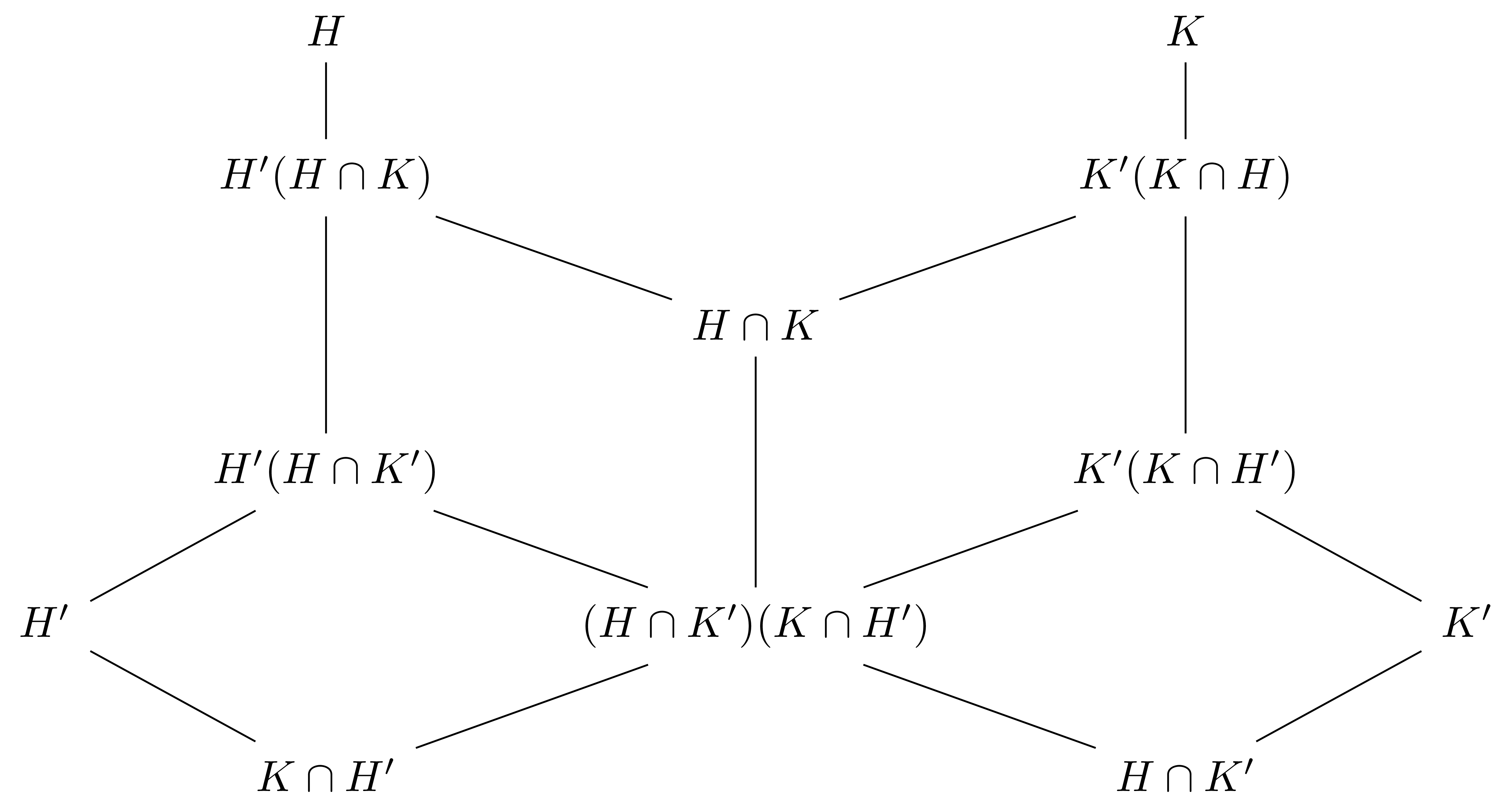
First, the fact that \(H'\cap K=H'\cap (H\cap K)\) and \(K'\cap H=K'\cap (K\cap H)\) are normal subgroups of \(H\cap K\) is a result of [Algebraic Structures] §Isomorphism Theorems, ⁋Lemma 4. Therefore, we know that their intersection \((H'\cap K)(K'\cap H)\) is also a normal subgroup of \(H\cap K\). Now looking at the left-hand side of the claimed isomorphism, from [Algebraic Structures] §Isomorphism Theorems, ⁋Theorem 5
\[H'(H'\cap K)(K'\cap H)=H'(H\cap K')\]is a normal subgroup of \(H'(H\cap K)\) and the isomorphism
\[\frac{H'(H\cap K)}{H'(H\cap K')}\cong \frac{H\cap K}{(H'\cap K)(K'\cap H)}\]exists.
Then the following holds.
Proposition 15 (Schreier) For any two subnormal series
\[G=G_0\supset G_1\supset \cdots\supset G_n=\{e\},\qquad G=H_0\supset H_1\supset\cdots\supset H_m=\{e\}\]there exist refinements \(G_\bullet'\) and \(H_\bullet'\) of them that are equivalent to each other.
Proof
Insert \(G_i\cap H_j\) between \(G_i\) and \(G_{i+1}\) as \(j\) varies, and insert \(G_i\cap H_j\) between \(H_j\) and \(H_{j+1}\) as \(i\) varies; then Lemma 14 shows that the refinements thus obtained are equivalent to each other.
Therefore the following holds.
Theorem 16 (Jordan-Hölder) Any two composition series are equivalent.
Definition 17 The length of a group \(G\) is defined as the upper bound of the lengths of strictly descending subnormal series.
Then if \(G\) has a composition series, we know that the length of any composition series of \(G\) is exactly the length of \(G\). Therefore the equality
\[\length(G)=\length(G/N)+\length(N)\]is a consequence of [Algebraic Structures] §Isomorphism Theorems, ⁋Theorem 7 and Theorem 16.
댓글남기기