This post was translated from Korean by LLM (Kimi). The translation may contain errors or awkward sentences. The Korean original is the source of truth.
Vector Bundles
Using §Tangent and Cotangent Bundles, ⁋Example 5 and §Tangent and Cotangent Bundles, ⁋Theorem 6, we can define the following.
Definition 1 For a manifold \(M\),
\[\mathcal{T}^{r,s}(M)=\mathcal{T}^{r,s}(TM),\quad \bigwedge\nolimits^\ast(M)=\bigwedge(T^\ast M),\quad \bigwedge\nolimits^k(M)=\bigwedge\nolimits^k(T^\ast M)\]are called the $(r,s)$-tensor bundle, exterior algebra bundle, and exterior \(k\)-bundle on \(M\), respectively. Elements of their smooth sections
\[\Gamma\left(\mathcal{T}^{r,s}(M)\right),\quad\Omega^\ast(M):=\Gamma\left(\bigwedge\nolimits^\ast(M)\right),\quad\Omega^k(M):=\Gamma\left(\bigwedge\nolimits^k(M)\right)\]are called a tensor field, differential form, and differential \(k\)-form, respectively.
For two simple tensors
\[\omega=\alpha^1\otimes\cdots\otimes \alpha^r\otimes u_{r+1}\otimes\cdots\otimes u_{r+s}\in\mathcal{T}^{r,s}(T_p^\ast M),\quad u=u_1\otimes\cdots\otimes u_r\otimes \alpha^{r+1}\otimes\cdots\otimes \alpha^{r+s}\in\mathcal{T}^{r,s}(T_pM)\]define
\[(\omega,u)=\alpha^1(u_1)\alpha^2(u_2)\cdots \alpha^{r+s}(u_{r+s}).\]Then \((-,-)\) is a non-degenerate pairing, so \(\mathcal{T}^{r,s}(T_p^\ast M)\cong\mathcal{T}^{r,s}(T_pM)^\ast\) holds. ([Linear Algebra] §Dual Spaces, ⁋Corollary 5)
Similarly, for two elements
\[\omega=\alpha^1\wedge\cdots\wedge \alpha^k\in \bigwedge\nolimits^k(T_p^\ast M),\quad u=u_1\wedge\cdots\wedge u_k\in\bigwedge\nolimits^k(T_pM)\]giving the pairing \((-,-)\) as
\[(\omega, u)=\det\bigl(\alpha^i(u_j)\bigr)\]we can verify that \(\bigwedge\nolimits^k(T_pM)^\ast\cong\bigwedge\nolimits^k(T_p^\ast M)\). Meanwhile, for a finite family of vector spaces \((V_i)_{1\leq i\leq n}\)
\[\bigoplus_{i=1}^n V_i^\ast\cong \left(\bigoplus_{i=1}^n V_i\right)^\ast\]holds, and since \(\bigwedge(V)\) is exactly the direct sum of finitely many \(\bigwedge\nolimits^k(V)\),
\[\bigwedge(T_p^\ast M)=\bigoplus_{k\geq 0}\bigwedge\nolimits^k(T_p^\ast M)=\bigoplus_{k\geq 0}\bigwedge\nolimits^k(T_pM)^\ast\cong\left(\bigwedge(T_pM)\right)^\ast\]holds.
Differential Forms and Pullback
Among the Definition 1 above, elements of \(\Omega^\ast(M)\) are of particular interest. By definition, any differential form \(\omega\in\Omega^\ast(M)\) is a function \(M\rightarrow\bigwedge\nolimits^\ast(M)\), and we write its value as
\[p\mapsto \omega_p\in\bigwedge\nolimits^\ast(T_pM).\]If we define the wedge product of two differential forms \(\omega\wedge\eta\) by the formula
\[(\omega\wedge\eta)_p=\omega_p\wedge\eta_p\qquad\text{for all $p\in M$}\]we can regard \(\Omega^\ast(M)\) as an \(\mathbb{N}\)-graded \(\mathbb{R}\)-algebra
\[\Omega^\ast(M)=\bigoplus_{k=0}^n\Omega^k(M).\]Moreover, since scalar multiplication by \(\mathbb{R}\) in \(\Omega^\ast(M)\) can actually be performed at each point \(p\), we may also think of the coefficients of \(\Omega^\ast(M)\) as \(C^\infty(M)\). Algebraically, this can also be thought of as changing the coefficient ring via the ring homomorphism \(\mathbb{R}\rightarrow C^\infty(M)\), and henceforth we always assume that \(\Omega^\ast(M)\) is equipped with such an \(\mathbb{N}\)-graded \(C^\infty(M)\)-algebra structure.
Now suppose we are given a \(C^\infty\) function \(F:M\rightarrow N\). Then the linear map \(dF_p:T_pM\rightarrow T_{F(p)}N\) is well-defined. Thus, applying the functoriality of the exterior algebra to the dual map of \(dF_p\), we obtain
\[\bigwedge({dF}_p^\ast):\bigwedge(T_{F(p)}^\ast N)\rightarrow\bigwedge(T_p^\ast M).\]([Multilinear Algebra] §Tensor Algebras, ⁋Definition 10) Let us denote by \(F^\ast\) the linear map \(\Omega^\ast(N)\rightarrow\Omega^\ast(M)\) obtained by assigning \(\bigwedge({dF}_p^\ast)\) to each point \(p\). That is, for any \(\omega\in\Omega^\ast(N)\)
\[(F^\ast\omega)_p=\bigwedge({dF}_p^\ast)(\omega_{F(p)})\]holds. The differential form \(F^\ast\omega\) obtained in this way is called the pullback of \(\omega\) by \(F\). Moreover, since \(F^\ast\) is a graded algebra homomorphism by definition, it also preserves \(\wedge\).
In particular, suppose \(\omega\) is a \(k\)-form. To compute \((F^\ast\omega)_p\) at a point \(p\in M\), plugging in \(k\) vectors \(X_1(p),\ldots, X_k(p)\), we obtain
\[(F^\ast\omega)_p(X_1(p),\ldots, X_k(p))=(F^\ast_p\omega_{F(p)})\bigl(X_1(p),\ldots, X_k(p)\bigr)=\omega_{F(p)}\bigl(dF_p(X_1(p)), \ldots, dF_p(X_k(p))\bigr).\]Exterior Derivative and de Rham Cohomology
We have already seen that \(\Omega^0(M)=C^\infty(M)\). For any \(f\in C^\infty(M)\), its differential \(df\) is the function taking each point \(p\in M\) to \(df_p:T_pM\rightarrow\mathbb{R}\). (§Examples of Differentials, ⁋Definition 6) That is, \(df\in T^\ast M=\Omega^1(M)\). This operator \(d\) is also defined for general differential forms as follows.
Theorem 2 For a manifold \(M\), there uniquely exists an anti-derivation \(d:\Omega^\ast(M)\rightarrow\Omega^\ast(M)\) of degree \(1\) satisfying the following two conditions. (##ref##)
- \(d^2=0\),
- For any \(f\in\Omega^0(M)\), \(df\) coincides with the differential of \(f\) as above.
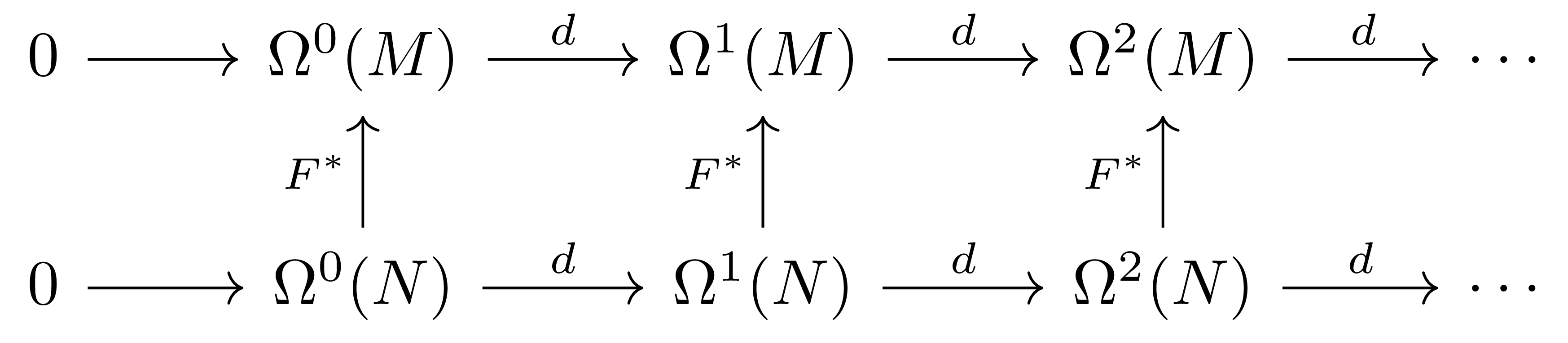
Moreover, this \(d\) commutes with the pullback \(F^\ast\).
A graded algebra equipped with a differential \(d\) in this way is called a differential graded algebra, or simply a DG-algebra. Meanwhile, by condition 1 above, the following sequence
\[0\longrightarrow\Omega^0(M)\overset{d}{\longrightarrow}\Omega^1(M)\overset{d}{\longrightarrow}\Omega^2(M)\overset{d}{\longrightarrow}\cdots\overset{d}{\longrightarrow}\Omega^n(M)\longrightarrow 0\tag{2}\]becomes a cochain complex. Also, since \(d\) commutes with \(F^\ast\) and \(F^\ast\) is a graded algebra homomorphism, in the above language we can say that \(F^\ast\) induces a chain map between de Rham complexes.
We call the homology group of the cochain complex (2) the de Rham cohomology group and write it as \(H^\ast_\text{dR}(M)\). The de Rham theorem shows that \(H_\text{dR}^\ast(M)\) obtained in this way carries the same information as other cohomology groups defined topologically.
Interior Multiplication
Definition 3 Consider a vector field \(X\) on a manifold \(M\). Then \(\iota_X:\Omega^\ast(M) \rightarrow\Omega^\ast(M)\) is the function assigning to any \(k\)-form \(\omega\) the \((k-1)\)-form \(\iota_X\omega\) defined by the formula
\[(\iota_X\omega)(X_1,\ldots, X_{k-1})=\omega(X,X_1,\ldots, X_{k-1}).\]This is called the interior multiplication by \(X\).
Proposition 4 For any manifold \(M\) and any vector field \(X\) on it, the interior multiplication \(\iota_X\) is an antiderivation of degree \(-1\).
References
[War] Frank W. Warner. Foundations of Differentiable Manifolds and Lie Groups, Graduate texts in mathematics, Springer, 2013
[Lee] John M. Lee. Introduction to Smooth Manifolds, Graduate texts in mathematics, Springer, 2012
댓글남기기