This post was translated from Korean by LLM (Kimi). The translation may contain errors or awkward sentences. The Korean original is the source of truth.
Extension by linearity
Theorem 1 (Extension by linearity) Fix an arbitrary \(\mathbb{K}\)-vector space \(V\) and a basis \(\mathcal{B}\). For another \(\mathbb{K}\)-vector space \(W\), whenever a function \(g:\mathcal{B}\rightarrow W\) is given, there exists a unique linear map \(G:V\rightarrow W\) such that \(g=G\circ\iota\).
Here \(\iota:\mathcal{B}\rightarrow V\) denotes the inclusion \(\mathcal{B}\hookrightarrow V\).
Proof
For the given function \(g\), it is obvious that a linear map \(G\) satisfying the condition must be unique. Indeed, if \(G':V\rightarrow W\) is another linear map satisfying the given condition, then for any \(v\in V\), if we write
\[v=\sum_{x\in \mathcal{B}}v_xx\]then
\[\begin{aligned}(G-G')\left(\sum_{x\in \mathcal{B}}v_xx\right)&=\sum_{x\in\mathcal{B}}v_x(G-G')(x)=\sum_{x\in\mathcal{B}}v_x(G-G')(\iota(x))\\&=\sum_{x\in\mathcal{B}}v_x(G\circ \iota-G'\circ\iota)(x)=\sum_{x\in\mathcal{B}}v_x(g-g)(x)=0\end{aligned}\]since this equals zero.
Now we must actually construct \(G\). Naturally, for any \(v=\sum_{x\in\mathcal{B}}v_xx\),
\[G(v)=\sum_{x\in\mathcal{B}} v_xg(x)\]it is natural to define it this way. Since the way to write \(v\) as a linear combination of elements of \(B\) is unique, \(G\) is well-defined, and one can easily prove that \(G\) is a linear map.
That is, we can find \(G:V\rightarrow W\) making the following diagram always commute.
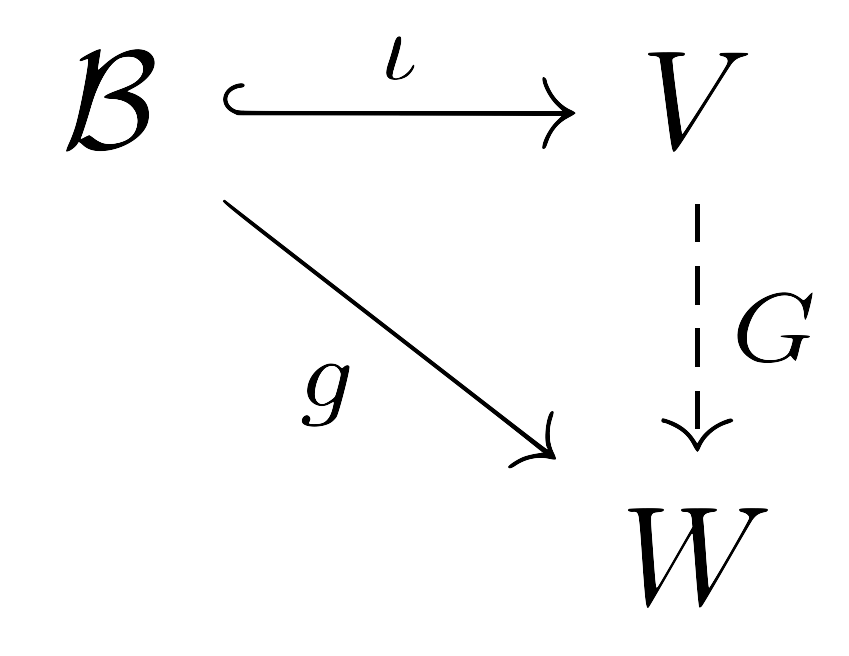
Conversely, given any linear map \(G:V\rightarrow W\), we can restrict it to \(\mathcal{B}\) to define a function \(g=G\circ\iota\), and by the uniqueness part of the above theorem, \(G\) is the only linear map satisfying this equation. Thus there exists a bijection between the following two sets.
\[\{\text{functions from $\mathcal{B}$ to $W$}\}\longleftrightarrow\{\text{linear maps from $V$ to $W$}\}\]In other words, a linear map from \(V\) to \(W\) is completely determined by how \(L\) acts on the basis \(\mathcal{B}\), and if \(V\) is finite-dimensional, this means that the linear map \(L\) is determined solely by its values at only finitely many elements.
In particular, assume the codomain \(W\) is also a finite-dimensional \(\mathbb{K}\)-vector space, and fix a basis \(\mathcal{B}=\{x_1,\ldots, x_n\}\) of \(V\) and a basis \(\mathcal{C}=\{y_1,\ldots,y_m\}\) of \(W\). Then by the preceding argument, a linear map \(L\) from \(V\) to \(W\) is completely determined by the \(n\) vectors in \(W\)
\[L(x_1),L(x_2)\ldots, L(x_n)\]and as elements of \(W\), these can again be expressed as linear combinations of elements of \(\mathcal{C}\)
\[\begin{aligned}L(x_1)&=\alpha_{11}y_1+\alpha_{21}y_2+\cdots+\alpha_{m1}y_m\\L(x_2)&=\alpha_{12}y_1+\alpha_{22}y_2+\cdots+\alpha_{m2}y_m\\&\phantom{a}\vdots\\L(x_n)&=\alpha_{1n}y_1+\alpha_{2n}y_2+\cdots+\alpha_{mn}y_m\end{aligned}\tag{1}\]Then the value of \(L\) at an arbitrary element of \(V\) can be expressed as a linear combination with respect to the basis \(\mathcal{C}\), using the scalars \(\alpha_{i,j}\) together with the scalars \(v_1,\ldots, v_n\) from the coordinate expression \(v=\sum_{i=1}^n v_ix_i\).
\[\begin{aligned}L(v_1x_1)&=\alpha_{11}v_1y_1+\alpha_{21}v_1y_2+\cdots+\alpha_{m1}v_1y_m\\L(v_2x_2)&=\alpha_{12}v_2y_1+\alpha_{22}v_2y_2+\cdots+\alpha_{m2}v_2y_m\\&\phantom{a}\vdots\\L(v_nx_n)&=\alpha_{1n}v_ny_1+\alpha_{2n}v_ny_2+\cdots+\alpha_{mn}v_ny_m\end{aligned}\]Thus, adding the corresponding sides, the left-hand side becomes
\[L(v_1x_1)+L(v_2x_2)+\cdots+L(v_nx_n)=L(v_1x_1+v_2x_2+\cdots+v_nx_n)=L(v)\]and the right-hand side becomes
\[(\alpha_{11}v_1+\alpha_{12}v_2+\cdots+\alpha_{1n}v_n)y_1+(\alpha_{21}v_1+\alpha_{22}v_2+\cdots+\alpha_{2n}v_n)y_2+\cdots+(\alpha_{m1}v_1+\alpha_{m2}v_2+\cdots+\alpha_{mn}v_n)y_m\]Therefore \(L\) can be understood as the following correspondence
\[v=\sum_{i=1}^n v_ix_i\quad\mapsto\quad \sum_{j=1}^m\left(\sum_{i=1}^n\alpha_{ji}v_i\right)y_j=L(v)\]Using the above theorem, we can prove the following proposition corresponding to [Set Theory] §Retraction and Section, ⁋Proposition 1.
Corollary 2 Let \(V,W\) be two \(\mathbb{K}\)-vector spaces and let \(L:V\rightarrow W\) be a linear map.
- If \(L\) is injective, there exists a linear map \(R:W\rightarrow V\) such that \(R\circ L=\id_V\).
- If \(L\) is surjective, there exists a linear map \(S:W\rightarrow V\) such that \(L\circ S=\id_W\).
Proof
-
First, suppose \(L\) is injective, and choose a basis \(x_1,\ldots,x_n\) of \(V\). Then \(L(x_1),\ldots, L(x_n)\) are linearly independent, and therefore we can find a basis \(\mathcal{B}\) of \(W\) containing them. Now define a function \(r:\mathcal{B}\rightarrow V\) by the following formula
\[r(v)=\begin{cases}x_i&\text{if $v=L(x_i)$}\\0&\text{otherwise}\end{cases}\]and apply Theorem 1 to obtain a linear map, which we call \(R\). Then for any element \(x_i\) of the basis \(\{x_1,\ldots,x_n\}\) of \(V\), we have \((R\circ L)(x_i)=x_i\), and hence by the uniqueness part of Theorem 1, \(R\circ L=\id_V\) holds.
-
Suppose \(L\) is surjective, and choose a basis \(x_1,\ldots,x_n\) of \(V\). Then \(L(x_1),\ldots, L(x_n)\) span \(W\), so we can select some of these vectors to form a basis \(\mathcal{B}\) of \(W\). Without loss of generality, let \(\mathcal{B}=\{L(x_1),\ldots, L(x_m)\}\) (\(m\leq n\)). Define a function \(s:\mathcal{B}\rightarrow V\) by the following formula
\[s(v)=x_k\qquad v=L(x_k)\]and apply Theorem 1 to this to obtain a linear map, which we call \(S\). Now for any element \(L(x_k)\) of the basis \(\mathcal{B}\) of \(W\), we have \((L\circ S)(L(x_k))=L(x_k)\), so again by the uniqueness part of Theorem 1, \(L\circ S=\id_W\) holds.
Space of Linear Maps
Lemma 3 Consider two \(\mathbb{K}\)-vector spaces \(V\), \(W\). If \(L,L_1,L_2\) are linear maps from \(V\) to \(W\), and \(\alpha\in\mathbb{K}\), then
\[L_1+L_2:v\mapsto L_1(v)+L_2(v),\qquad \alpha L:v\mapsto \alpha L(v)\]are also linear.
Proof
Let \(v, v_1,v_2\in V\) and \(\alpha\in\mathbb{K}\). Then
\[\begin{aligned} (L_1+L_2)(v_1+v_2)&=L_1(v_1+v_2)+L_2(v_1+v_2)\\ &=L_1(v_1)+L_1(v_2)+L_2(v_1)+L_2(v_2)\\ &=L_1(v_1)+L_2(v_1)+L_1(v_2)+L_2(v_2)\\ &=(L_1+L_2)(v_1)+(L_1+L_2)(v_2) \end{aligned}\]and
\[\begin{aligned} (L_1+L_2)(\alpha v)&=L_1(\alpha v)+L_2(\alpha v)=\alpha L_1(v)+\alpha L_2(v)\\ &=\alpha(L_1(v)+L_2(v))\\ &=\alpha (L_1+L_2)(v). \end{aligned}\]Therefore \(L_1+L_2\) is a linear map. The second claim can be shown similarly.
Thus, we can make the following definition.
Definition 4 For two \(\mathbb{K}\)-vector spaces \(V,W\), the \(\mathbb{K}\)-vector space obtained by giving the set of linear maps from \(V\) to \(W\) the operations from Lemma 3 is denoted \(\Hom_\mathbb{K}(V,W)\), or simply \(\Hom(V,W)\) when the field \(\mathbb{K}\) is clear from context.
In particular, when \(W=\mathbb{K}\), we call \(\Hom(V,\mathbb{K})\) the dual space of \(V\) and denote it by \(V^\*\). The elements of \(V^\ast\) are called linear functionals.
The zero vector in the vector space \(\Hom(V,W)\) is the function \(0\) sending every element to 0. (§Linear Maps, ⁋Example 10) When referring to this function, let us call it the zero function for convenience.
Suppose both spaces \(V,W\) are finite-dimensional, and let \(\mathcal{B}=\{x_1,\ldots, x_n\}\) and \(\mathcal{C}=\{y_1,\ldots, y_m\}\) be bases of \(V\) and \(W\), respectively. Consider the \(mn\) functions from \(\mathcal{B}\) to \(W\)
\[f_i^j(x)=\begin{cases}y_j&\text{if $x=x_i$}\\0&\text{otherwise}\end{cases}\]That is, \(f_i^j\) is the function that sends only \(x_i\) to \(y_j\) and everything else to 0. Then by Theorem 1, there exists a unique linear map \(B_i^j\) such that \(f_i^j=B_i^j\circ\iota\).
Proposition 5 Let \(V,W\) be two finite-dimensional \(\mathbb{K}\)-vector spaces with bases \(\{x_1,\ldots,x_n\}\) and \(\{y_1,\ldots,y_m\}\), respectively. Then \(\Hom(V,W)\) is an \(mn\)-dimensional vector space, and the \(mn\) linear maps \(B_i^j\) above form a basis of \(\Hom(V,W)\).
Proof
It suffices to prove the claim about the basis.
First, the \(B_i^j\) are linearly independent. For scalars \(\alpha_{11},\ldots,\alpha_{mn}\), suppose
\[\alpha_{11}B_1^1+\alpha_{12}B_2^1+\cdots+\alpha_{mn}B_n^m=0\]That is, both sides are the zero function from \(V\) to \(W\), and therefore for any \(v\in V\) the following equation
\[\alpha_{11}B_1^1(v)+\alpha_{12}B_2^1(v)+\cdots+\alpha_{mn}B_n^m(v)=0\]holds. In particular, this equation also holds for \(v=x_1,\ldots, x_n\), and then
\[\alpha_{11}B_1^1(x_k)+\alpha_{12}B_2^1(x_k)+\cdots+\alpha_{mn}B_n^m(x_k)=0\]holds. But by the definition of \(B_i^j\), the value \(B_i^j(x_k)\) is \(y_j\) only when \(i=k\), so the above equation becomes
\[\alpha_{1k}y_1+\alpha_{2k}y_2+\cdots+\alpha_{mk}y_k=0\]Now \(y_1,\ldots,y_k\) are linearly independent, so \(\alpha_{1k},\ldots,\alpha_{mk}\) are all \(0\). Since \(k\) was arbitrary, \(\alpha_{11},\ldots,\alpha_{mn}\) are all 0, and the \(B_i^j\) are linearly independent.
On the other hand, these \(B_i^j\) span \(\Hom(V,W)\). Given an arbitrary \(L\in\Hom(V,W)\), we can find scalars \(\alpha_{11},\ldots,\alpha_{mn}\) satisfying equation (1) from the introduction. Now the map defined by the formula
\[L'(v)=\sum_{i,j}\alpha_{ji}B_i^j(v)\]is a linear map. Moreover, substituting \(v=x_k\) gives
\[L'(x_k)=\sum_{i,j}\alpha_{ji}B_i^j(x_k)=\sum_{j=1}^m\alpha_{jk}B_k^j(x_k)=\sum_{j=1}^m\alpha_{jk}y_j=L(x_k)\]Now by the uniqueness part of Theorem 1, we have \(L'=L\).
댓글남기기