This post was translated from Korean by LLM (Kimi). The translation may contain errors or awkward sentences. The Korean original is the source of truth.
Now we define differential modules. For this we need a simple lemma; first consider the second case assumed in §Derivations, ⁋Definition 2. That is, we consider a commutative ring \(A\), a \(\Delta\)-graded \(A\)-algebra \(E\), a graded \(A\)-module \(F\), and an \(\varepsilon\)-derivation \(d:E \rightarrow F\).
Functoriality of Derivations
In addition to the above assumptions, we assume that every algebra appearing in this section is unital associative, and all algebra homomorphisms are unital.
Proposition 1 Let two associative unital graded \(A\)-algebras \(E,F\) be given, let \(M\) be an \((E,E)\)-bimodule, and let \(N\) be a graded \((F,F)\)-bimodule. Then for a graded \(A\)-algebra homomorphism \(\rho: E \rightarrow F\) and a degree \(0\) graded \(E\)-homomorphism \(\theta: M \rightarrow N\) of \(E\)-bimodules defined by \(\rho\), the following hold.
- For any \(\varepsilon\)-derivation \(d': F \rightarrow N\), the composition \(d'\circ\rho: E \rightarrow \rho^\ast N\) is also an \(\varepsilon\)-derivation of the same degree.
- For any \(\varepsilon\)-derivation \(d: E \rightarrow M\), the composition \(\theta\circ d: E \rightarrow \rho^\ast N\) is also an \(\varepsilon\)-derivation of the same degree.
The proof of this is immediate from the definition of \(\rho^\ast\). Meanwhile, in this situation we can also give \(F\) an \((E,E)\)-bimodule structure. Then it is natural to ask when \(d':F \rightarrow N\) is also (left/right) \(E\)-linear.
Proposition 2 Assume the situation of Proposition 1, and let an \(\varepsilon\)-derivation \(d': F \rightarrow N\) be given. Then \(d'\) is left (resp. right) \(E\)-linear if and only if \(d'\) vanishes identically on the subalgebra \(\rho(E)\) of \(F\).
Now define \(\Der_A(F, N)\) to be the set of \(A\)-derivations from \(F\) to \(N\). Then the set of derivations satisfying the condition of Proposition 2 and becoming \(E\)-linear is the same as the set of derivations vanishing identically on \(\rho(E)\), so this set forms an \(A\)-submodule of \(\Der_A(F, N)\). We denote this by \(\Der_E(F,N)\).
In addition, let three graded \(A\)-algebras \(E,F,G\) be given, and let graded \(A\)-algebra homomorphisms \(\rho: A \rightarrow B\), \(\sigma: B \rightarrow C\) be given. Then for any graded \(A\)-algebra \(H\), the sequence
\[0 \rightarrow \Der_F(G, H) \rightarrow \Der_E(G,H) \rightarrow \Der_E(F, H)\]is exact for the following three \(A\)-modules
\[\Der_E(F, \rho_\ast H),\qquad \Der_F(G,H),\qquad\Der_E(G, H).\]For any \(\Delta\)-graded \(A\)-module \(M\) and any \(\delta\in \Delta\), define \(M[\delta]\) by the formula
\[(M[\delta])_\mu=M_{\delta+\mu}\]Since the \(\Delta\)-graded \(A\)-algebra \(E\oplus M[\delta]\) exists, we can now give \(E\oplus M[\delta]\) a graded \(A\)-algebra structure using the following formula for homogeneous elements \(x\in E\) and the resulting elements \((x,y), (x',y')\) of \(E\oplus M[\delta]\):
\[(x,y)(x',y')=(xx', xy+\varepsilon(\delta, \deg x)xy')\]In this case, we call the projection map \(\epsilon: E\oplus M[\delta] \rightarrow E\) the augmentation map, and we know that this is a graded \(A\)-algebra homomorphism.
Now if a degree \(0\) graded \(A\)-linear map \(g:E \rightarrow E\oplus M[\delta]\) satisfies \(\epsilon\circ g=\id_A\), then by definition we know that it must be of the form \(x\mapsto (x,f(x))\) for some degree \(\delta\) graded \(A\)-linear map \(f:E \rightarrow M\), and conversely any degree \(\delta\) \(A\)-linear map \(f\) defines a \(g\) satisfying the above condition.
Then the following proposition is also a consequence of a simple calculation.
Proposition 3 A graded \(K\)-linear map \(f: A \to E\) of degree \(\delta\) is an \(\varepsilon\)-derivation if and only if the map \(x \mapsto (x, f(x))\) is a graded \(K\)-algebra homomorphism from \(A\) to \(A \oplus E[\delta]\).
On the other hand, for the next section we also need to examine when the graded \(A\)-algebra \(E\oplus M[\delta]\) defined above is associative and unital.
Proposition 4 In the above situation, \(E \oplus M[\delta]\) is an associative unital algebra if and only if \(E\) is associative unital and the two maps \((a, x) \mapsto a \cdot x\) and \((a, x) \mapsto x \cdot a\) define an \((A, A)\)-bimodule structure on \(M\). In this case, \(E \oplus M[\delta]\) has unity \((1, 0)\).
Tensor Algebras and Derivations
The exterior algebra, which appeared as an important example in the previous post, is obtained from the following more general setting.
Proposition 5 Let \(A\) be a commutative ring and \(M\) an \(A\)-module, let \(B\) be one of \(\T(M)\), \(\S(M)\), or \(\bigwedge(M)\), and let \(E\) be a \((B,B)\)-bimodule. Assume that a derivation \(d_0: A \rightarrow E\) and an abelian group homomorphism \(d_1: M \rightarrow E\) satisfy the condition
\[d_1(ax)=ad_1(x)+d_0(a)x.\]If \(B=\S(M)\), additionally assume the condition
\[xd_1(y)+d_1(x)y=yd_1(x)+d_1(y)x,\]and if \(B=\bigwedge(M)\), additionally assume the condition
\[xd_1(x)+d_1(x)x=0.\]Then regarding \(B\) as a \(\mathbb{Z}\)-algebra, there exists a unique \(A\)-derivation \(d: B \rightarrow E\) satisfying \(d\vert_A = d_0\) and \(d\vert_M = d_1\).
Proof
First define multiplication on the abelian group \(B \oplus E\) by the formula
\[(b, t)(b', t') = (bb', bt' + b't)\]and regard this as an associative \(\mathbb{Z}\)-algebra. Then via the canonical injection \(t\mapsto (0,t)\) we can identify \(E\) with a two-sided ideal of the \(\mathbb{Z}\)-algebra \(B\oplus E\), and in this case \(E^2=0\).
On the other hand, defining \(h_0: B \to B \oplus E\) by \(h_0(a) = (a, d_0(a))\), this is a (unital) ring homomorphism by Proposition 3, and via this \(B \oplus E\) becomes an \(A\)-algebra. Now after giving \(B\oplus E\) such an \(A\)-module structure, consider the function \(h_1: M \rightarrow B\oplus E\) defined by \(h_1(x) = (x, d_1(x))\). Then by the given conditions the formula
\[h_1(ax) = h_0(a) h_1(x)\]holds, so \(h_1\) is an \(A\)-linear map from \(M\) to \(B\). Therefore, using the given assumptions and the universal property of \(T(M)\), \(S(M)\), or \(\bigwedge(M)\), we obtain a unique \(A\)-algebra homomorphism \(h:B \rightarrow B\oplus E\) satisfying \(h\vert_M=h_1\). Meanwhile, we can easily check that composing \(h\) with the augmentation map \(B\oplus E \rightarrow B\) yields \(\id_B\), so again by Proposition 3 there exists a unique \(\varepsilon\)-derivation \(d:B \rightarrow E\) such that \(h(b)=(b,d(b))\), and from this we obtain the desired result.
Universal Property
In this section we assume that every algebra is associative unital, and all algebra homomorphisms are unital.
For any \(A\)-algebra \(E\), the tensor product \(E\otimes_AE\) has an \((E,E)\)-bimodule structure by multiplying elements of \(E\) on both sides. Considering the multiplication map
\[m: E\otimes_AE \rightarrow E\]of \(E\), it is obvious that \(m\) preserves this \((E,E)\)-bimodule structure. Therefore we can consider the kernel \(\mathfrak{I}\) of \(m\), which is a sub-\((E,E)\)-bimodule of \(E\otimes_AE\). Then the following lemma is a simple calculation.
Lemma 6 The map \(\delta_E: x \mapsto x \otimes 1 - 1 \otimes x\) is an \(A\)-derivation from \(E\) to \(\mathfrak{I}\). Moreover, \(\mathfrak{I}\) is generated as a left \(A\)-module by the image of \(\delta_E\).
Proof
The first claim follows from the following calculation:
\[(xy)\otimes 1-1\otimes(xy)=(x\otimes 1-1\otimes x)y+x(y\otimes 1-1\otimes y).\]Now let an arbitrary element \(\sum_i x_i\otimes y_i\) of \(\mathfrak{I}\) be given. That is, \(\sum_i x_iy_i=0\). Then from this we obtain the formula
\[\sum_i x_i\otimes y_i=\sum_i \left(x_i(1\otimes y_i)-(x_iy_i)\orimes 1\right)=\sum_i x_i(1\otimes y_i-y_i\otimes 1),\]so the second claim is also immediate.
From this we now obtain the following universal property.
Proposition 7 The map \(\delta_E\) obtained in Lemma 6 satisfies the following universal property.
For every \((E,E)\)-bimodule \(M\) and every \(A\)-derivation \(d: E \to M\), there exists a unique \((E,E)\)-bimodule homomorphism \(f: \mathfrak{I} \to M\) such that \(d=f\circ\delta_E\).
Proof
First, by Proposition 1 we know that for every \((E, E)\)-bimodule homomorphism \(f: \mathfrak{I} \to M\), the composition \(f \circ \delta_E\) is an \(A\)-derivation from \(E\) to \(M\).
On the other hand, for uniqueness, from the definition of \(\delta_E\) we know that we must have
\[f(x \otimes 1 - 1 \otimes x) = dx,\]and since by Lemma 6 \(\mathfrak{I}\) is generated by the image of \(\delta_E\), any \(f\) satisfying the given condition must be unique if it exists. Moreover, using the calculation from the preceding lemma, we know that for any \(\sum x_i y_i\in \mathfrak{I}\) the formula
\[f\left( \sum_i x_i \otimes y_i \right) = \sum_i x_i f(1 \otimes y_i - y_i \otimes 1) = - \sum_i x_i dy_i\]must necessarily hold. Therefore, to show existence we must verify that this defines an \((E,E)\)-bimodule homomorphism. For this, first note that the map \((x, y) \mapsto -x \cdot dy\) is an \(A\)-bilinear map from \(E\) to \(M\), so from this we know that the \(A\)-bilinear map \(g: E \otimes E \to M\) defined by \(g(x \otimes y) = -x \cdot dy\) is well-defined. Then its restriction to \(\mathfrak{I}\) equals \(f\), and it now suffices to show that this restriction preserves the \(E\)-bimodule structure, which is a simple calculation.
By the above proposition we obtain a canonical \(A\)-module isomorphism
\[\Hom_{(E, E)}(\mathfrak{I}, M) \rightarrow \Der_A(E, M).\]That is, we can think of the \((E,E)\)-bimodule \(\mathfrak{I}\) as representing the \(A\)-derivations from \(E\) to \(M\).
If moreover \(E\) is a commutative \(A\)-algebra, then we can find a representation of the derivations from \(E\) to \(M\) in \(\lMod{E}\).
First consider \(E\otimes_AE\). In the preceding argument, the \((E,E)\)-bimodule structure on \(E\otimes_AE\) was given by the formula
\[x(u\otimes v)y=(xu)\otimes(vy).\]If \(E\) is commutative as in our present assumption, then \(E\otimes_AE\) is a (commutative) ring, and from the formula
\[x(u\otimes v)y=(xu)\otimes(vy)=(x\otimes y)(u\otimes v)\]we see that this bimodule structure is in fact the same as the ring structure of \(E\otimes_AE\). Therefore \(\mathfrak{I}\) is an ideal of \(E\otimes_AE\).
Now let us assume a better situation. That is, suppose now that \(E\) is a commutative \(A\)-algebra. Then any \(E\)-module \(M\) can be viewed as an \((E,E)\)-bimodule. On the other hand, the \((E,E)\)-bimodule structure on \(E\otimes_AE\) appearing above is given, in this case, by the multiplication of \(E\otimes_AE\); hence \(\mathfrak{I}\), which was a sub-\((E,E)\)-bimodule of \(E\otimes_AE\), is now an ideal of \(E\otimes_AE\). Moreover, since the multiplication map \(m\) of the ring is surjective, we obtain the canonical isomorphism
\[(E\otimes_AE)/\mathfrak{I}\cong E.\]Meanwhile, any \(E\)-module \(M\) can be regarded as an \((E,E)\)-bimodule by viewing its action as both a left and a right action. On the other hand, if we view the \(E\)-module \(M\) as an \(E\otimes_AE\)-module \(M\) via the multiplication map \(m:E\otimes_AE \rightarrow E\), then from the adjunction
\[\Hom_{(E,E)}(\mathfrak{I}, M) \rightarrow \Hom_{E\otimes_AE}(\mathfrak{I}, M)\]we obtain the isomorphisms
\[\Hom_{E\otimes_AE}(\mathfrak{I}, M)\cong \Hom_{(E,E)}(\mathfrak{I}, M)\cong\Der_A(E, M).\]Now we further show that
\[\Hom_E(\mathfrak{I}/\mathfrak{I}^2, M)\cong \Hom_{E\otimes_AE}(\mathfrak{I}, M)\cong \Hom_{(E,E)}(\mathfrak{I}, M)\cong\Der_A(E, M).\]First, for any \(z\in M\) and any generator \(1\otimes x-x\otimes1\) of \(\mathfrak{I}\), view \(\mathfrak{I}\) as an \(E\otimes_AE\)-module as above. Then the commutativity of \(E\) gives the formula
\[(1\otimes x-x\otimes1)z=0,\]so \(\mathfrak{I}M=0\). Therefore \(\mathfrak{I}\) lies in the annihilator of the \(E\otimes_AE\)-module \(M\), and hence we can regard \(M\) as an \((E\otimes_AE)/\mathfrak{I}\)-module. On the other hand, rewriting the \(A\)-module \(\mathfrak{I}\) via the formula
\[((E\otimes_AE)/\mathfrak{I})\otimes_A\mathfrak{I}\cong\mathfrak{I}/\mathfrak{I}^2,\]we obtain the desired claim. That is, the following holds.
Proposition 8 Consider a commutative \(A\)-algebra \(E\), the multiplication map \(m:E\otimes_AE \rightarrow E\), and the kernel \(\mathfrak{I}\) of \(m\). Then give \(\mathfrak{I}/\mathfrak{I}^2\) an \(E\)-module structure via the canonical isomorphism
\[(E\otimes_AE)/\mathfrak{I}\cong E.\]On the other hand, defining \(\delta_{E/A}: E \rightarrow \mathfrak{I}/\mathfrak{I}^2\) by the formula
\[x\mapsto (x\otimes 1-1\otimes x)+\mathfrak{I}^2,\]\(\delta_{E/A}\) is an \(A\)-derivation and satisfies the following universal property.
For any \(E\)-module \(M\) and any \(A\)-derivation \(D:E \rightarrow M\), there exists a unique \(A\)-linear map \(g:\mathfrak{I}/\mathfrak{I}^2 \rightarrow M\) such that \(D=g\circ\delta_{E/A}\).
Definition 9 The \(E\)-module \(\mathfrak{I}/\mathfrak{I}^2\) is called the module of \(A\)-differentials (or the (\(E\)-)module of differentials), and is denoted by \(\Omega_{A}(E)\) or \(\Omega_{E/A}\). Also, we write \(\delta_{E/A}(x)\) as \(d_{E/A}(x)\), and when there is no danger of confusion we simply write this as \(dx\). For each \(x \in E\), we call \(d_{E/A}(x)\) the differential of \(x\).
Therefore, we obtain the canonical isomorphism
\[\Hom_E(\Omega_{E/A}, N)\cong\Der_A(E, N).\]Example 10 Let \(A\) be a commutative ring and \(M\) an \(A\)-module. Then the symmetric algebra \(\S(M)\) is a commutative \(A\)-algebra. Therefore, for any \(\S(M)\)-module \(N\) and any \(A\)-derivation \(D:\S(M)\rightarrow N\), there exists a unique \(A\)-linear map \(g:\Omega_{\S(M)/A}\rightarrow N\) such that the formula
\[D=g\circ d_{\S(M)/A}\]holds.
Meanwhile, given any \(A\)-derivation \(D:\S(M)\rightarrow L\), we can verify through Proposition 5 that its restriction \(D\vert_M\) to \(M\) is an \(A\)-module homomorphism from \(M\) to \(L\), and that this correspondence \(D\mapsto D\vert_M\) is in fact an \(\S(M)\)-module isomorphism. On the other hand, since \(L\) is an \(\S(M)\)-module, by [Algebraic Structures] §Change of Base Ring, ⁋Proposition 5 we have
\[\Hom_{\S(M)}(M\otimes_A\S(M),L)\cong\Hom_A(M,L),\]so combining these, we see that any \(A\)-derivation \(D:\S(M)\rightarrow N\) can be written in the form \(D=h\circ D_0\), where \(D_0\) is the \(A\)-derivation obtained by extending the canonical homomorphism
\[M\rightarrow M\otimes_A\S(M);\qquad x\mapsto x\otimes1,\]and \(h\in \Hom_{\S(M)}(M\otimes_A\S(M),L)\) is suitable.
By a simple calculation, the \(A\)-linear map \(\Omega_{\S(M)/A}\rightarrow M\otimes_A\S(M)\) obtained in the first calculation when \(N=M\otimes_A\S(M)\), and the \(h\) obtained in the second calculation when \(L=\Omega_A(\S(M))\), are inverses of each other; hence we know that the isomorphism
\[\Omega_{\S(M)/A}\cong M\otimes_A\S(M)\]holds, and moreover, if we write this isomorphism as \(\omega:M\otimes_A\S(M)\rightarrow\Omega_{\S(M)/A}\), then for any \(x\in M\) we know that \(\omega(x\otimes1)=d_{\S(M)/A}(x)=dx\).
In particular, if \(M\) is a free \(A\)-module of finite rank \(n\), then \(\S(M)\) can be identified with the polynomial algebra \(A[\x_1,\ldots, \x_n]\), and under this identification the \(d\x_i\) are
Now let us prove properties of \(\Omega_{E/A}\). From now on, every ring is commutative, every algebra is associative, commutative, and unital, and every algebra homomorphism is unital.
Proposition 11 Suppose the following commutative diagram is given, and regard \(E\) and \(E'\) as \(A\)- and \(A'\)-algebras via the vertical maps.
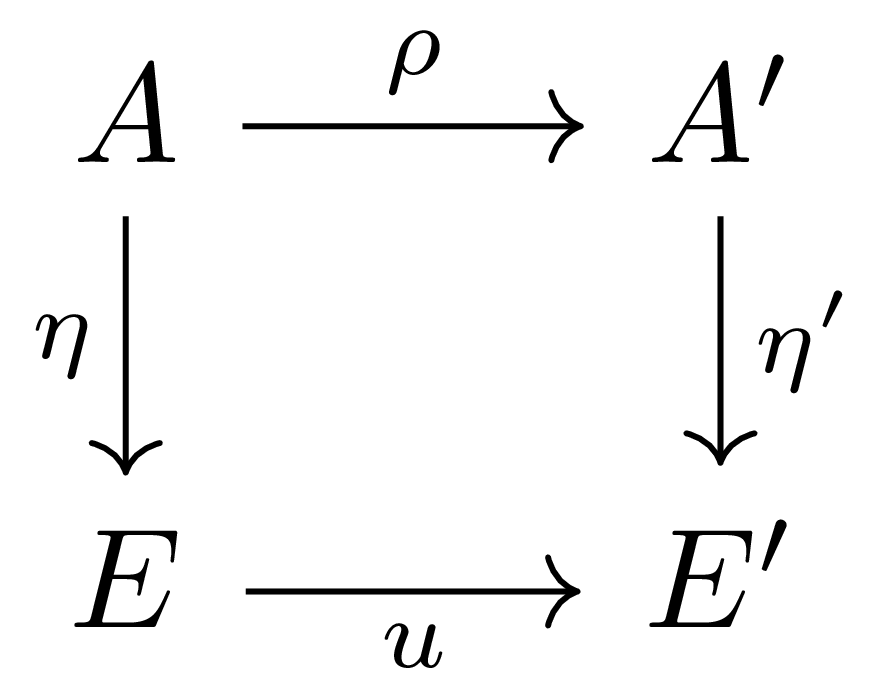
Then there exists a unique \(A\)-linear map
\[\nu: \Omega_{E/A} \rightarrow \Omega_{E'/A'}\]making the following diagram commute:
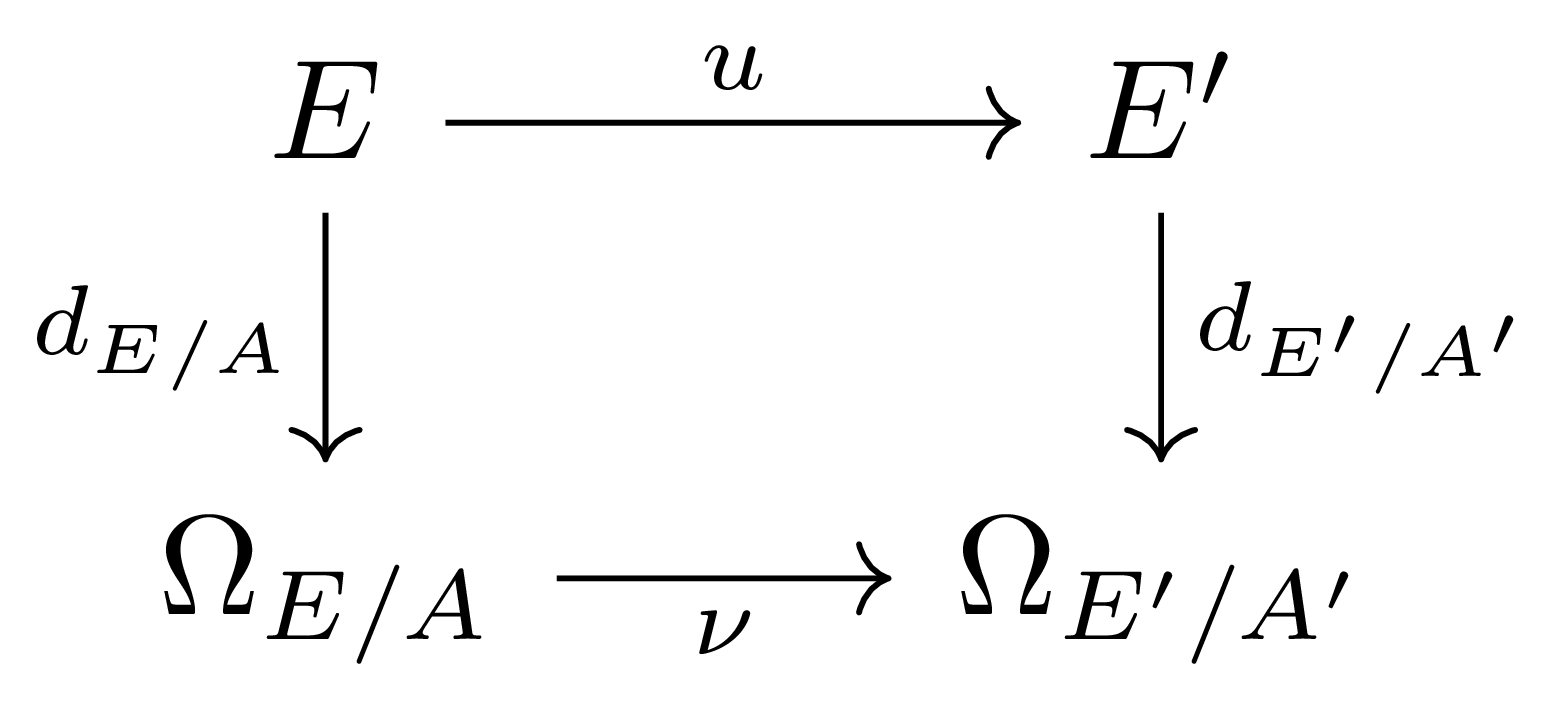
Proof
The proof of this is nothing but an appropriate use of the other universal properties employed in proving Proposition 8.
From this we see that if we regard \(\Omega\) as the correspondence taking an \(A\)-algebra \(A \rightarrow E\) to the module of its differentials \(\Omega_A(E)\), then \(\Omega\) also possesses functoriality.
On the other hand, since \(\Omega_{A'}(E')\) is an \(A'\)-module, by [Algebraic Structures] §Change of Base Ring, ⁋Proposition 5 we obtain from Proposition 11 the following \(A'\)-linear map:
\[\Omega_0(u):\Omega_A(E)\otimes_E E'\rightarrow\Omega_{A'}(E').\]Denoting by \(i_E\) the canonical morphism \(\Omega_A(E)\rightarrow \Omega_A(E)\otimes_EE'\), we know that \(\Omega(u)=\Omega_0(u)\circ i_E\).
Considering the isomorphism
\[\Hom_E(\Omega_A(E), M)\cong\Der_A(E, M)\]given by the universal property of Proposition 8, we obtain the following commutative diagram:
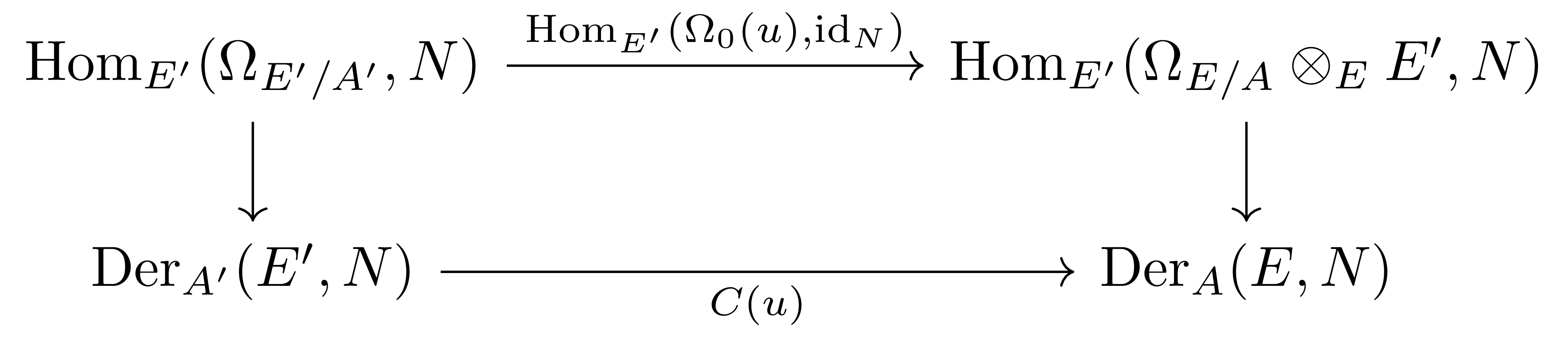
Here the right-hand vertical map is the composite of the above isomorphism and the isomorphism of [Algebraic Structures] §Change of Base Ring, ⁋Proposition 5,
\[\Hom_{E'}(\Omega_A(E)\otimes_EE', N) \rightarrow \Hom_E(\Omega_A(E), N)\rightarrow\Der_A(E, N),\]and the bottom horizontal map is
\[\Der_{A'}(E', N) \rightarrow \Der_A(E, N);\qquad D\mapsto D\circ u\]obtained from the functoriality of \(\Der\).
Proposition 12 Suppose \(E' = E \otimes_AA'\), and let \(\eta : A \to E'\) and \(u : E \to E'\) be the canonical morphisms. Then the \(A'\)-linear map
\[\Omega_0(u) : \Omega_{E/A}\otimes_EE'\rightarrow\Omega_{E'/A'}\]is an isomorphism.
Proof
First, since the vertical maps are all isomorphisms, if we show that \(C(u)\) is an isomorphism then we know that for any \(N\),
\[\Hom_{E'}(\Omega_{E'/A'} , N) \rightarrow \Hom_{E'}(\Omega_{E/A}\otimes_AE',N)\]is an isomorphism. That is, the sequence
\[0\rightarrow\Hom_{E'}(\Omega_{E'/A'} , N) \rightarrow \Hom_{E'}(\Omega_{E/A}\otimes_AE',N)\rightarrow 0\]is exact for any \(N\). Now since \(\Hom\) is a left exact functor (§Projective, Injective, and Flat Modules, ⁋Proposition 2), the exactness of the above sequence for all \(N\) is equivalent to the exactness of the sequence
\[0 \rightarrow\Omega_{E/A}\otimes_EE'\rightarrow\Omega_{E'/A'}\rightarrow 0.\]Therefore, to prove the claim it suffices to show that \(C(u)\) is bijective.
First,
\[\Hom(u, \id_N):\Hom_{A'}(E\otimes_AA', N) \rightarrow \Hom_A(E, N)\]is an isomorphism, and since \(C(u)\) is nothing but its restriction to \(\Der_{A'}(E', N)\), it is obvious that \(C(u)\) is injective. That \(C(u)\) is surjective can also be proved without difficulty.
In particular, consider the case where \(\rho:A \rightarrow A'\) is \(\id_A: A\rightarrow A'\), so that \(u:E\rightarrow E'\) is an \(A\)-algebra homomorphism. Then through the above process \(u\) induces an \(E'\)-linear homomorphism
\[\Omega_0(u): \Omega_{E/A}\otimes_AE'\rightarrow\Omega_{E'/A}.\]On the other hand, if we regard \(E'\) as an \(E\)-algebra via \(E\rightarrow E'\), then the derivation \(d_{E'/E}: E' \rightarrow\Omega_{E'/E}\) obtained here is also an \(A\)-derivation; hence by the universal property of \(\Omega_{E'/A}\) there exists a factorization
\[E'\overset{d_{E'/A}}{\longrightarrow}\Omega_{E'/A}\overset{\Omega_u}{\longrightarrow}\Omega_{E'/E}.\]Then again by the universal property there exists the following commutative diagram:
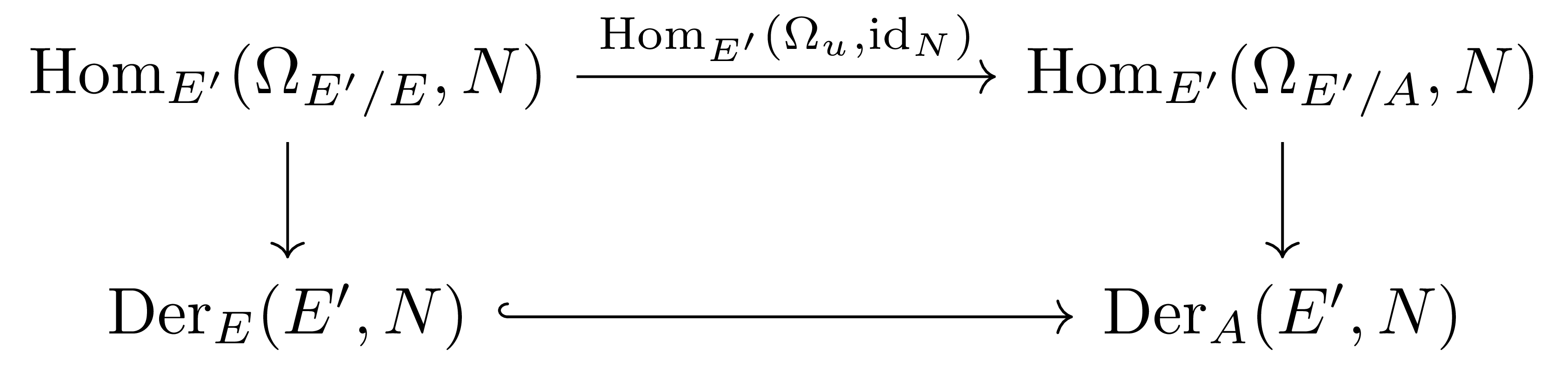
Now we introduce two exact sequences that are frequently used.
Proposition 13 The sequence of \(E'\)-modules
\[\Omega_A(E)\otimes_EE'\overset{\Omega_0(u)}{\longrightarrow}\Omega_{E'/A}\overset{\Omega_u}{\longrightarrow}\Omega_{E'/E}\longrightarrow0\]is exact.
Proof
Again from the fact that \(\Hom\) is a left exact functor (§Projective, Injective, and Flat Modules, ⁋Proposition 2), it suffices to show that the sequence
\[0 \rightarrow \Hom_{E'}(\Omega_{E'/E},N) \rightarrow \Hom_{E'}(\Omega_{E'/A}, N) \rightarrow \Hom_{E'}(\Omega_{E/A}\otimes_EE',N)\]is exact for any \(E'\)-module \(N\). However, using the commutative diagrams employed before and after Proposition 12, we can convert this into the sequence of modules of derivations
\[0 \rightarrow \Der_E(E', N) \rightarrow \Der_A(E', N) \rightarrow \Der_A(E, N),\]and we showed immediately after Proposition 2 that this is exact.
Now consider in particular the case where \(u:E \rightarrow E'\) is surjective, so that for \(\mathfrak{I}=\ker u\) we have an isomorphism \(E'\cong E/\mathfrak{I}\). Denote by \(d'\) the restriction of the canonical derivation \(d=d_{E/A}\) to \(\mathfrak{I}\),
\[\mathfrak{I}\overset{d\vert_{\mathfrak{I}}}{\longrightarrow}\Omega_{E/A}\overset{i_E}{\longrightarrow}\Omega_{E/A}\otimes_EE'.\]Then for any \(x,y\in \mathfrak{I}\),
\[d'(xy)=d(xy)\otimes1=dy\otimes u(x)+dx\otimes u(y)=0,\]so the following \(E\)-linear map
\[\overline{d}:\mathfrak{I}/\mathfrak{I}^2\rightarrow\Omega_{E/A}\otimes_EE'\]is well-defined. Moreover, since \(\mathfrak{I}\) annihilates \(\mathfrak{I}/\mathfrak{I}^2\), \(\overline{d}\) is an \(E'=E/\mathfrak{I}\)-linear map.
Proposition 14 In the above situation, the sequence of \(E'\)-linear maps
\[\mathfrak{I}/\mathfrak{I}^2\overset{\overline{d}}{\longrightarrow}\Omega_{E/A}\otimes_EE'\overset{\Omega_0(u)}{\longrightarrow}\Omega_{E'/A}\longrightarrow0\]is exact.
Proof
Using the notation of the preceding argument, we can identify \(\Omega_{E/A}\otimes_EE'\) with \(\Omega_{E/A}/\mathfrak{I}\Omega_{E/A}\). Then under this identification, the image of \(\overline{d}\) becomes the image of \(d(\mathfrak{I})\subset\Omega_{E/A}\) in the quotient module \(\Omega_{E/A}/\mathfrak{I}\Omega_{E/A}\). Therefore, taking the \(A\)-submodule \(I\) of \(\Omega_{E/A}\) to be that generated by \(\mathfrak{I}\Omega_{E/A}\) and \(d(\mathfrak{I})\), we obtain the isomorphism
\[\frac{\Omega_{E/A}\otimes_EE'}{\im(\overline{d})}\cong\frac{\Omega_{E/A}}{I},\]and through this we obtain the desired result.
댓글남기기