This post was translated from Korean by LLM (Kimi). The translation may contain errors or awkward sentences. The Korean original is the source of truth.
First, let us define the following.
Definition 1 Let a manifold \(M\) and a coordinate system \((U,\varphi)\) be given. Write \(\varphi=(x^i)_{i=1}^m\), let \(0\leq k\leq m\), and for \(p\in \varphi(U)\) consider the set
\[S=\{q\in U\mid x^i(q)=r^i(p), k+1\leq i\leq m\}.\]The manifold obtained by endowing \(S\) with the subspace topology and the coordinate system \((S, (x^j\vert_S)_{j=1}^k)\) is called a slice of \((U,\varphi)\).
Lemma 2 Let an immersion \(F:M\rightarrow N\) between two manifolds be given. Then for any \(p\in M\), there exist a coordinate system \((V,\varphi)\) containing \(F(p)\) and a suitable open neighborhood \(U\) of \(p\) such that \(F\vert_U\) is injective and \(F(U)\) is a slice of \((V,\varphi)\).
Proof
In the lemma above, one must take care to note that for an open set \(U\) in \(M\), \(F(U)\) is a slice of \((V,\varphi)\). For example, \(F(M)\cap V\) is generally not a slice, and the same is true even when \(F\) is a submanifold.
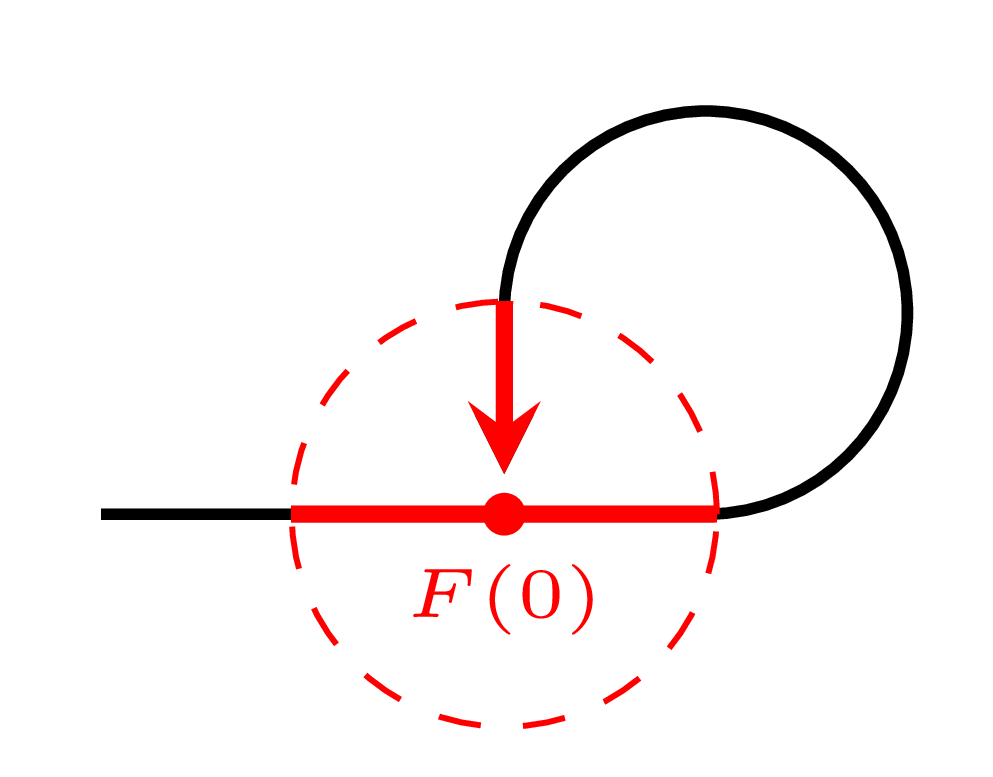
But if \(M\) is an embedding, we may choose \((V,\varphi)\) appropriately so that \(F(M)\cap V\) is a slice of \(V\). From this perspective, the above lemma can be summarized as
An immersed submanifold is locally embedded.
The Implicit Function Theorem and Its Consequences
Now we are ready to extend the implicit function theorem to differentiable manifolds.
Theorem 3 (Implicit Function Theorem) Let \(U\subset\mathbb{R}^{m-n}\times\mathbb{R}^n\) be an open set, and to distinguish, denote the coordinates of \(\mathbb{R}^{m-n}\) by \(r^1,\ldots, r^{m-n}\) and the coordinates of \(\mathbb{R}^n\) by \(s^1,\ldots, s^n\). Also, let \(f:U\rightarrow\mathbb{R}^n\) be \(C^\infty\), and for some point \((x_0, y_0)\in U\) let \(f(x_0,y_0)\). If at the point \((x_0,y_0)\) the \(n\times n\) submatrix
\[\begin{pmatrix}\partial f^1/\partial s^1&\partial f^1/\partial s^2&\cdots&\partial f^1/\partial s^n\\\partial f^2/\partial s^1&\partial f^2/\partial s^2&\cdots&\partial f^2/\partial s^n\\\vdots&\vdots&\ddots&\vdots\\\partial f^n/\partial s^1&\partial f^n/\partial s^2&\cdots&\partial f^n/\partial s^n\end{pmatrix}\]of the Jacobian matrix
\[\begin{pmatrix}\partial f^1/\partial r^1&\partial f^1/\partial r^2&\cdots&\partial f^1/\partial r^{m-n}&\partial f^1/\partial s^1&\partial f^1/\partial s^2&\cdots&\partial f^1/\partial s^n\\\partial f^2/\partial r^1&\partial f^2/\partial r^2&\cdots&\partial f^2/\partial r^{m-n}&\partial f^2/\partial s^1&\partial f^2/\partial s^2&\cdots&\partial f^2/\partial s^n\\ \vdots&\vdots&\ddots&\vdots&\vdots&\vdots&\ddots&\vdots\\\partial f^n/\partial r^1&\partial f^n/\partial r^2&\cdots&\partial f^n/\partial r^{m-n}&\partial f^n/\partial s^1&\partial f^n/\partial s^2&\cdots&\partial f^n/\partial s^n\end{pmatrix}\]is nonsingular, then there exist a suitable open neighborhood \(V\) of \(x_0\), a suitable open neighborhood \(W\) of \(y_0\), and a \(C^\infty\) function \(g:V\rightarrow W\) such that \(V\times W\subseteq U\) and for each \((p,q)\in V\times W\),
\[f(p,q)=0\iff q=g(p)\]holds.
Corollary 4 (Submersion Level Set Theorem) Let \(F:M\rightarrow N\) be \(C^\infty\), fix \(q\in F(M)\) and let \(P=F^{-1}(q)\). If for every \(p\in P\) the differential \(dF_p:T_pM\rightarrow T_{F(p)}N\) is surjective, then there exists a unique manifold structure on \(P\) such that the canonical injection \(\iota:P\hookrightarrow M\) is a submanifold.
Moreover, in this case \(\iota\) is an embedding and the codimension \(\dim M-\dim P\) of \(P\) equals \(\dim N\).
Proof
The hypothesis of the next corollary is weaker than that of the preceding one, so it is more useful.
Corollary 5 (Constant-Rank Level Set Theorem) Let \(F:M\rightarrow N\) be \(C^\infty\), and suppose that the differential \(dF_p:T_pM\rightarrow T_{F(p)}N\) defined at each \(p\in P\) has the same rank at every point \(p\in P\). Then \(F:M\rightarrow N\) is an embedded submanifold.
Using these theorems, one can show that certain subsets of a given manifold \(M\) are embedded submanifolds. This typically follows an argument such as the one below.
Example 6 Consider the function from \(\mathbb{R}^{n+1}\) to \(\mathbb{R}\) defined by
\[f(x)=\lvert x\rvert^2=\sum_{i=1}^{n+1} r^i(x)^2.\]For any point \(x\in \mathbb{R}^{n+1}\) and \(v\in T_x\mathbb{R}^{n+1}\),
\[df_x(v)=v(f)=\sum v^i\frac{\partial f}{\partial r^i}\bigg|_{x}=2\sum r^i(x) v^i\]holds, and from this we see that if \(x\) is not the origin, then by adjusting \(v\) we can make \(df_x(v)\) take any real value. That is, since \(df_x\) is always surjective away from the origin, there exists a unique manifold structure on \(f^{-1}(1)\) making it a submanifold of \(\mathbb{R}^{n+1}\). By uniqueness, this structure coincides with the manifold structure given on \(S^n\), and again by Corollary 5 we can see that this structure is an embedded submanifold of \(\mathbb{R}^{n+1}\).
References
[War] Frank W. Warner. Foundations of Differentiable Manifolds and Lie Groups, Graduate texts in mathematics, Springer, 2013
[Lee] John M. Lee. Introduction to Smooth Manifolds, Graduate texts in mathematics, Springer, 2012
댓글남기기