
This post was translated from Korean by LLM (Kimi). The translation may contain errors or awkward sentences. The Korean original is the source of truth.
Field Extensions
We saw in §Fields, ⁋Proposition 2 that a morphism between fields is either injective or the zero map. In this post we consider the former case.
We call an injective field morphism a field extension. Then, for a fixed field \(\mathbb{K}\in\Field\), the under category of \(\mathbb{K}\) becomes the category of extensions of \(\mathbb{K}\).
Although this notation differs slightly from that of §Categories, ⁋Example 13, we often denote a field extension \(\mathbb{K}\rightarrow \mathbb{L}\) by \(\mathbb{L}/\mathbb{K}\). Then, whenever a field extension \(\mathbb{L}/\mathbb{K}\) is given, we can identify \(\mathbb{K}\) with a subfield of \(\mathbb{L}\) via the injective map \(\mathbb{K}\hookrightarrow\mathbb{L}\). However, if \(\mathbb{L}=\mathbb{K}\) and \(\mathbb{K}\hookrightarrow\mathbb{L}=\mathbb{K}\) is an endomorphism, such an identification may cause confusion, so in this case we do not identify \(\mathbb{K}\) with a subfield of \(\mathbb{L}\).
By definition, given two extensions \(\mathbb{K} \rightarrow \mathbb{L}_1\) and \(\mathbb{K} \rightarrow \mathbb{L}_2\), the following commutative diagram
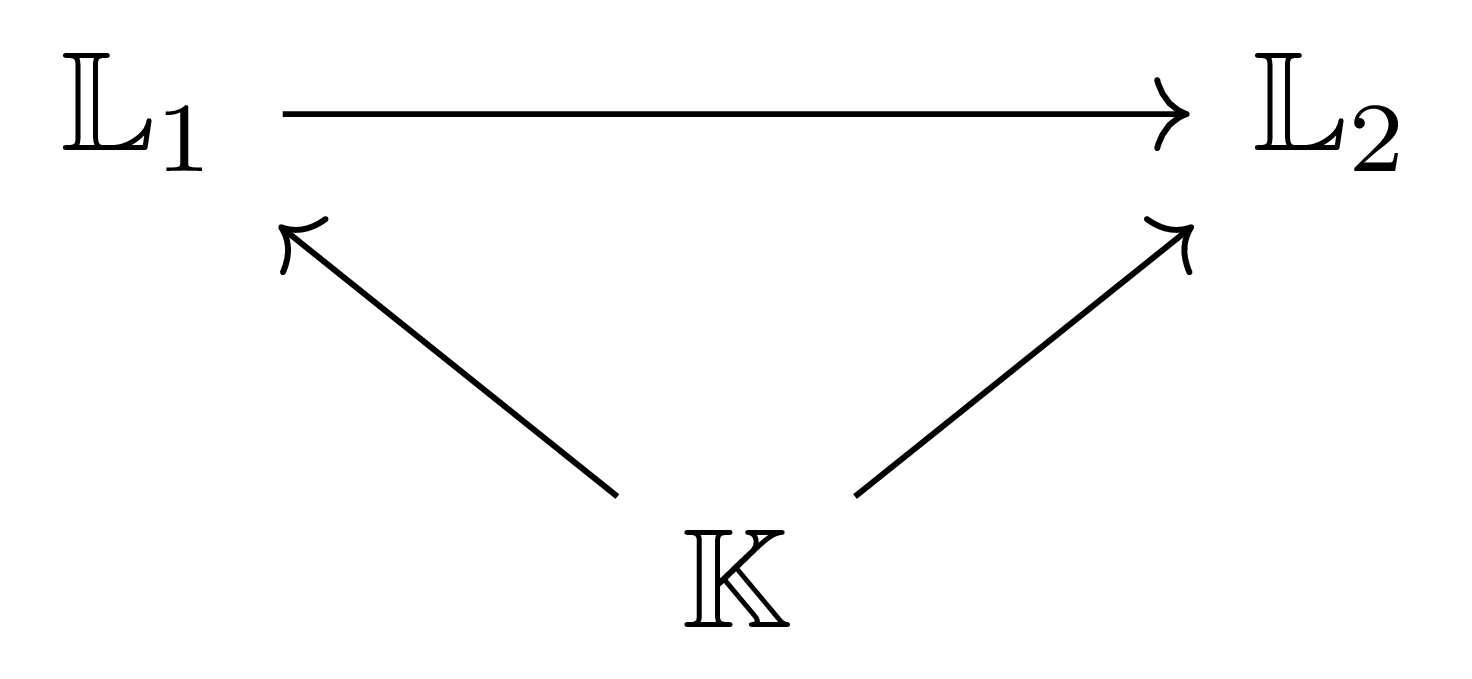
becomes a morphism between them. Here, since both \(\mathbb{L}_1\) and \(\mathbb{L}_2\) are fields, the morphism \(\mathbb{L}_1 \rightarrow \mathbb{L}_2\) must be injective. Subject to the caution above, in this case we call \(\mathbb{L}_1\) a subextension of \(\mathbb{L}_2\).
Thus any field extension \(\mathbb{L}/\mathbb{K}\) can be regarded as an associative unital \(\mathbb{K}\)-algebra (which is itself a field).
Remark We consider \(\mathbb{K}\)-algebras and homomorphisms between them in order to treat situations similar to the above; henceforth in our posts the category \(\Alg{\mathbb{K}}\) will always be the category of unital associative \(\mathbb{K}\)-algebras. That is, by a \(\mathbb{K}\)-algebra we shall always mean a unital associative \(\mathbb{K}\)-algebra, and by a \(\mathbb{K}\)-algebra homomorphism we shall mean a unital \(\mathbb{K}\)-algebra homomorpihsm.
Any \(\mathbb{K}\)-algebra is also a \(\mathbb{K}\)-module, so its dimension is well-defined. (§Bases, ⁋Proposition 6)
Definition 1 For any \(\mathbb{K}\)-algebra \(A\), we call \(\dim_{\mathbb{K}}A\) the degree of \(A\) and denote it by \([A:\mathbb{K}]\).
Then the following is obvious from the definition.
Proposition 2 For a field extension \(\mathbb{L}_2/\mathbb{L}_1/\mathbb{K}\), the equality \([\mathbb{L}_2:\mathbb{K}]=[\mathbb{L}_2:\mathbb{L}_1][\mathbb{L}_1:\mathbb{K}]\) holds.
More generally, for a field \(\mathbb{K}\) and any \(\mathbb{K}\)-algebra \(E\), we can define \([E:\mathbb{K}]\) as \(\dim_\mathbb{K}E\). Then the following proposition is simple linear algebra.
Proposition 3 For a finite degree \(\mathbb{K}\)-algebra \(E\), if \(x\in E\) is a non-zerodivisor in \(E\), then \(x\) is an invertible element of \(E\).
Proof
By assumption $$E$$ is a finite-dimensional $$\mathbb{K}$$-algebra, and since $$x$$ is a non-zerodivisor in $$E$$, the following function $$E \rightarrow E;\qquad y\mapsto xy$$ is injective. Since $$E$$ is finite-dimensional, the above linear map being injective is equivalent to it being surjective, and hence there exists $$y\in E$$ such that $$xy=1$$, from which we obtain the desired result.In particular, if a finite-dimensional \(\mathbb{K}\)-algebra \(E\) is an integral domain, then \(E\) is necessarily a field.
Meanwhile, for any ring \(A\), we have denoted by \(A[\x]\) the polynomial ring in the variable \(\x\) with coefficients in \(A\), which can be thought of as the smallest algebra containing \(A\) and the variable \(\x\). In a similar way, to adjoin an element \(\x\) to a field \(\mathbb{K}\), we must also adjoin its inverses this time.
Definition 4 For a field extension \(\mathbb{L}/\mathbb{K}\) and a subset \(A\subseteq \mathbb{L}\), we denote by \(\mathbb{K}(A)\) the smallest subextension of \(\mathbb{L}\) containing \(A\).
In this definition, \(\mathbb{L}\) is needed only to define \(A\), and regardless of what \(\mathbb{L}\) actually is, \(\mathbb{K}(A)\) will be an isomorphic field. For this reason, we often fix a (very large) field extension \(\Omega\) of \(\mathbb{K}\) (without worrying about what \(\Omega\) is) and consider subsets \(M,N\) of this extension.
Proposition 5 For two subsets \(M,N\) of some extension of \(\mathbb{K}\), the following formula
\[K(M \cup N) = K(M)(N) = K(N)(M)\]holds.
The proof of this is almost obvious from the minimality in the definition.
Meanwhile, to obtain the field \(\mathbb{K}(A)\) of Definition 4, one can fix an extension \(\mathbb{L}\) of \(\mathbb{K}\) and then take the intersection of all subextensions of \(\mathbb{L}\) containing \(A\). On the other hand, since we have shown that morphisms in the category of extensions of \(\mathbb{K}\) are nothing but extensions, the following holds.
Proposition 6 Let \(\mathcal{F}\) be the set of subfields of a field \(E\); with the inclusion relation \(\subseteq\) it becomes a directed set. In particular, the union \(L\) of the fields belonging to \(\mathcal{F}\) is a field.
If there exists a finite set \(A\) such that \(\mathbb{L}=\mathbb{K}(A)\), we call the extension \(\mathbb{L}/\mathbb{K}\) a finite extension. Then in particular a finite degree field extension is a finite extension, because a basis of \(\mathbb{L}\) as a \(\mathbb{K}\)-vector space will serve as a generator of \(\mathbb{L}\) as a field.
Now let two \(\mathbb{K}\)-extensions \(\mathbb{L}_1/\mathbb{K}\), \(\mathbb{L}_2/\mathbb{L}\) be given. Then we can consider the smallest extension containing both \(\mathbb{L}_1\) and \(\mathbb{L}_2\).
Definition 7 For two \(\mathbb{K}\)-extensions \(\mathbb{L}_1/\mathbb{K}\), \(\mathbb{L}_2/\mathbb{L}\), a \(\mathbb{K}\)-extension \(\mathbb{K} \rightarrow \mathbb{M}\) is called their composite if there exist \(\mathbb{K}\)-algebra homomorphisms \(\mathbb{L}_1 \rightarrow \mathbb{M}\) and \(\mathbb{L}_2 \rightarrow \mathbb{M}\) making the following diagram
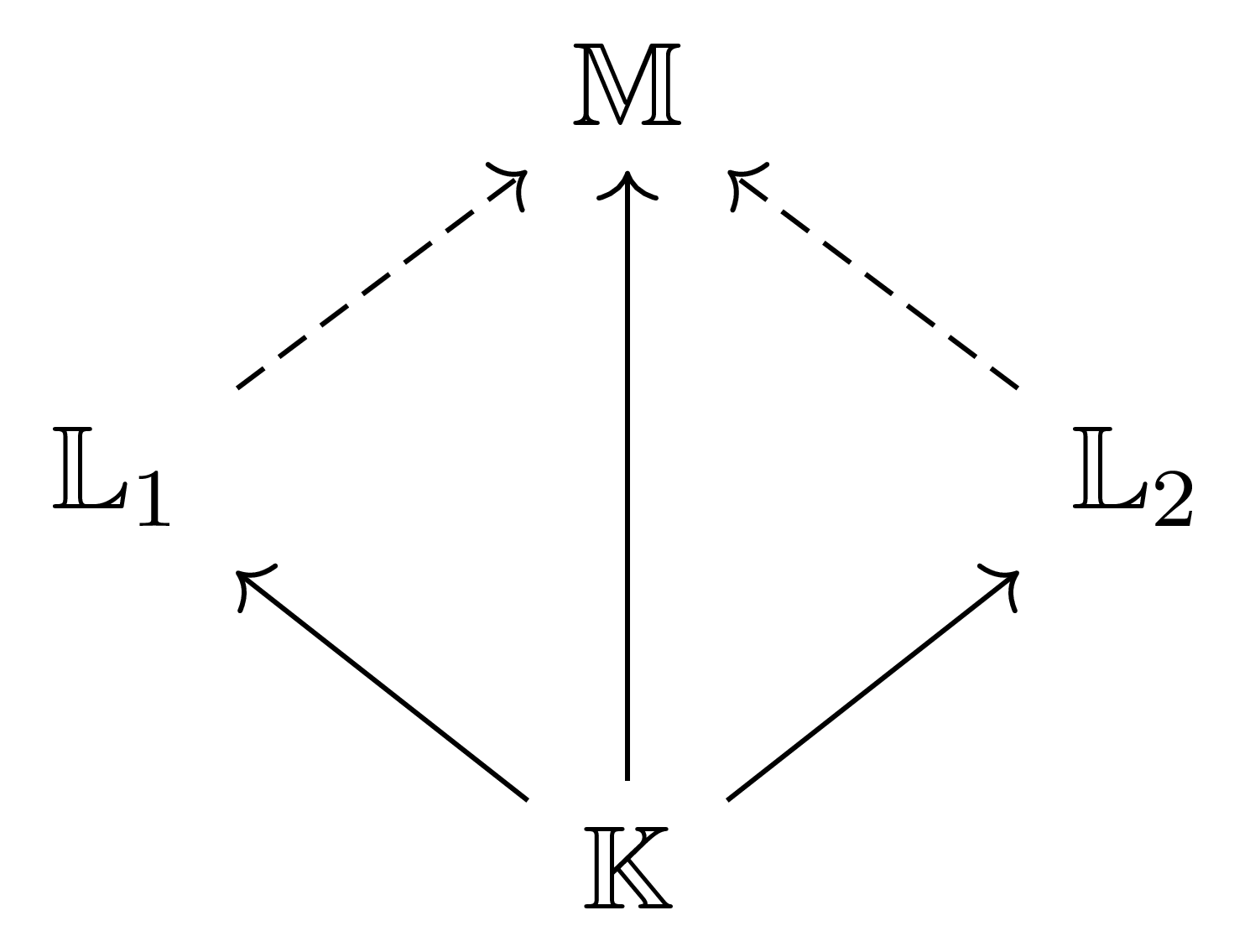
commute.
This can be made concrete as follows.
Proposition 8 Let two \(\mathbb{K}\)-extensions \(\mathbb{L}_1, \mathbb{L}_2\) be given.
-
For their composite field \(\mathbb{M}\) and extensions \(u_i: \mathbb{L}_i \rightarrow \mathbb{M}\), the kernel of the function \(u_1\ast u_2: \mathbb{L}_1\otimes_\mathbb{K} \mathbb{L}_2 \rightarrow \mathbb{M}\) defined by the formula
\[\mathbb{L}_1\otimes_\mathbb{K} \mathbb{L}_2 \rightarrow \mathbb{M};\qquad x_1\otimes x_2\mapsto u_1(x_1)u_2(x_2)\]is a prime ideal.
-
Conversely, for any prime ideal \(\mathfrak{p}\) of \(\mathbb{L}_1\otimes_\mathbb{K} \mathbb{L}_2\), there exist a suitable composite field \(\mathbb{M}\) and extensions \(u_i: \mathbb{L}_i \rightarrow \mathbb{M}\) such that \(\mathfrak{p}\) is the kernel of \(u_1\ast u_2\).
Proof
-
The image \(\im(u_1\ast u_2)\) of \(u_1\ast u_2\) is a subring of the field \(\mathbb{M}\), and hence an integral domain. The given claim is now obvious from §Fields of Fractions, ⁋Proposition 8 and §Quotient Rings, Ring Isomorphisms, ⁋Theorem 3.
-
Conversely, let \(\mathfrak{p}\) be a prime ideal of \(\mathbb{L}_1\otimes_\mathbb{K}\mathbb{L}_2\), and let \(\mathbb{M}=\Frac((\mathbb{L}_1\otimes_\mathbb{K}\mathbb{L}_2)/\mathfrak{p})\) be the field of fractions of the integral domain \((\mathbb{L}_1\otimes_\mathbb{K}\mathbb{L}_2)/\mathfrak{p}\). Then for each \(x_1\in \mathbb{L}_1\) and \(x_2\in \mathbb{L}_2\), defining \(u_1(x_1)\) to be the image of \(x_1\otimes 1\) in \(\mathbb{M}\) and \(u_2(x_2)\) to be the image of \(1\otimes x_2\) in \(\mathbb{M}\), we see that these satisfy the required conditions.
Moreover, it is also obvious that the composite field obtained from the second result is uniquely determined up to isomorphism. Meanwhile, for any two \(\mathbb{K}\)-extensions \(\mathbb{L}_1, \mathbb{L}_2\), since \(\mathbb{L}_1\otimes_\mathbb{K} \mathbb{L}_2\) always has a prime ideal (§Rings, ⁋Theorem 9), we can verify that any two \(\mathbb{K}\)-extensions have a composite field.
Algebraic Extensions
Let us fix a suitable extension \(\Omega\) of \(\mathbb{K}\). Unless stated otherwise, all field extensions are assumed to be subextensions of \(\Omega\).
For any two \(\mathbb{K}\)-subalgebras \(E,F\) of \(\Omega\), considering the multiplication map \(\mu: E\otimes_\mathbb{K}F \rightarrow \Omega\), its image \(G\) is the subring of \(\Omega\) generated by \(E\cup F\).
Definition 9 In the above situation, if the multiplication map \(\mu: E\otimes_\mathbb{K}F \rightarrow G\) is an isomorphism, we say that \(E\) and \(F\) are linearly disjoint.
It is not difficult to see that this is equivalent to the family \((x_iy_j)_{i\in I,j\in J}\) being linearly independent when \((x_i)_{i\in I}\) and \((y_j)_{j\in J}\) are \(\mathbb{K}\)-bases of \(E\) and \(F\), respectively.
In particular, when \(E,F\) are \(\mathbb{K}\)-extensions, we obtain the following proposition.
Proposition 10 For two \(\mathbb{K}\)-extensions \(\mathbb{L}_1, \mathbb{L}_2\), the following hold.
-
If \(\mathbb{L}_2\) has finite degree, the subring of \(\Omega\) generated by \(\mathbb{L}_1 \cup \mathbb{L}_2\) is a field, which coincides with \(\mathbb{L}_1(\mathbb{L}_2)\). Moreover, the degree of \(\mathbb{L}_1(\mathbb{L}_2)\) over \(\mathbb{L}_1\) is also finite and
\[[\mathbb{L}_1(\mathbb{L}_2) : \mathbb{L}_1] \leq [\mathbb{L}_2 : \mathbb{K}]\]with equality holding when \(\mathbb{L}_1\) and \(\mathbb{L}_2\) are linearly disjoint. In this case, \(\mathbb{L}_1(\mathbb{L}_2)\) is \(\mathbb{L}_1\)-isomorphic to \(\mathbb{L}_1 \otimes_\mathbb{K} \mathbb{L}_2\).
-
Assume further that the degree of \(\mathbb{L}_1\) is also finite. Then the degree of \(\mathbb{L}_1(\mathbb{L}_2) = \mathbb{K}(\mathbb{L}_1 \cup \mathbb{L}_2)\) is also finite and
\[[\mathbb{K}(\mathbb{L}_1 \cup \mathbb{L}_2) : \mathbb{K}] \leq [\mathbb{L}_1 : \mathbb{K}][\mathbb{L}_2 : \mathbb{K}]\]with equality holding when \(\mathbb{L}_1\) and \(\mathbb{L}_2\) are linearly disjoint.
Proof
-
Let \(G\) be the subring of \(\Omega\) generated by \(\mathbb{L}_1 \cup \mathbb{L}_2\). If \((y_j)_{1 \leq j \leq n}\) is a \(\mathbb{K}\)-basis of \(\mathbb{L}_2\), then \(G\) is generated as an \(\mathbb{L}_1\)-vector space by the \(y_j\). Thus \(G\) becomes an \(\mathbb{L}_1\)-algebra of finite rank \(\leq n\). Since \(G\) is contained in the field \(\Omega\), it is an integral domain, and hence is a field by Proposition 3. Consequently \(G=\mathbb{L}_1(\mathbb{L}_2)\), and
\[[\mathbb{L}_1(\mathbb{L}_2) : \mathbb{L}_1] \leq [\mathbb{L}_2 : \mathbb{K}]\]holds. Moreover, if \([\mathbb{L}_1(\mathbb{L}_2) : \mathbb{L}_1] = [\mathbb{L}_2 : \mathbb{K}]\), then the \(y_j\) must be linearly independent over \(\mathbb{L}_1\); that is, \(\mathbb{L}_1\) and \(\mathbb{L}_2\) are linearly disjoint.
-
This is obvious from the formula
\[[\mathbb{L}_1(\mathbb{L}_2) : \mathbb{K}] = [\mathbb{L}_1(\mathbb{L}_2) : \mathbb{L}_1][\mathbb{L}_1 : \mathbb{K}]\].
In general, for two \(\mathbb{K}\)-extensions \(\mathbb{L}_1,\mathbb{L}_2\), we mentioned earlier that the ring \(\mathbb{K}[\mathbb{L}_1\cup \mathbb{L}_2]\) is not a field. However, the formula
\[\Frac(\mathbb{K}[\mathbb{L}_1\cup\mathbb{L}_2])=\mathbb{K}(\mathbb{L}_1\cup\mathbb{L}_2)\]holds. More generally, let \(S_i\subseteq \mathbb{L}_i\) be subsets satisfying \(\Frac(S_i)=\mathbb{L}_i\). If \(G\) is the ring generated by \(S_1\cup S_2\), then we obtain the isomorphism
\[\Frac(G)\cong \mathbb{K}(\mathbb{L}_1\cup\mathbb{L}_2).\]The following proposition extends this observation to the language of linearly disjoint extensions.
Proposition 11 Let \(\mathbb{L}_1, \mathbb{L}_2\) be two extensions of \(\mathbb{K}\), and let \(E_1, E_2\) be \(\mathbb{K}\)-subalgebras of \(\Omega\). Writing \(\mathbb{L}_i=\Frac(E_i)\), then \(\mathbb{L}_1\) and \(\mathbb{L}_2\) are linearly disjoint if and only if \(E_1\) and \(E_2\) are linearly disjoint.
Proof
One direction is obvious, so assume that \(E_1, E_2\) are linearly disjoint. Then we can first show that \(E_1\) and \(\mathbb{L}_2\) are linearly disjoint, because any \(E_2\)-free family in \(\Omega\) is also \(\mathbb{L}_2\)-free. By the same logic, \(\mathbb{L}_1\) and \(\mathbb{L}_2\) are linearly disjoint.
Meanwhile, since a linear combination of an arbitrary family consists only of finite sums (even if the family is infinite), the following holds.
Proposition 12 Let \(\mathbb{L}_1, \mathbb{L}_2\) be two \(\mathbb{K}\)-extensions. If \(\mathbb{L}_1\) and \(\mathbb{L}_2\) are linearly disjoint, then every subextension of \(\mathbb{L}_1\) and every subextension of \(\mathbb{L}_2\) are also linearly disjoint over \(\mathbb{K}\). Conversely, if for all finitely generated subextensions \(\mathbb{L}_i'\) of the \(\mathbb{L}_i\), the extensions \(\mathbb{L}_1'\) and \(\mathbb{L}_2'\) are linearly disjoint, then \(\mathbb{L}_1\) and \(\mathbb{L}_2\) are also linearly disjoint.
In other words, whether two arbitrary extensions are linearly disjoint can be checked by looking only at their finite subextensions.
Proposition 13 Let three \(\mathbb{K}\)-extensions \(\mathbb{L},\mathbb{M}_1,\mathbb{M}_2\) be given, and suppose \(\mathbb{M}_1 \subseteq \mathbb{M}_2\). Then \(\mathbb{L}\) and \(\mathbb{M}_2\) being linearly disjoint is equivalent to \(\mathbb{L}\) and \(\mathbb{M}_1\) being linearly disjoint and at the same time \(\mathbb{L}(\mathbb{M}_1)\) and \(\mathbb{M}_2\) being linearly disjoint.
Proof
First assume that \(\mathbb{L}\) and \(\mathbb{M}_2\) are linearly disjoint. Then by Proposition 12, \(\mathbb{L}\) and \(\mathbb{M}_1\) are also linearly disjoint. On the other hand, a \(\mathbb{K}\)-basis of \(\mathbb{L}\) is also an \(\mathbb{M}_1\)-basis of \(\mathbb{M}_1[\mathbb{L}]\). But by assumption this basis is \(\mathbb{M}_2\)-free, so \(\mathbb{M}_1[\mathbb{L}]\) and \(\mathbb{M}_2\) are linearly disjoint. Moreover, by Proposition 11, \(\mathbb{L}(\mathbb{M}_1) = \mathbb{M}_1(\mathbb{L})\) and \(\mathbb{M}_2\) are also linearly disjoint.
Now let us show the converse. As above, taking a \(\mathbb{K}\)-basis \(B\) of \(\mathbb{L}\), the hypothesis implies that \(B\) is \(\mathbb{M}_1\)-free. Hence \(B\) is an \(\mathbb{M}_1\)-basis of \(\mathbb{M}_1[\mathbb{L}]\), and again by hypothesis \(\mathbb{M}_1[\mathbb{L}]\) and \(\mathbb{M}_2\) are linearly disjoint, so we obtain the desired result.
Consider a field \(\mathbb{K}\) and a \(\mathbb{K}\)-algebra \(E\). Then for any \(x\in E\), exactly one of the following two holds.
- \((x^n)_{n\geq 0}\) is \(\mathbb{K}\)-free.
- There exists \(n\) such that \(1,x,\cdots, x^{n-1}\) are \(\mathbb{K}\)-linearly dependent.
Definition 14 In the above situation, if the first case holds we call \(x\in E\) transcendental, and if the second case holds we call \(x\) algebraic.
Now suppose \(x\in E\) is algebraic. Then the smallest \(n\) such that \(1,x,\ldots, x^{n-1}\) are \(\mathbb{K}\)-linearly dependent is called the degree of \(x\), and for the linear combination
\[a_nx^n+a_{n-1}x^{n-1}+\cdots+a_1x+a_0=0\]the polynomial
\[f(\x)=\x^n-\sum_{k=0}^{n-1}\frac{a_k}{a_n}\x^k\]is called the minimal polynomial of \(x\).
Then the following theorem holds, and its proof is not very difficult either.
Theorem 15 For an algebraic element \(x\in E\) of a \(\mathbb{K}\)-algebra \(E\), let \(n\) be the degree of \(x\) and \(f\) its minimal polynomial. Then the following hold.
- For \(g \in \mathbb{K}[\x]\), the necessary and sufficient condition for \(g(x) = 0\) is that \(g\) be a multiple of \(f\).
- Define \(\mathbb{K}[\x] \rightarrow \mathbb{K}[x]\) by \(g\mapsto g(x)\). Then this morphism factors through the quotient algebra \(\mathbb{K}[\x]/(f)\), and the resulting map \(\mathbb{K}[\x]/(f) \rightarrow \mathbb{K}[x]\) is an isomorphism. Moreover, in this case \(1, x, \dots, x^{n-1}\) form a \(\mathbb{K}\)-basis of \(\mathbb{K}[x]\), and therefore \([\mathbb{K}[x] : \mathbb{K}] = n\) holds.
- If \(E\) is an integral domain, then \(\mathbb{K}[x]\) is a field, and \(f\in \mathbb{K}[\x]\) is the unique monic irreducible polynomial satisfying \(f(x) = 0\).
- The necessary and sufficient condition for \(x\) to be an invertible element in \(E\) is that \(f(0) \neq 0\), and in this case \(x^{-1} \in \mathbb{K}[x]\).
Also, for an extension \(\mathbb{K}\hookrightarrow \mathbb{L}\) and an \(\mathbb{L}\)-algebra \(E\), if an element \(x\in E\) is algebraic over \(\mathbb{K}\), then \(x\) is also algebraic over \(\mathbb{L}\), and its degree does not exceed that over \(\mathbb{K}\).
Definition 16 A field extension \(\mathbb{L}/\mathbb{K}\) in which every element is algebraic is called an algebraic extension. A field extension that is not algebraic is called a transcendental extension.
Then it is not difficult to see that an extension \(\mathbb{L}/\mathbb{K}\) being algebraic is equivalent to every \(\mathbb{K}\)-subalgebra of \(\mathbb{L}\) being a field. Also, the following proposition is obvious.
Proposition 17 A degree \(n\) \(\mathbb{K}\)-extension \(\mathbb{L}\) is necessarily an algebraic extension, and the degree of any element of \(\mathbb{L}\) is a divisor of \(n\).
Proof
\[[\mathbb{L}:\mathbb{K}]=[\mathbb{L}:\mathbb{K}(x)][\mathbb{K}(x):\mathbb{K}].\]Extending this inductively, we obtain the following.
Theorem 18 Let a finitely generated \(\mathbb{K}\)-extension \(\mathbb{L}\) be generated by algebraic elements \(a_1, \dots, a_m\). Then \(\mathbb{L}/\mathbb{K}\) is a finite degree extension. Moreover, if for each \(i\) we let \(n_i\) be the degree of \(a_i\) over \(\mathbb{K}(a_1, \dots, a_{i-1})\), then the degree of \(\mathbb{L}\) over \(\mathbb{K}\) is \(n_1 n_2 \cdots n_m\), and the elements
\[a_1^{\nu_1} a_2^{\nu_2} \cdots a_m^{\nu_m}\qquad (0 \leq \nu_i \leq n_i - 1)\]form a \(\mathbb{K}\)-basis of \(\mathbb{L}\).
In particular, for a set \(A\) consisting only of algebraic elements, \(\mathbb{K}(A)=\mathbb{K}[A]\) holds. Moreover, algebraic extensions are transitive. That is, the following proposition holds.
Proposition 19 For a field extension \(\mathbb{M}/\mathbb{L}/\mathbb{K}\), the necessary and sufficient condition for \(\mathbb{M}\) to be algebraic over \(\mathbb{K}\) is that \(\mathbb{L}\) be algebraic over \(\mathbb{K}\) and at the same time \(\mathbb{M}\) be algebraic over \(\mathbb{L}\).
Proof
One direction is obvious, so it suffices to show the converse. Assume that \(\mathbb{L}\) is algebraic over \(\mathbb{K}\) and that \(\mathbb{M}\) is algebraic over \(\mathbb{L}\), and pick an arbitrary element \(x\) of \(\mathbb{M}\). We must show that \(x\) is algebraic over \(\mathbb{K}\).
First, by assumption \(x\) is algebraic over \(\mathbb{L}\). Let \(g \in \mathbb{L}[\x]\) be the minimal polynomial of \(x\), and let \(A\) be the set of coefficients of \(g\). Then \(g \in \mathbb{K}(A)[\x]\), and therefore \(x\) is algebraic over \(\mathbb{K}(A)\).
Moreover, \(\mathbb{K}(A \cup \{x\}) = \mathbb{K}(A)(x)\) has finite degree over \(\mathbb{K}(A)\). Since \(A \subseteq \mathbb{L}\) and \(\mathbb{L}\) is algebraic over \(\mathbb{K}\), by Theorem 18 the extension \(\mathbb{K}(A)\) has finite degree over \(\mathbb{K}\). Hence \(\mathbb{K}(A \cup \{x\})\) has finite degree over \(\mathbb{K}\), and therefore \(x\) is algebraic over \(\mathbb{K}\).
댓글남기기