This post was machine-translated from Korean by Kimi CLI. The translation may contain errors. The Korean original is the source of truth.
Definition of Projective Space
In this post we define projective varieties, another important class of algebraic varieties. We begin with the following.
Definition 1 The projective \(n\)-space \(\mathbb{P}^n_{\mathbb{K}}\) over a field \(\mathbb{K}\) is defined as follows. As a set,
\[\mathbb{P}^n = (\mathbb{K}^{n+1} \setminus \{0\}) / \sim\]where the equivalence relation \(\sim\) is given by
\[(x_0, \ldots, x_n) \sim (y_0, \ldots, y_n) \iff \text{$x_i = \lambda y_i$ for some $\lambda \in \mathbb{K}^\ast$, for all $i$}\]When there is no danger of confusion, we simply write \(\mathbb{P}^n\).
The equivalence class \([(x_0, \ldots, x_n)]\) is usually denoted by \([x_0 : \cdots : x_n]\), and these are called homogeneous coordinates. The \(x_0, \ldots, x_n\) are called coordinates, and at least one of them must be nonzero. The key feature of homogeneous coordinates is that the coordinates determine only a ratio. That is, for every \(\lambda\in \mathbb{K}^\ast\) we have \([x_0 : \cdots : x_n] = [\lambda x_0 : \cdots : \lambda x_n]\).
Homogeneous Polynomials and Projective Space
Just as in the affine case, we must now give \(\mathbb{P}^n\) a topology. Again, we will define closed sets as zero sets of polynomials, but the point to notice is that since \(\mathbb{P}^n\) is defined as a quotient set, a polynomial does not in general define a function on \(\mathbb{P}^n\). That is, for arbitrary \(F \in \mathbb{K}[x_0, \ldots, x_n]\) we have \([x_0 : \cdots : x_n] = [\lambda x_0 : \cdots : \lambda x_n]\), but in general
\[F(x_0, \ldots, x_n)\neq F(\lambda x_0, \ldots, \lambda x_n),\]and the only polynomials for which this evaluation is well defined at every point of \(\mathbb{P}^n\), independent of the chosen representative, are the constant polynomials. However, if we care only about the zero set defined by a polynomial, this problem disappears. For a homogeneous polynomial \(F\) of degree \(d\) we have
\[F(\lambda x_0, \ldots, \lambda x_n) = \lambda^d F(x_0, \ldots, x_n),\]and therefore
\[F(\lambda x_0, \ldots, \lambda x_n) = 0 \iff F(x_0, \ldots, x_n) = 0.\]Hence the zero set of a homogeneous polynomial is well defined on projective space.
Definition 2 A polynomial \(F \in \mathbb{K}[\x_0, \ldots, \x_n]\) is homogeneous of degree \(d\) if for every \(\lambda \in \mathbb{K}\)
\[F(\lambda \x_0, \ldots, \lambda \x_n) = \lambda^d F(\x_0, \ldots, \x_n)\]holds.
Although the definition is stated in a complicated way, it essentially says that when the polynomial is expressed as a sum of monomials, every monomial has degree \(d\). We can now define the following.
Definition 3 For homogeneous polynomials \(F_1, \ldots, F_k \in \mathbb{K}[\x_0, \ldots, \x_n]\), the projective algebraic set \(Z(F_1, \ldots, F_k)\) is defined by
\[Z(F_1, \ldots, F_k) = \{[x_0 : \cdots : x_n] \in \mathbb{P}^n \mid F_1(x) = \cdots = F_k(x) = 0\}.\]A projective variety is a projective algebraic set that cannot be written as a union of strictly smaller projective algebraic sets.
As explained above, since each \(F_i\) is homogeneous, one can check that this is well defined.
Recall that when dealing with affine varieties, it was enough to consider only ideals rather than arbitrary subsets of \(\mathbb{K}[\x_1,\ldots, \x_n]\). In the projective case the same philosophy applies, but with the additional homogeneity assumption we can define the notion of a homogeneous ideal.
Definition 4 An ideal \(\mathfrak{a} \subseteq \mathbb{K}[\x_0, \ldots, \x_n]\) is homogeneous if it is generated by homogeneous polynomials.
For a homogeneous ideal \(\mathfrak{a}\), if we define its zero set \(Z(\mathfrak{a})\) to be the set of points where every homogeneous polynomial in \(\mathfrak{a}\) vanishes, then, just as in the affine case, we can define the Zariski topology. For this we need the following proposition.
Proposition 5 The following hold.
- \(Z(0) = \mathbb{P}^n\), \(Z(1) = \emptyset\),
- \(\bigcap_iZ(\mathfrak{a}_i) = Z\left(\sum_i \mathfrak{a}_i\right)\),
- \(Z(\mathfrak{a}) \cup Z(\mathfrak{b}) = Z(\mathfrak{a} \cap \mathfrak{b}) = Z(\mathfrak{a}\mathfrak{b})\).
Proof
The only difference from the affine case is that the polynomials treated here are all homogeneous, but the proof logic itself is identical, so we omit the proof.
Just as in the affine case, this shows that there exists a topology on projective space \(\mathbb{P}^n\) whose closed sets are the projective algebraic sets, and we can give each projective variety the subspace topology induced from it. This topology is likewise called the Zariski topology. (We first studied the Zariski topology in the affine case in [Affine Varieties] §Definition of Affine Varieties.)
Projective Nullstellensatz
Definition 6 The homogeneous ideal \(I(X)\) of a subset \(X \subseteq \mathbb{P}^n\) is defined by
\[I(X) = \{F \in \mathbb{K}[\x_0, \ldots, \x_n] \mid F \text{ is homogeneous and } F(x) = 0 \text{ for all } x \in X\}.\]Theorem 7 (Projective Nullstellensatz) Let \(\mathbb{K}\) be an algebraically closed field and let \(\mathfrak{a} \subseteq \mathbb{K}[\x_0, \ldots, \x_n]\) be a homogeneous ideal. Then
- \(Z(\mathfrak{a}) = \emptyset \iff \mathfrak{a} \supseteq (\x_0, \ldots, \x_n)\),
- \(I(Z(\mathfrak{a})) = \sqrt{\mathfrak{a}}\) (if \(Z(\mathfrak{a}) \ne \emptyset\)).
The difference from the affine case is that \(Z(\mathfrak{a}) = \emptyset\) does not mean \(\mathfrak{a} = (1)\), but rather that \(\mathfrak{a}\) contains the irrelevant ideal \((\x_0, \ldots, \x_n)\). This is because \((\x_0, \ldots, \x_n)\) corresponds to the origin of \(\mathbb{K}^{n+1}\), which is excluded from the definition of projective space.
Standard Affine Cover
Projective space \(\mathbb{P}^n\) can be covered by \(n+1\) copies of affine space. This is one of the most important ways to understand projective space.
Definition 8 For \(i = 0, 1, \ldots, n\), the \(i\)-th standard open set \(U_i\) is defined by
\[U_i = \{[x_0 : \cdots : x_n] \in \mathbb{P}^n \mid x_i \ne 0\}.\]Give each \(U_i\) the subspace topology inherited from \(\mathbb{P}^n\). Then the following holds.
Proposition 9 Each \(U_i\) is homeomorphic to affine space \(\mathbb{A}^n\) (in the subspace topology).
Proof
For convenience of notation we prove the case \(i=0\). Define a map \(\varphi_0: U_0 \to \mathbb{A}^n\) by
\[\varphi_0([x_0 : x_1 : \cdots : x_n]) = \left(\frac{x_1}{x_0}, \ldots, \frac{x_n}{x_0}\right).\]The inverse map \(\psi_0: \mathbb{A}^n \to U_0\) is given by
\[\psi_0(a_1, \ldots, a_n) = [1 : a_1 : \cdots : a_n].\]That these are inverses of each other is obvious from the definitions. We must now show that both \(\varphi_0\) and \(\psi_0\) are continuous.
First, to show that \(\varphi_0\) is continuous, consider a closed set \(Z(f)\) in \(\mathbb{A}^n\). Then
\[\varphi_0^{-1}(Z(f)) = \left\{[x_0 : \cdots : x_n] \in U_0 \mid f\left(\frac{x_1}{x_0}, \ldots, \frac{x_n}{x_0}\right) = 0\right\}.\]Now if \(f\) is a polynomial of degree \(d\), then
\[F(x_0,\ldots, \x_n)=\x_0^d f(\x_1/\x_0, \ldots, \x_n/\x_0)\]is a homogeneous polynomial and \(\varphi_0^{-1}(Z(f)) = Z(F) \cap U_0\). This is a closed set in the subspace topology on \(U_0\).
Next we show that the inverse map \(\psi_0\) is continuous. Consider a closed set \(Z(F) \cap U_0\) in \(U_0\), where \(F\) is a homogeneous polynomial of degree \(d\). Then
\[\psi_0^{-1}(Z(F) \cap U_0) = \{(x_1, \ldots, x_n) \in \mathbb{A}^n \mid F(1, x_1, \ldots, x_n) = 0\}.\]Since \(F(1, \x_1, \ldots, \x_n)\) is a polynomial in \(\mathbb{K}[\x_1, \ldots, \x_n]\), the set \(\psi_0^{-1}(Z(F) \cap U_0)\) is closed in \(\mathbb{A}^n\).
Therefore \(\varphi_0\) and \(\psi_0\) are continuous inverses of each other, so \(\varphi_0\) is a homeomorphism.
Intuitively, we may think of \(U_i\) as the set of points whose coordinate \(x_i\) is not “at infinity.” Moreover, \(\mathbb{P}^n = U_0 \cup \cdots \cup U_n\), and by the proposition above each \(U_i \cong \mathbb{A}^n\). Since the key ingredient in the proof of the above proposition is the following statement, we separate it out.
Proposition 10 For a projective variety \(X \subseteq \mathbb{P}^n\) and a standard open set \(U_i\), the intersection \(X \cap U_i\) is an affine variety on \(U_i \cong \mathbb{A}^n\).
Proof
For \(U_0\), suppose \(X = Z(F_1, \ldots, F_k)\) where each \(F_j\) is homogeneous of degree \(d_j\). Then \(X \cap U_0\) consists of the points in \(\mathbb{A}^n\) satisfying
\[F_j\left(1, \frac{\x_1}{\x_0}, \ldots, \frac{\x_n}{\x_0}\right) = 0, \quad j = 1, \ldots, k.\]Multiplying both sides by \(\x_0^{d_j}\) gives
\[\x_0^{d_j} F_j\left(1, \frac{\x_1}{\x_0}, \ldots, \frac{\x_n}{\x_0}\right) = F_j(\x_0, \x_1, \ldots, \x_n) = 0.\]Now set \(f_j(\x_1, \ldots, \x_n) = F_j(1, \x_1, \ldots, \x_n)\); then \(X \cap U_0 = Z(f_1, \ldots, f_k) \subseteq \mathbb{A}^n\).
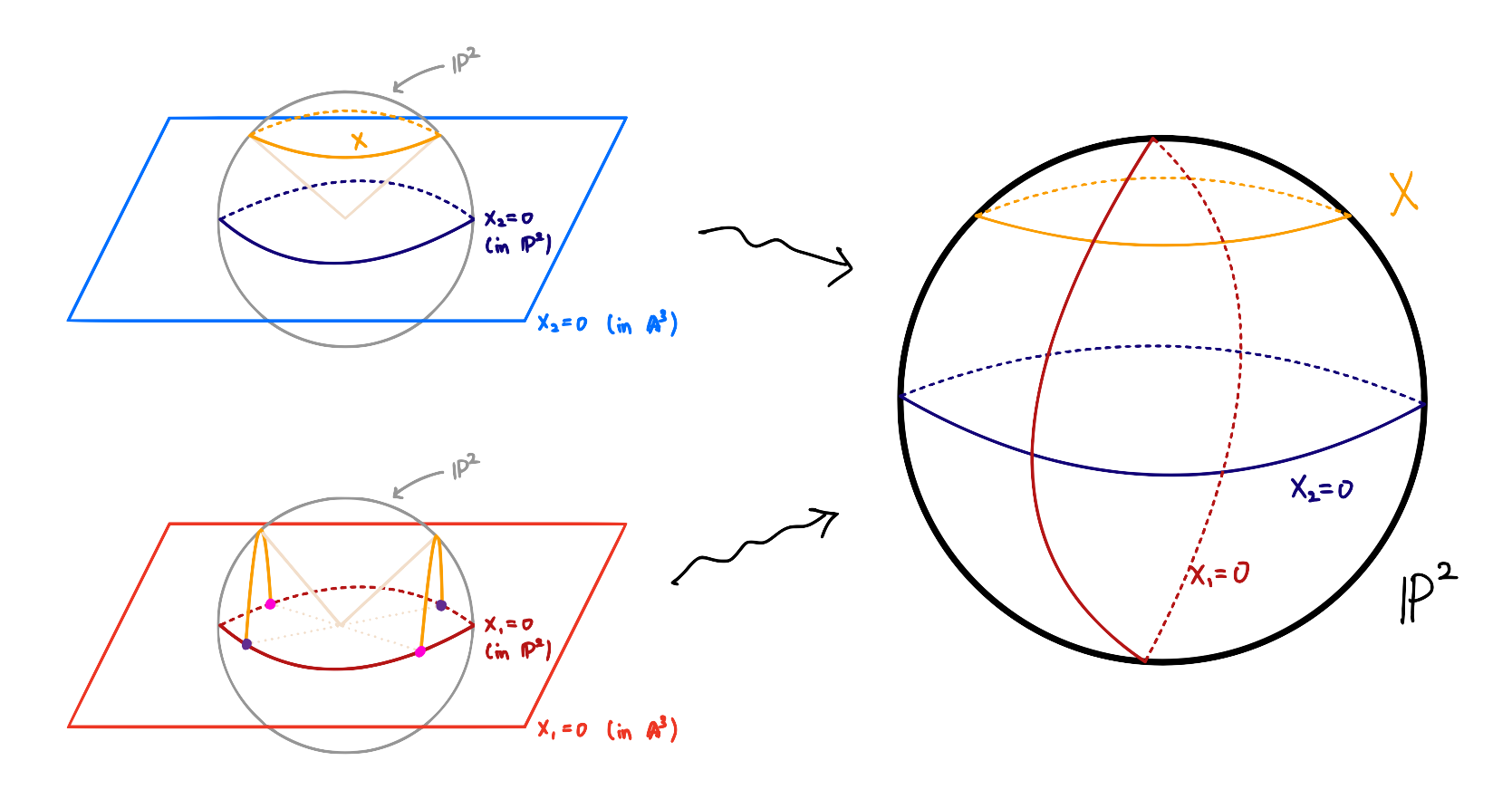
Example 11 To interpret the above proposition geometrically, let \(\mathbb{K}=\mathbb{R}\) and consider the conic \(X = Z(\x_0^2 + \x_1^2 - \x_2^2)\) in \(\mathbb{P}^2\).
This conic is the expression in homogeneous coordinates of the cone \(\x_0^2 + \x_1^2 = \x_2^2\) in \(\mathbb{A}^3\). Then Proposition 10 tells us how \(X\) looks in the standard open sets. Namely, to see what \(X\) looks like in \(U_i\) we simply put \(1\) in place of \(\x_i\) and regard the remaining \(n\) variables as coordinates on \(\mathbb{A}^n\). In particular we obtain the following.
- In \(U_0\) and \(U_1\), the curve \(X\) is the hyperbola \(1+y^2-z^2=0\) and \(x^2+1-z^2=0\), respectively.
- In \(U_2\), the curve \(X\) is the circle \(x^2+y^2=1\).
This happens because the equation \(\x_0^2 + \x_1^2 = \x_2^2\) defines a cone in \(\mathbb{A}^3\), and intersecting it with the planes \(\x_0=1\), \(\x_1=1\), \(\x_2=1\) yields hyperbolas and a circle.
On the other hand, we can also interpret this directly in \(\mathbb{P}^2\). To do so, we construct \(\mathbb{P}^2\) as follows. For points with \(\x_2\neq 0\) we apply radial projection onto the upper hemisphere satisfying \(\x_2>0\); for points with \(\x_2=0\) we identify antipodal points. Through this construction, \(\mathbb{P}^2\) can be thought of as the “line at infinity” \(\mathbb{P}^1\) together with the plane \(\mathbb{A}^2\) corresponding to the surface of the upper hemisphere. Then the given cone first becomes a circle contained in the upper hemisphere via radial projection, and from this we see that \(X\) appears as a circle in \(\mathbb{P}^2\).
Of course, we could also have constructed \(\mathbb{P}^2\) by radially projecting points with \(\x_0\neq 0\) onto the upper hemisphere with \(\x_0>0\) and taking the points with \(\x_0=0\) as \(\mathbb{P}^1\). In this process two semicircles would be drawn on the upper hemisphere, but the boundary points of these two semicircles would be identified with each other in the process of identifying the points with \(\x_0=0\), so in this picture too \(X\) would be a circle.
From this point of view, looking at \(X\) in \(U_i\) corresponds to removing the line at infinity \(\x_i=0\) from \(\mathbb{P}^2\). If we look at \(X\) in \(U_2\), then as we saw above, \(X\) does not meet the line at infinity \(\x_2=0\), so removing this line leaves a complete circle. However, if for instance we remove the line at infinity \(\x_1=0\), then \(X\) meets \(\x_1=0\) in two points, and so we can understand that removing these two points from the circle \(X\) and “unfolding” gives a hyperbola.
Affine Cone
The preceding example shows how to view a curve in projective space inside each affine open chart, but one may still find this somewhat less than intuitive. Another way to understand a projective variety as a geometric object in affine space is to consider its affine cone.
Definition 12 The affine cone \(C(X) \subseteq \mathbb{A}^{n+1}\) of a projective variety \(X \subseteq \mathbb{P}^n\) is defined by
\[C(X) = \{(x_0, \ldots, x_n) \in \mathbb{A}^{n+1} \setminus \{0\} \mid [x_0 : \cdots : x_n] \in X\} \cup \{0\}.\]In other words, \(C(X)\) is the union of the points of \(\mathbb{A}^{n+1}\) that appear when all points of \(X\) are expressed in homogeneous coordinates, together with the origin.
Example 13 The affine cone \(C(X)\) of the conic \(X = Z(\x_0^2 + \x_1^2 - \x_2^2) \subseteq \mathbb{P}^2\) from Example 11 is the cone \(\x_0^2 + \x_1^2 = \x_2^2\) in \(\mathbb{A}^3\).
The following properties then hold, and their proofs are not difficult.
Proposition 14 The affine cone \(C(X)\) of a projective variety \(X \subseteq \mathbb{P}^n\) satisfies the following properties:
-
(Homogeneity) \(C(X)\) is a union of lines passing through the origin. That is, if \((x_0, \ldots, x_n) \in C(X)\) and \(\lambda \in \mathbb{K}\), then \((\lambda x_0, \ldots, \lambda x_n) \in C(X)\).
-
(Algebraic structure) If \(X = Z(F_1, \ldots, F_k)\), then \(C(X) = V(F_1, \ldots, F_k) \subseteq \mathbb{A}^{n+1}\), where the \(F_i\) are regarded as polynomials on \(\mathbb{A}^{n+1}\).
-
(Correspondence) The correspondence \(X \leftrightarrow C(X)\) gives a one-to-one correspondence between projective varieties and affine algebraic sets consisting of lines through the origin.
Through this proposition we can study properties of the affine cone \(C(X)\) to gain indirect information about the properties of \(X\).
Morphisms Between Projective Varieties
Finally we define morphisms of projective varieties. Earlier, when defining projective algebraic sets, we saw that zero sets of polynomials are not in general well defined on projective space; a similar issue arises when defining morphisms, and the solution is again homogeneous polynomials.
Definition 15 A function \(\varphi: X \to Y\) is a morphism between projective varieties \(X \subseteq \mathbb{P}^n\) and \(Y \subseteq \mathbb{P}^m\) if for each point \(x\) there exist homogeneous polynomials \(F_0, \ldots, F_m\) of the same degree such that
\[\varphi(x) = [F_0(x) : \cdots : F_m(x)]\]and for every \(x \in X\) the \(F_i(x)\) are not simultaneously zero.
If \(F_0, \ldots, F_m\) are all homogeneous polynomials of the same degree \(d\), then since \(F_i(\lambda x) = \lambda^d F_i(x)\) we have
\[[F_0(\lambda x) : \cdots : F_m(\lambda x)] = [\lambda^d F_0(x) : \cdots : \lambda^d F_m(x)] = [F_0(x) : \cdots : F_m(x)],\]so one can check that well-definedness is guaranteed. The following examples are typical morphisms.
Example 16 First, the Veronese embedding (of degree 2) from \(\mathbb{P}^1\) to \(\mathbb{P}^2\) defined by
\[[x:y]\mapsto [x^2: xy:y^2]\]is a morphism between projective spaces. As another example, the Segre embedding of \(\mathbb{P}^1\times \mathbb{P}^1\) into \(\mathbb{P}^3\) is the morphism given by the formula
\[([x:y], [u:v])\mapsto [xu: xv: yu: yv].\]Example 17 Twisted cubic in \(\mathbb{P}^3\)
\[C = \{[1 : t : t^2 : t^3] \mid t \in \mathbb{K}\} \cup \{[0 : 0 : 0 : 1]\}\]is the common zero locus of the three quadratic polynomials
\[\x_0 \x_2 - \x_1^2, \quad \x_0 \x_3 - \x_1 \x_2, \quad \x_1 \x_3 - \x_2^2,\]and is isomorphic to \(\mathbb{P}^1\). In fact, extending the notion of the Veronese embedding examined in Example 16 to \(d=3\), the map
\[[x:y]\mapsto [x^3: x^2y: xy^2: y^3]\]is an isomorphism from \(\mathbb{P}^1\) onto \(C\).
References
[Har] J. Harris, Algebraic Geometry: A First Course, Springer, 1992.
[Sha] I. R. Shafarevich, Basic Algebraic Geometry I: Zarieties in Projective Space, Springer, 2013.
[Ful] W. Fulton, Algebraic Curves, 2008.
댓글남기기