As mentioned in §Cohomology, the acyclic models theorem is a generalization of the original proof of §Cohomology, ⁋Theorem 9, and can be used not only for proving §Cohomology, ⁋Theorem 9 but also in various other situations. In this post, we prove the acyclic models theorem and introduce several corollaries, including the proof of §Cohomology, ⁋Theorem 9.
Category with models
When developing homology theory, we typically use \(n\)-simplices, which help us examine arbitrary elements of \(\Top\). We can formulate this as follows.
Definition 1 A category with models is a pair \((\mathcal{A},\mathcal{M})\) consisting of a category \(\mathcal{A}\) and a collection \(\mathcal{M}\) of objects in \(\mathcal{A}\). In this case, the objects belonging to \(\mathcal{M}\) are called models.
This definition by itself is not particularly meaningful. Now we define the following.
Definition 2 Let a category with models \((\mathcal{A},\mathcal{M})\) be given, and let a covariant functor \(F_\bullet:\mathcal{A}\rightarrow \Ch_{\geq0}(\lMod{A})\) be given.
- The functor \(F_\bullet\) is said to be acyclic on \(\mathcal{M}\) if for each \(M\in\mathcal{M}\), we have \(H_i(F(M))=0\) for all \(i>0\).
-
The functor \(F_\bullet\) is said to be free on \(\mathcal{M}\) if for each \(n\), the following natural isomorphism
\[F_n(-)\cong \bigoplus_{M\in \mathcal{M}}\mathbb{Z}\Hom_\mathcal{A}(M,-)\]holds.
For example, consider the category with models \((\Top, \mathcal{M})\) where the collection \(\mathcal{M}\) of standard \(n\)-simplices \(\Delta^n\) serves as models. Then the functor \(C_\bullet:\Top \rightarrow \Ab\) that assigns to each \(X\in \Top\) the chain complex \(C_\bullet(X)\) of singular \(n\)-simplices is both acyclic on \(\mathcal{M}\) and free on \(\mathcal{M}\).
- That \(C_\bullet\) is acyclic on \(\mathcal{M}\) follows from §Homology, ⁋Proposition 11. Note that the condition that the functor \(F_\bullet\) is acyclic on \(\mathcal{M}\) does
not require that the \(0\)-th homology of \(F_\bullet(X)\) be zero. - That \(C_\bullet\) is free on \(\mathcal{M}\) is immediate since each \(C_n(X)\) is the free abelian group generated by \(\Delta^n \rightarrow X\), that is, \(C_n(X)=\mathbb{Z}\Hom_\Top(\Delta^n,X)\).
Acyclic models theorem
The main theorem of this post is the following.
Theorem 3 (Acyclic models theorem) Let a category with models \((\mathcal{A},\mathcal{M})\) and two functors \(F_\bullet, G_\bullet:\mathcal{A}\rightarrow \Ch_{\geq0}(\lMod{A})\) be given, with \(F_\bullet\) free on \(\mathcal{M}\) and \(G_\bullet\) acyclic on \(\mathcal{M}\). Then whenever a natural transformation
\[f(-)_0:H_0(F(-)) \Rightarrow H_0(G(-))\]between the two functors
\[H_0(F(-)),H_0(G(-)): \mathcal{A}\rightarrow \lMod{A}\]is given, there exists a natural transformation
\[f_\bullet(-):F_\bullet(-) \rightarrow G_\bullet(-)\]such that \(H_0(f)=f_0\), and such a natural transformation \(f\) is unique up to natural chain homotopy.
In other words, starting from \(f(X)_0: H_0(F(X))\rightarrow H_0(G(X))\) defined at the homology level, we need to construct a chain map \(f_\bullet(X):F_\bullet(X)\rightarrow G_\bullet(X)\). To do this, let us first define the \(0\)-th component \(f_0(X)\) of \(f_\bullet(X)\). Since \(F_0(X)\) is free, this amounts to defining where each \(u:M\rightarrow X\) is sent. On the other hand, by the following commutative diagram
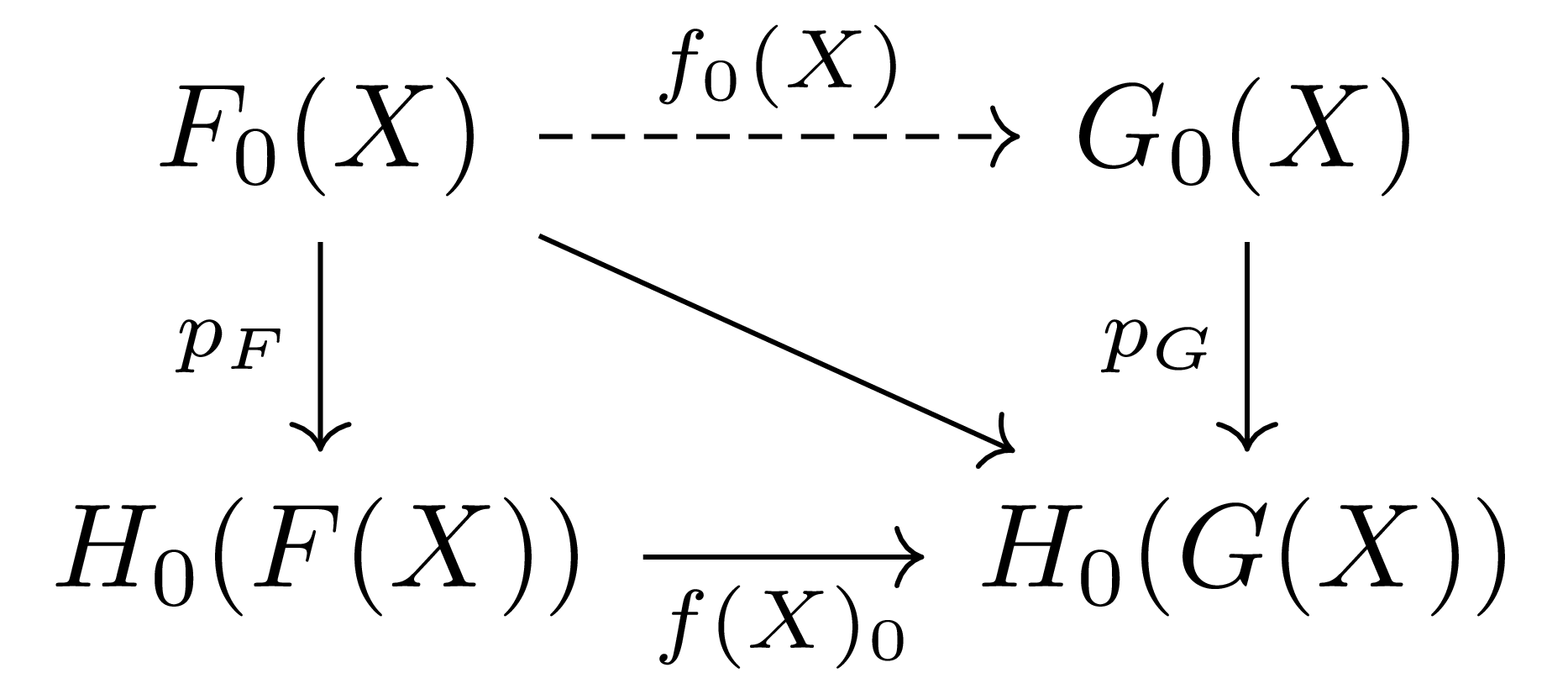
the map \(F_0(X)\rightarrow H_0(G(X))\) is defined in a natural way, and since \(p_G\) is surjective, we can define a lifting \(F_0(X)\rightarrow G_0(X)\) from this.
However, there is a slight problem when trying to define \(f_\bullet(X)\) in higher degrees. Suppose inductively that components up to \(f_{n-1}(X)\) have been defined, and let us define \(f_n(X)\). That is, we need to define a lifting of the following diagram
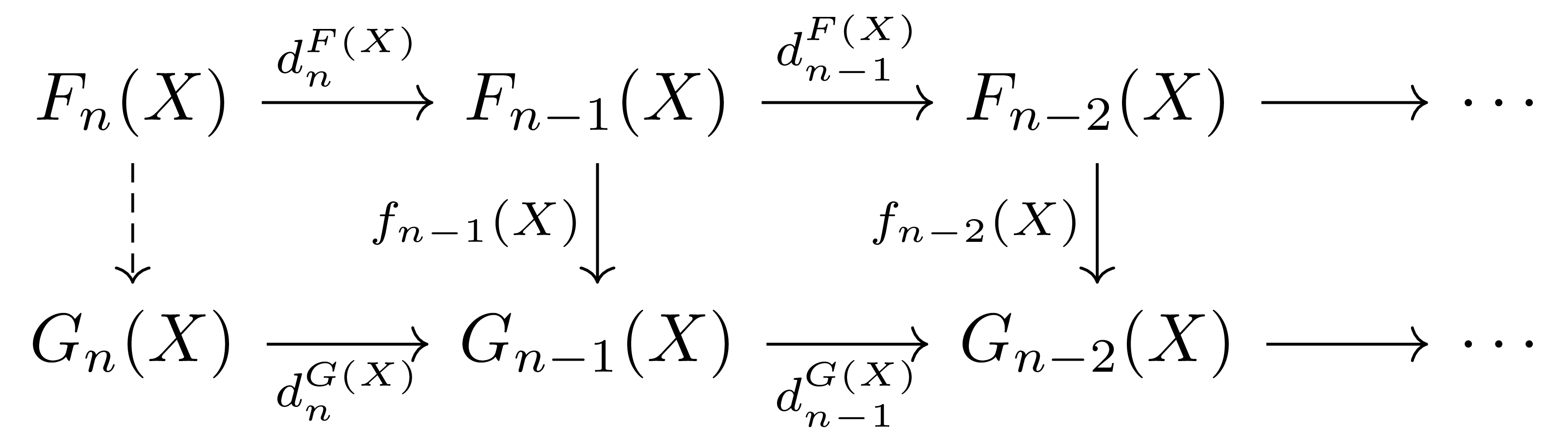
but unlike the previous situation, we require the newly defined \(f_n(X)\) to satisfy the following commutativity condition
\[d_n^{G(X)}\circ f_n(X)=f_{n-1}(X)\circ d_n^{F(X)}.\]Also, it is not even clear how to define \(f_n(X)\) (even without the above commutativity condition).
To resolve this, we use the condition that \(G\) is acyclic on \(\mathcal{M}\). First, from the fact that the functor \(F_n\) is free, we know that we only need to define \(f_n\) on the models \(M\). For an arbitrary object \(X\), a free module \(F_n(X)\), and a generator \(u:M \rightarrow X\), using the following diagram
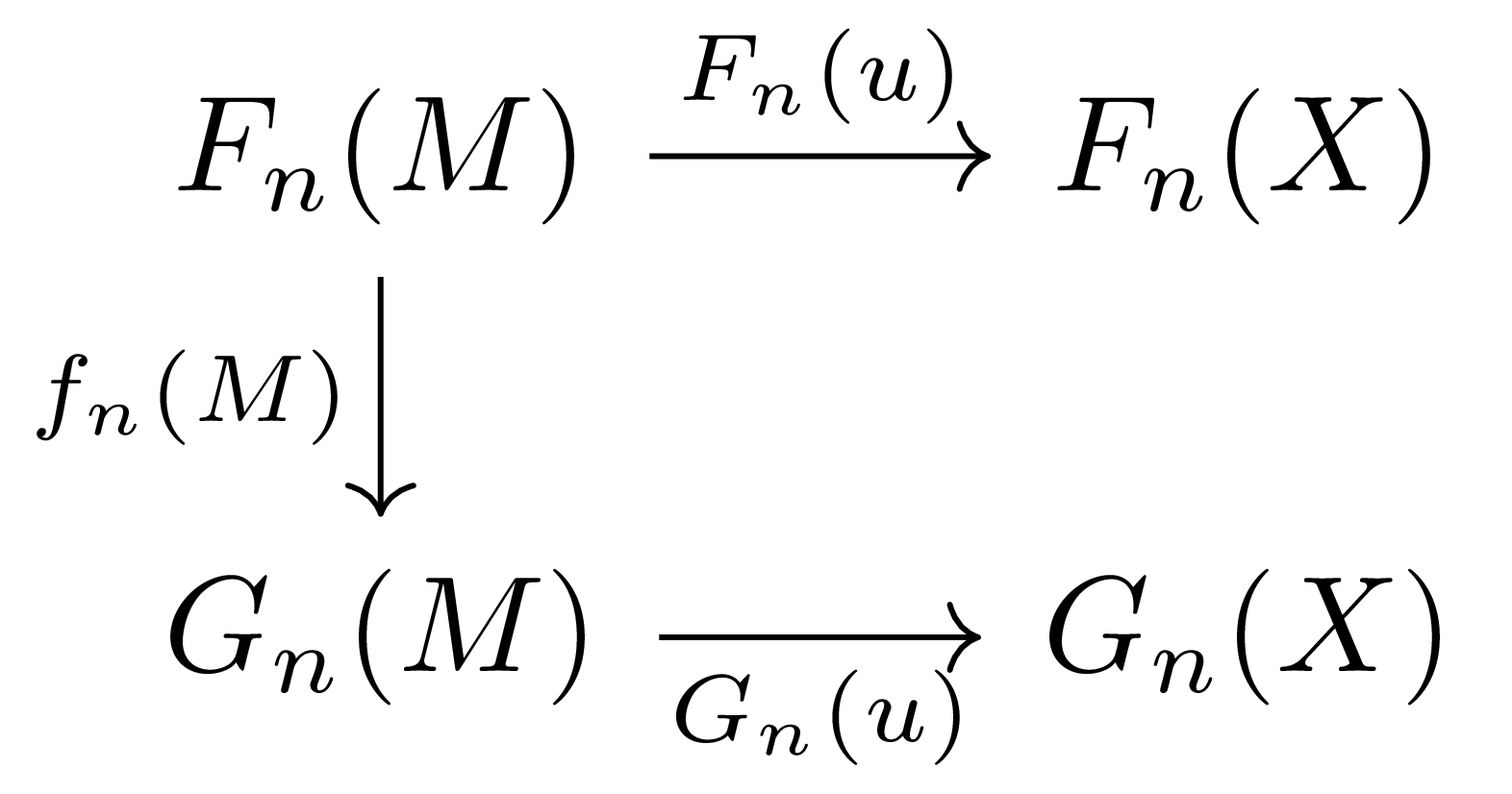
the element of \(F_n(M)\) corresponding to \(\id_M\) becomes \(u\) in \(F_n(X)\), so we can send \(u\) to \((G_n(u)\circ f_n(M))(\id_M)\). Now that we have shifted our attention to models, what we need to do is lift the previous diagram
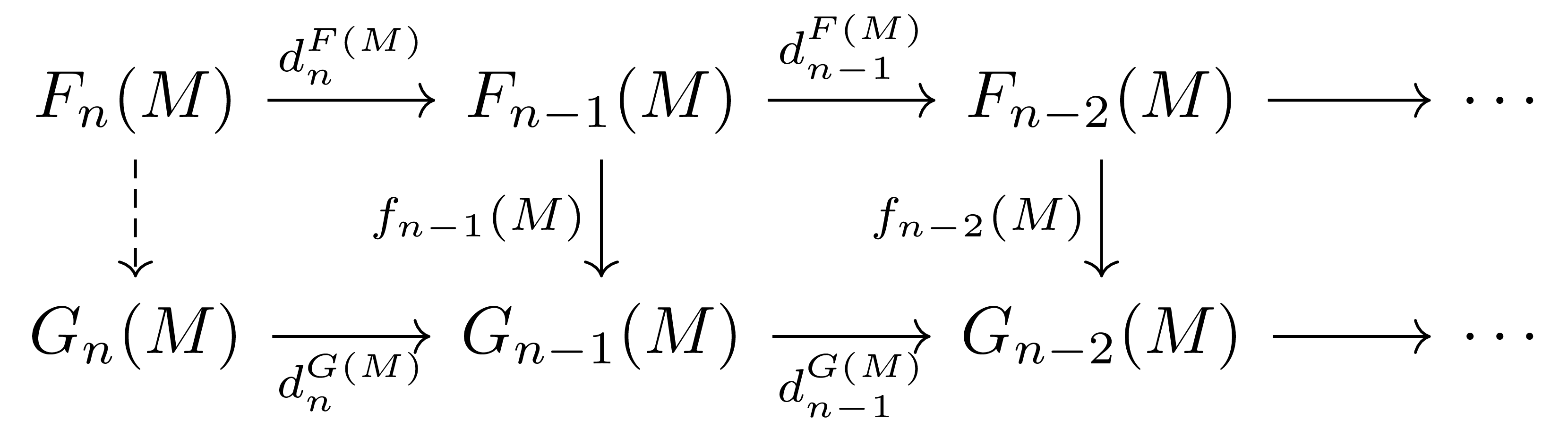
But now for any \(x_n\in F_n(M)\),
\[0=(f_{n-2}(M)\circ d_{n-1}^{F(M)}\circ d_n^{F(M)})(x_n)=(d_{n-1}^{G(M)}\circ f_{n-1}(M)\circ d_n^{F(M)})(x_m)\]so by the assumption that \(G\) is acyclic on \(\mathcal{M}\),
\[f_{n-1}(d_n^{F(M)}(x_n))\in \ker d_{n-1}^{G(M)}=\im d_n^{G(M)}\]and therefore we can find \(y_n\) satisfying \(d_n^{G(M)}(y_n)=f_{n-1}(d_n^{F(M)}(x_n))\), from which we can construct the \(n\)-th component of the chain map \(f_\bullet(M)\). At this point, different choices of \(y_n\) give different lifts \(f_n\), and their difference defines a chain homotopy.
Applications of the acyclic models theorem
The acyclic models theorem is first used in proving the Künneth theorem discussed in the previous post. Consider the category \(\Top^2\) consisting of pairs of topological spaces, and the two functors
\[C_\bullet(-\times -;A),\qquad C_\bullet(-;A)\otimes_A C_\bullet(-;A)\]from \(\Top^2\) to \(\Ch_{\geq 0}(\lMod{A})\). Now if we take the models \(\mathcal{M}\) to be the collection of
\[(\Delta^p, \Delta^q)\in\Top^2\]then these are all free on \(\mathcal{M}\) and acyclic on \(\mathcal{M}\). Now we can see that the following function
\[C_p(X;A)\times C_q(Y;A)\rightarrow C_{p+q}(X\times Y;A);\qquad (\sigma,\tau)\mapsto \sigma\times\tau\]is an isomorphism at \(H_0\), and then the lifting of this function becomes the Eilenberg-Zilber map, and the lifting of the inverse of this function becomes the Alexander-Whitney map.
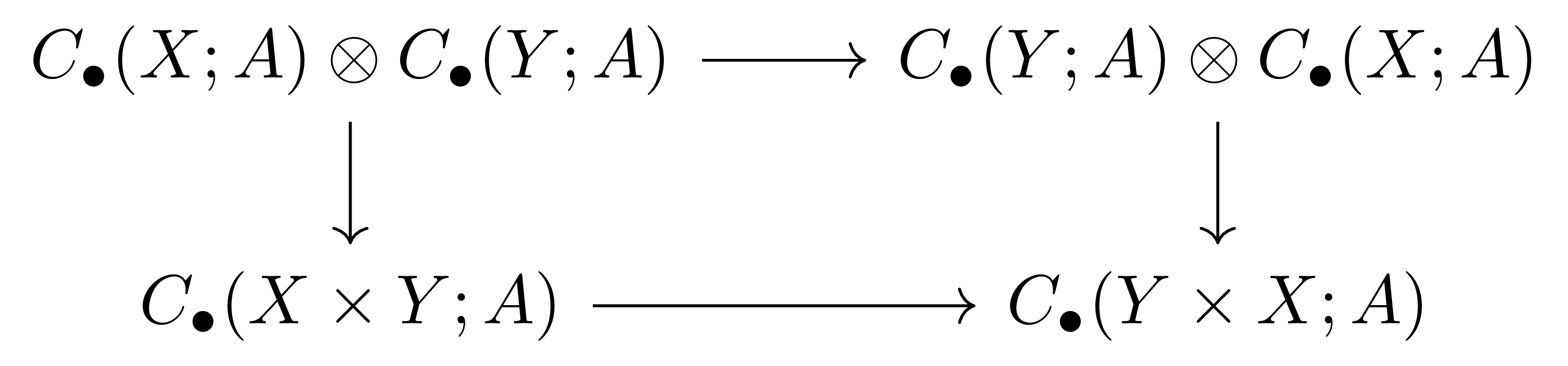
As a similar example, consider the four functors from \(\Top^2\) to \(\Ch_{\geq 0}(\lMod{A})\)
\[(X,Y)\mapsto C_\bullet(X\times Y;A),\quad (X,Y)\mapsto C_\bullet(Y\times X;A),\quad (X,Y)\mapsto C_\bullet(X;A)\otimes_AC_\bullet(Y;A),\quad (X,Y)\mapsto C_\bullet(Y;A)\otimes_AC_\bullet(X;A)\]and we can consider the obvious functions between them, and lifting these using Theorem 3 gives a commutative diagram in \(\Ch_{\geq0}(\lMod{A})\)
References
댓글남기기