This post was translated from Korean by LLM (Kimi). The translation may contain errors or awkward sentences. The Korean original is the source of truth.
In the previous post, we defined the dual space \(V^\ast\) of a vector space \(V\), and saw that if \(V\) is finite-dimensional, then \(V\) is isomorphic to \(V^{\ast\ast}\), the double dual of \(V^\ast\). The key fact used in this process was that a non-degenerate pairing \(\langle -,-\rangle:V\times W \rightarrow \mathbb{K}\) defines injective linear maps from \(V\) to \(W^\ast\) and from \(W\) to \(V^\ast\). We applied this fact to the canonical pairing
\[\langle -,-\rangle:V\times V^\ast\rightarrow \mathbb{K};\quad (v,f)\mapsto f(v)\]and, considering dimensions, saw that \(V\) and \(V^{\ast\ast}\) are isomorphic. To describe this induced map \(V\rightarrow V^{\ast\ast}\), we did not need to choose a basis of \(V\).
Meanwhile, we mentioned at the beginning of the previous post that \(V\) and \(V^\ast\) also have the same dimension, but unlike the natural isomorphism \(V\rightarrow V^{\ast\ast}\) above, this requires choosing a specific basis \(\{x_1,\ldots, x_n\}\) of \(V\), then taking its dual basis \(\{\xi^1,\ldots, \xi^n\}\), and defining the map via \(x_i\mapsto \xi^i\).
Bilinear Forms
Now we focus on the case \(V=W\).
Definition 1 For any pairing \(\langle -,-\rangle:V\times W\rightarrow \mathbb{K}\), if \(W=V\), we call this pairing a bilinear form defined on \(V\). We say that \(\langle -,-\rangle\) is a non-degenerate bilinear form if it is non-degenerate as a pairing.
Suppose a bilinear form on \(V\) is given. Then by the same argument as above, we obtain linear maps from \(V\) to \(V^\ast\)
\[v\mapsto \langle v,-\rangle,\qquad v\mapsto \langle -,v\rangle\]In general these two need not be equal, but we can make the following definition.
Definition 2 For any bilinear form \(\langle-,-\rangle:V\times V\rightarrow \mathbb{K}\), if the identity
\[\langle v,w\rangle=\langle w,v\rangle\]holds for all \(v,w\in V\), we say that this form is symmetric. If the identity
\[\langle v,w\rangle=-\langle w,v\rangle\]holds for all \(v,w\in V\), we say that this form is alternating.
Non-Degenerate Bilinear Forms
Let a finite-dimensional \(\mathbb{K}\)-vector space \(V\) be given, and consider the canonical pairing \(\langle-,-\rangle:V\times V^\ast\rightarrow \mathbb{K}\) mentioned above. If a non-degenerate pairing \(\langle -,-\rangle:V\times V\rightarrow \mathbb{K}\) is given on \(V\), then from §Dual Spaces, ⁋Corollary 5 we know that \(\langle -,-\rangle\) defines an isomorphism
\[V\rightarrow V^\ast;\qquad v\mapsto \langle -,v\rangle\tag{1}\]For convenience, we henceforth assume that \(\langle -,-\rangle\) is a symmetric non-degenerate bilinear form from the outset. Then \(\langle -,-\rangle\) has the isomorphism defined by equation (1), which can be written as follows.
Corollary 3 Consider a finite-dimensional \(\mathbb{K}\)-vector space \(V\) equipped with a symmetric non-degenerate bilinear form \(\langle -,-\rangle\). For any given \(f\in V^\ast\), there exists a unique \(w\in V\) such that
\[f(v)=\langle v,w\rangle\qquad\text{for all $v\in V$}\]holds.
Then in particular we can bring the notion of orthogonal complement defined in the previous post into \(V\). That is, we define as follows.
Definition 4 Consider a finite-dimensional \(\mathbb{K}\)-vector space \(V\) equipped with a symmetric non-degenerate bilinear form \(\langle -,-\rangle\). For any \(v\in V\), the set of all \(w\in V\) satisfying \(\langle w,v\rangle=0\) is called the orthogonal complement of \(v\), denoted \(v^\perp\). More generally, for any set \(S\), we define the set
\[S^\perp=\bigcap_{v\in S}v^\perp\]as the orthogonal complement of \(S\).
Of course, even if \(\langle -,-\rangle\) were not symmetric, we could make the same definition, and in fact, once we choose whether to send \(v\) to \(\langle -,v\rangle\) or to \(\langle v,-\rangle\) and stick to this choice consistently, we obtain the same result. In any case, to avoid possible confusion we maintain the condition that \(\langle -,-\rangle\) is symmetric.
The vector \(w\in V\) uniquely determines \(f\in V^\ast\) by Corollary 3, and the above definition means that if \(f\) obtained in this way is the orthogonal complement of \(v\) in the sense of §Dual Spaces, ⁋Definition 7, then we think of \(w\) as being orthogonal to \(v\), and regard the collection of such \(w\) as the orthogonal complement. Through this process, we can bring all the results of §Dual Spaces into \(V\). In the remainder of this post, we examine this process in detail.
First, suppose symmetric non-degenerate bilinear forms \(\langle -,-\rangle_V\) and \(\langle -,-\rangle_W\) are given on two finite-dimensional \(\mathbb{K}\)-vector spaces \(V\) and \(W\). Also, for convenience of discussion, let us denote the isomorphisms determined by these bilinear forms as
\[\varphi_V:V^\ast\rightarrow V,\qquad \varphi_W:W^\ast\rightarrow W\]respectively.
If two bases \(\mathcal{B}=\{x_1,\ldots, x_n\}\) and \(\mathcal{C}=\{y_1,\ldots, y_m\}\) are given on \(V\) and \(W\) respectively, then the dual bases
\[\mathcal{B}^\ast=\{\xi^1,\ldots, \xi^n\},\qquad\mathcal{C}^\ast=\{\upsilon^1,\ldots,\upsilon^m\}\]are well-defined. Now consider the bases
\[\mathcal{B}'=\{\varphi_V(\xi^1),\ldots,\varphi_V(\xi^n)\},\qquad\mathcal{C}'=\{\varphi_W(\upsilon^1),\ldots,\varphi_W(\upsilon^m)\}\]obtained by transferring these along \(\varphi_V\) and \(\varphi_W\). In other words, these are elements of \(V\) and \(W\) defined by the formulas
\[\langle x_i,\varphi_V(\xi^j)\rangle=\delta_{ij},\qquad\langle y_i,\varphi_W(\upsilon^j)\rangle=\delta_{ij}\]Now for any \(L:V\rightarrow W\), suppose
\[\begin{aligned}L(x_1)&=\alpha_{11}y_1+\alpha_{21}y_2+\cdots+\alpha_{m1}y_m\\L(x_2)&=\alpha_{12}y_1+\alpha_{22}y_2+\cdots+\alpha_{m2}y_m\\&\phantom{a}\vdots\\L(x_n)&=\alpha_{1n}y_1+\alpha_{2n}y_2+\cdots+\alpha_{mn}y_m\end{aligned}\]If we think of the dual map \(L^\ast:W^\ast\rightarrow V^\ast\) as a map from \(W\) to \(V\) via the above identifications \(\varphi\), that is, if we consider \(L':W\rightarrow V\) defined by the following diagram
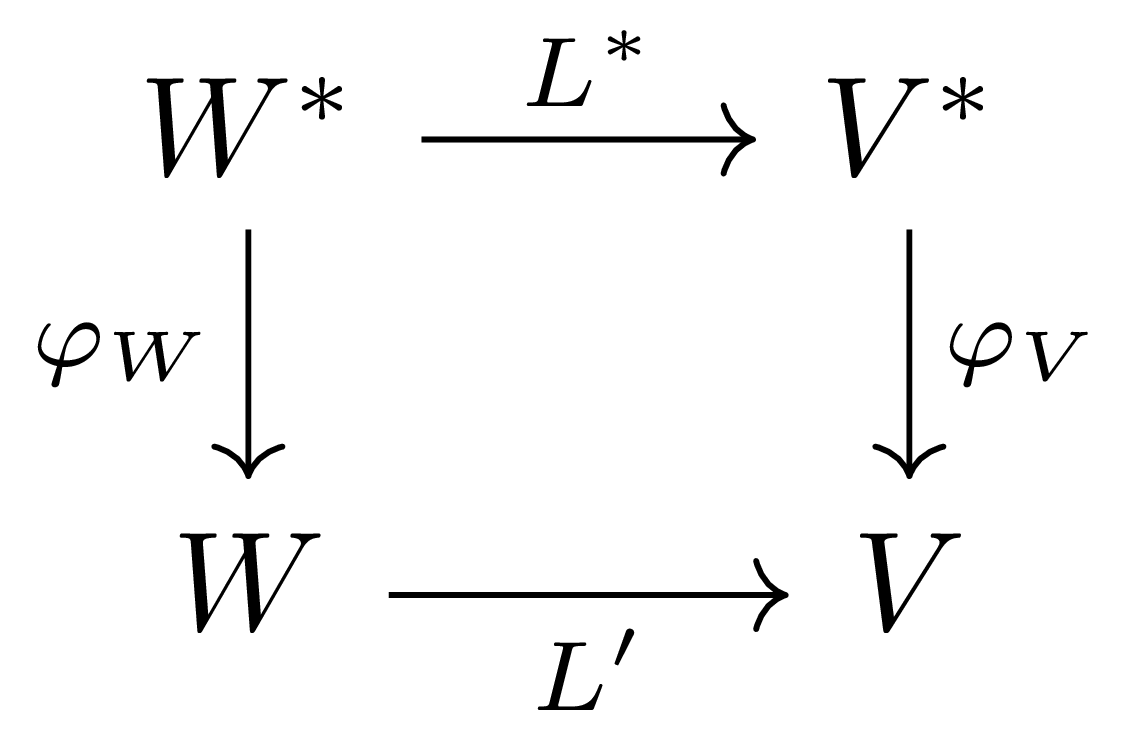
then we can verify that the matrix representation of this linear map with respect to the two bases \(\mathcal{C}'\) and \(\mathcal{B}'\) is \([L']_{\mathcal{B}'}^{\mathcal{C}'}\).
Meanwhile, we can see that \(L':W\rightarrow V\) defined in this way satisfies the equation
\[\langle Lv, w\rangle_W=\langle v,L'w\rangle_V\qquad\text{for all $v\in V$ and $w\in W$}\tag{1}\]This can be checked from
\[\langle Lv,w\rangle=(\varphi^{-1}(w))(Lv)=(\varphi^{-1}_W(w)\circ L)(v)=(L^\ast(\varphi^{-1}_W(w))(v)=(\varphi^{-1}_V(v)\circ L')(w)=(\varphi^{-1}_V(v))(L'w)=\langle v,L'w\rangle\]We call such an \(L'\) satisfying this equation the adjoint of the linear map \(L\), and with a slight abuse of notation, also write it as \(L^\ast\).
The results of §Dual Spaces, §§Orthogonal Complements were all obtained from the equation \((Lv,f)=(v,L^\ast f)\) for the canonical pairing. Therefore, replacing this with equation (1) for the non-degenerate bilinear forms \(\langle -,-\rangle\) obtained above, we get the following results.
Proposition 5 Suppose two \(\mathbb{K}\)-vector spaces \(V\) and \(W\) equipped with symmetric non-degenerate bilinear forms, a linear map \(L:V\rightarrow W\), and its adjoint \(L^\ast:W\rightarrow V\) are given. Then
- For any subspace \(U\subseteq V\), we have \(L(U)^\perp=(L^\ast)^{-1}(U^\perp)\).
- For any subspace \(U\subseteq W\), we have \(L^\ast(U)^\perp=L^{-1}(U^\perp)\).
- We have \((\im L)^\perp=\ker(L^\ast)\).
- We have \((\im L^\ast)^\perp=\ker L\).
In particular, the subspaces
\[\ker L, \quad(\ker L)^\perp, \quad\im L,\quad(\im L)^\perp\]of \(V\) and \(W\) obtained from 3 and 4 are sometimes called the four fundamental subspaces determined by \(L\). In particular, they satisfy
\[V=\ker L\oplus(\ker L)^\perp,\qquad W=\im L\oplus(\im L)^\perp\]Orthogonal Bases
Now consider a \(\mathbb{K}\)-vector space \(V\) equipped with a symmetric non-degenerate bilinear form. Then a subset \(\{v_1,\ldots, v_n\}\) of \(V\) is called an orthogonal set if \(\langle v_i,v_j\rangle=0\) whenever \(i\neq j\). If a basis \(\mathcal{B}\) of \(V\) is also an orthogonal set, we call it an orthogonal basis.
Definition 6 If a field \(\mathbb{K}\) satisfies the condition
\[\underbrace{1+1+\cdots+1}_\text{$p$ times}=0\]then we say that the characteristic of \(\mathbb{K}\) is \(p\), and write \(\ch \mathbb{K}=p\). If there is no natural number \(p\) satisfying the above formula, we consider \(\mathbb{K}\) to have characteristic 0.
For example, \(\mathbb{R}\) has characteristic 0. If we define addition and multiplication on \(\mathbb{F}_2=\{0,1\}\) by the formulas
\[0+0=0,\quad 0+1=1,\quad 1+0=1,\quad 1+1=2\]and
\[0\cdot 0=0,\quad 0\cdot 1=0,\quad 1\cdot 0=0,\quad 1\cdot 1=1\]respectively, then we can verify that \(\mathbb{F}_2\) satisfies the field axioms, and in this case \(\ch\mathbb{F}_2=2\).
Proposition 7 For a field \(\mathbb{K}\) with \(\ch \mathbb{K}\neq 2\), a \(\mathbb{K}\)-vector space \(V\) equipped with a symmetric non-degenerate bilinear form always has an orthogonal basis.
Proof
First, we prove a simple lemma. For an arbitrarily fixed \(v\in V\), there exists \(u\in V\) such that \(\langle u,v\rangle\neq 0\). Then
\[2\langle u,v\rangle=\langle u+v,u+v\rangle-\langle u,u\rangle-\langle v,v\rangle\]and by the two conditions \(\langle u,v\rangle\neq 0\) and \(\ch \mathbb{K}\neq 2\), the left-hand side is nonzero. Therefore, at least one of the three terms \(\langle u+v,u+v\rangle\), \(\langle u,u\rangle\), \(\langle v,v\rangle\) on the right-hand side is nonzero. Thus,
In any \(\mathbb{K}\)-vector space equipped with a non-degenerate symmetric bilinear form, there necessarily exists a vector \(w\) satisfying \(\langle w,w\rangle\neq 0\).
We prove the original proposition by induction on the dimension of \(V\). There is nothing to prove when \(\dim V=0\). Now assume the proof is complete for the case \(\dim V=k\). Then for any vector space \(V\) with \(\dim V=k+1\), there exists a vector \(w\) satisfying \(\langle w,w\rangle\neq 0\).
Now let \(W=\span w\) and consider \(W^\perp\). Then for any \(v\in V\), from the formula
\[v=\frac{\langle v,w\rangle}{\langle w,w\rangle}w+\left(v-\frac{\langle v,w\rangle}{\langle w,w\rangle}w\right)\]we know that any element of \(V\) can be expressed as a sum of elements from \(W\) and \(W^\perp\). Also, since \(\langle w,w\rangle\neq 0\) by assumption, we have \(W\cap W^\perp=\{0\}\). Therefore, by §Dimension of Vector Spaces, ⁋Example 8,
\[k+1=\dim V=\dim(W+W^\perp)=\dim W+\dim W^\perp-\dim(W\cap W^\perp)\]from which we know that \(\dim W^\perp=k\). Moreover, for any \(v\in W^\perp\), for \(u\) satisfying \(\langle u,v\rangle\neq 0\),
\[u'=u-\frac{\langle u,w\rangle}{\langle w,w\rangle}w\in W^\perp\]is an element of \(W^\perp\) and satisfies
\[\langle u',v\rangle=\langle u,v\rangle\neq 0\]That is, \(W^\perp\) is also non-degenerate with respect to \(\langle-,-\rangle\), and so by the inductive hypothesis, there exists an orthogonal basis \(\mathcal{B}\) of \(W^\perp\). Now \(\mathcal{B}\cup\{v\}\) is an orthogonal basis of \(V\), so we obtain the desired result.
Gram Matrix
Let an arbitrary bilinear form \(\langle-,-\rangle:V\times V\rightarrow \mathbb{K}\) be given. If a basis \(\{x_1,\ldots, x_n\}\) of \(V\) is fixed, then for any \(v=\sum v_ix_i\) and \(w=\sum w_jx_j\) the formula
\[\langle v,w\rangle=\left\langle\sum_{i=1}^nv_ix_i,\sum_{j=1}^n w_jx_j\right\rangle=\sum_{i,j=1}^n v_iw_j\langle x_i,x_j\rangle\]holds. For a moment, let \(G\) denote the \(n\times n\) matrix whose \((i,j)\)-entry is \(\langle x_i,x_j\rangle\); then the above formula can be written simply as
\[\langle v,w\rangle=v^t Gw\]In this case, we call \(G\) the Gram matrix with respect to the basis \(\mathcal{B}\).
Consider two bases \(\mathcal{B}\) and \(\mathcal{C}\) given on \(V\). Let us denote their Gram matrices by \(G_\mathcal{B}\) and \(G_\mathcal{C}\) respectively, and write the above formula precisely; then we can say
\[\langle v,w\rangle=[v]^t_\mathcal{B}G_\mathcal{B}[w]_\mathcal{B}=[v]^t_\mathcal{C}G_\mathcal{C}[w]_\mathcal{C}\]Now since \([v]_\mathcal{C}=[\id]_\mathcal{C}^\mathcal{B}[v]_\mathcal{B}\), the rightmost side of the above formula becomes
\[[v]_\mathcal{C}^tG_\mathcal{C}[w]_\mathcal{C}=\left([\id]_\mathcal{C}^\mathcal{B}[v]_\mathcal{B}\right)^tG_\mathcal{B}\left([\id]_\mathcal{C}^\mathcal{B}[w]_\mathcal{B}\right)=[v]_\mathcal{B}^t\left(([\id]_\mathcal{C}^\mathcal{B})^t G_\mathcal{B}[\id]_\mathcal{C}^\mathcal{B}\right)[w]_\mathcal{B}\][Lee] 이인석, 선형대수와 군, 서울대학교 출판문화원, 2005.
[Goc] M.S. Gockenbach, Finite-dimensional linear algebra, Discrete Mathematics and its applications, Taylor&Francis, 2011.
댓글남기기